WATER-IN-OIL EMULSIFIERS 737

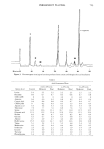
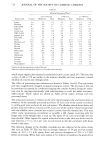
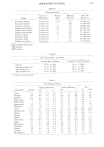
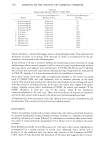
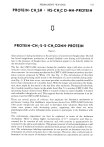
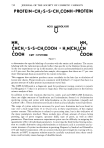
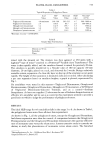
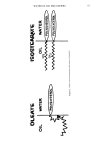
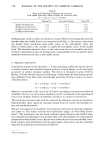
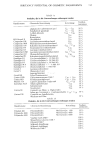
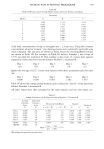
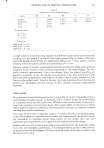
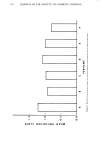
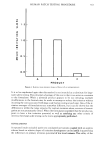
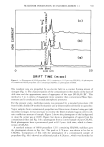
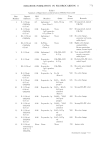
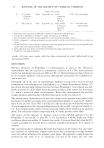
738 JOURNAL OF THE SOCIETY OF COSMETIC CHEMISTS Table III Water-in-Oil Spreading Coefficients (S2) (dynes/cm) FOR SOME POLYGLYCEROL ESTERS IN VARIOUS OILS S2 =• soln oil - (• aq +X/ interface) Mineral Oil Isopropyl Palmitate Castor Oil Triglycerol diisostearate - 75.5 Hexaglycerol triisostearate - 75.4 Octaglycerol pentaisostearate - 75.7 Octaglycerol pentaoleate - 75.7 -73.2 -75.6 -72.0 -72.0 -71.4 -70.0 -73.2 -76.7 methyl groups on the iso-fatty acid seems to be more effective in bonding the water/oil interface than the double bond in an unsaturated acid (Fig. 2). One theory is that since the double bond contributes some polar nature to the hydrophobic chain, the chain is twisted back to the interface to satisfy the hydrophilic nature of the double bond. The branched saturated chain, on the other hand, has no hydrophilic site and is left free to penetrate into the oil, leaving room on the interface to be occupied by more emulsifier molecules and thus a more stable system. II. SPREADING COEFFICIENTS It has been proposed in the literature (3, 4) that spreading coefficients related directly to surface tension, and interfacial tension between 2 liquid phases, can be used quite accurately to predict emulsion stability. The theory is discussed in great detail by Becher (3) from which he derives the following 2 relationships for determining spread- ing coefficient (S) by the readily determinable quantities of surface tension (T) and in- terfacial tensions. S• = T soln aq - (T oil + T interface) S= = T soln aq - (T aq + T interface) where S1 corresponds to the case of an oil droplet spreading on an aqueous solution of emulsifier (hence to an oil-in-water emulsion), and S2 corresponds to the spreading of water on an oil-phase solution of emulsifier, and hence to a water-in-oil emulsion. This work was concerned only with the values for S= relating to water-in-oil emulsions. Experimentally, these values are calculated simply from the readily determinable sur- face and interfacial tensions. One per cent solutions of emulsifiers were prepared in mineral oil, isopropyl palmitate, and castor oil. The surface tensions were determined using a du Nuoy Ring Tensio- meter.* The tensiometer was previously calibrated against benzene and distilled water and tensiometer performance was checked after each determination by repeating the measurement with distilled water. Results were always found to be reproducible. Inter- facial tensions were determined with the same degree of precision, and the calculated values for S= yielded the results found in Table III. *Cenco, Chicago, IL.
Purchased for the exclusive use of nofirst nolast (unknown)
From: SCC Media Library & Resource Center (library.scconline.org)