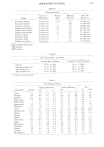
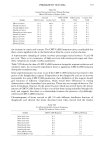
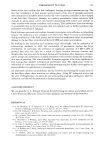
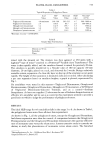
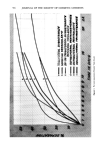
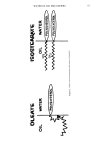
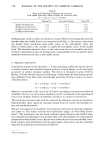
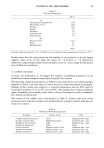
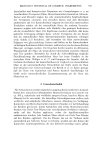
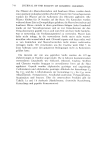
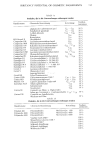
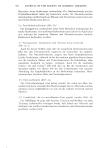
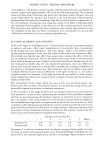
WATER-IN-OIL EMULSIFIERS Table IV W/O Cleansing Cream 739 Wt. % (A) Hydrogenated Vegetable Oil 25.0 Mineral Oil, 70 visc. 20.0 Beeswax 10.0 Lanolin 3.0 Emulsifier 5.0 Polysorbate 60 2.0 Propyl paraben 0.1 (B) Deionized water 34.0 Borax 0.7 Methyl paraben 0.2 100.0 Procedure: Heat both phases to 75øC. Add (B) to (A) with stirring. Continue agitation until cooled to 35øC. Becher states that the requirement for the stability of w/o emulsions is for the largest negative value of S2. In the table, the values of- 70 dyn/cm to -76 dyn/cm are sufficiently large enough to place these emulsifiers into the correct range for the forma- tion of stable w/o emulsions. III. COSMETIC EMULSIONS A study was undertaken to investigate the auxiliary emulsifying properties of our emulsifiers in more complex cosmetically acceptable w/o systems. The cleansing cream formula shown in Table IV was prepared for each of the auxiliary emulsifiers tested. Care was taken to insure that each cream was prepared identically. Samples of the creams were placed in a constant temperature oven at 49øC and in a freeze/thaw incubator (12 h. at 4øC/12 h. at 40øC). The samples were observed daily for signs of instability most notably water and/or oil layers forming as a result of instability for a period of a full month. The results of the stability tests, summarized in Table V, indicate that most of the emulsions made with the polyglycerols exhibited better emulsion stability than the sor- bitan ester controls. Table V Stabilities of W/O Cleansing Cream Emulsifier FreezemThaw 120øF Octaglycerol pentaisostearate Octaglycerol pentaoleate Hexaglycerol triisostearate Trigylcerol diisostearate Glycerol trioleate Sorbitan monostearate Sorbitan sesquioleate Stable Slight Oil Separation Stable Stable Separation after 14 days Separation after 1 day Separation after 2 days Separation after 9 days Separation after 7 days Separation after 7 days Stable Separation after 7 days Separation after I day Separation after 2 days

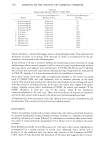
740 JOURNAL OF THE SOCIETY OF COSMETIC CHEMISTS SUMMARY Various properties of polyglycerol esters of isostearic and oleic acid have been presented in this paper. Through spreading coefficient studies, we believe that their utility as w/o emulsifiers have been demonstrated in very simple and more complex w/o systems. ACKNOWLEDGMENTS The authors are indebted to Dr. Harold Silverman and his staff at the Massachusetts College of Pharmacy for their surface tension determinations. REFERENCES (1) W. C. Griffin, "Calculation of HLB values of non-ionic surfactants,"J. Soc. Cosmet. Chem., 5,249-56, (1954). (2) At/as Cosmetic Formulary, Cold Creams and Cleansing Products, Bulletin #LD-133, 7M (March 1970). (3) P. Becher, "Spreading, HLB, and emulsion stability," J. Soc. Cosmet. Chem., 11,325-32 (1960). (4) E. S. Chen, S. Ross, P. Becher, and H. J. Ranauto, "Spreading coefficients and hydrophile-lipophile balance of aqueous solutions of emulsifying agents," J. Phys. Chem., 63, 1681 (1959).
Purchased for the exclusive use of nofirst nolast (unknown)
From: SCC Media Library & Resource Center (library.scconline.org)