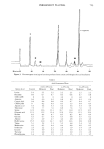
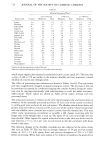
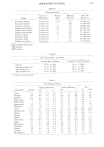
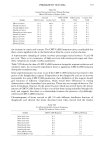
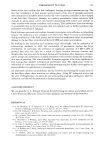
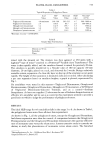
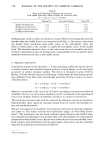
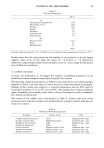
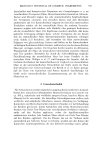
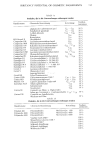
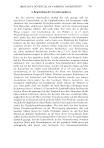
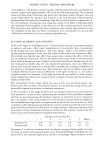
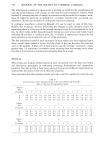
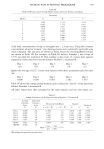
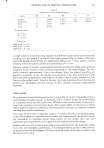
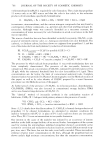
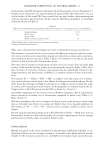
HUMAN PATCH TESTING PROCEDURE Table III Slopes of Irritation upon Average Daily Irritation Levels, by Product and Subject 759 Treatment Subject A B C 1 1.283 1.379 1.155 2 0.945 1.379 0.017 3 0.804 2.037 0.383 4 1.410 1.414 0.529 5 0.383 0.689 0.192 6 1.251 1.251 0.287 7 1.027 0.900 -0.240 8 1.379 1.088 1.634 9 1.088 1.956 1.379 if the final concentration of soap or detergent was - 2.5 per cent. Using this constant concentration of active "irritant," two shaving creams and a commonly used toilet soap were compared. The raw data are shown in Table II and the resulting Mandel slopes are shown in Table III. For example, in Table III Subject Number 1 has a slope of 1.379 recorded for treatment B. This number is the result of a linear least squares regression of the irritation scores for Subject Number 1, treatment B, Day 1 Day 2 Day 3 Day 4 Day 5 0.0 0.0 1.0 2.0 2.0 against the average of all 27 scores (nine subjects with three treatments each) for each day. Day 1 Day 2 Day 3 Day 4 Day 5 0.000 0.389 0.963 1.482 1.667 Table IV shows the computational method used to obtain the "best fit" of the data from Subject Number 1, treatment B. All other slopes were then calculated in the same manner, and the nine slopes cor- Table IV Sample Calculation on the Slope for Subject Number 1, Treatment B Average Irritation Score X Individual Irritation Deviations from Means Squares Score Products Y x =(X-•) y =(Y-•/) x z y= xy Day 1 0.000 Day 2 0.389 Day 3 0.963 Day 4 1.482 Day 5 1.667 0.0 -0.900 - 1.0 0.810 1.00 0.900 0.0 -0.511 -1.0 0.261 1.00 0.511 1.0 0.063 0.0 0.004 0.00 0.000 2.0 0.582 1.0 0.339 1.00 0.582 2.0 0.767 1.0 0.588 1.00 0.767 SUM 4.501 MEAN 0.900 5.0 0.001 a 0.0 2.002 4.00 2.760 1.0 • xy 2.760 -- -- Slope - E x • 2.002 1.379 aRounding error produced non-zero sum.

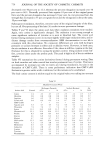
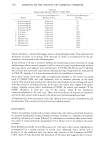
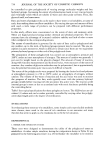
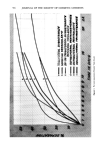
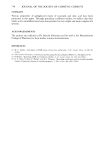
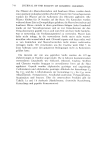
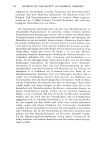
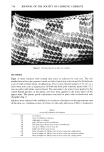
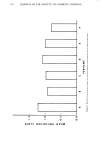
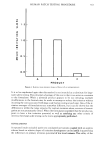
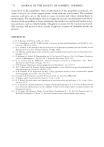
760 JOURNAL OF THE SOCIETY OF COSMETIC CHEMISTS 01.5 z '•0.5 A ! B PRODUCT C Figure 2 Relative mean irritation slopes of two shaving creams (A & C) and a mild toilet soap (B) responding to a single treatment were averaged to obtain the treatment mean. Figure 2 shows the average irritation slope for each product, while Table V shows the analysis of variance. Shaving cream was substantially and significantly (P 0.01) less irritating than the toilet soap, as well as possibly less irritating than the other (P 0.10) shaving cream. In a separate experiment, six perfumes were evaluated for irritancy in a standard foam shaving cream formula. All samples were diluted to a 2.5 per cent detergent level. Eight subjects were used, however, one failed to complete the test. Differences in mean irritation slopes were, nevertheless, apparent in the seven remaining subjects (Fig. 3), and Tukey's Test (honestly significant difference) indicated that the shaving cream with perfume A produced more irritation than that with perfume F (P 0.01), and that the product with perfume D was perhaps more irritating than that with perfume F (P = 0.1). The test has demonstrated that commercially available products intended for daily use and in prolonged contact with the skin can vary considerably in their irritation potential. In another test, three commonly used commercial roll-on antiperspirants were tested
Purchased for the exclusive use of nofirst nolast (unknown)
From: SCC Media Library & Resource Center (library.scconline.org)