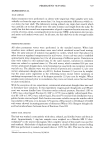
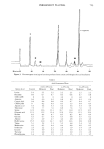
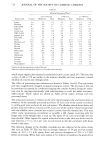
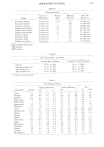
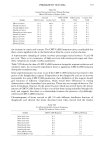
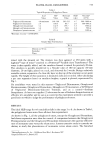
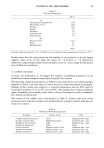
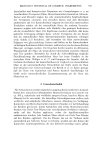
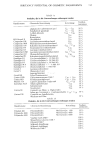
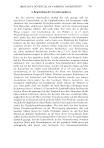
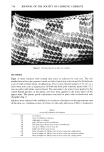
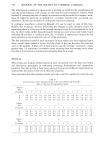
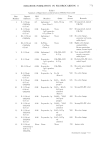
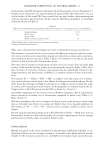
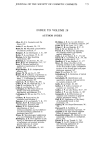
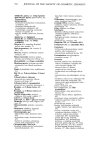
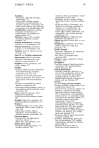
MALODOR FORMATION IN FLUOROCARBON 11 771 Table I Summary of Experiments on Generation of Methyl Isocyanide Run Number Organic Substrate H.• O Time (ml) Metals(s) Other (hours) Remarks 8. 11. 12. 13. 14. 15. P-11 50ml, CHaNO• 0.15 ml P-11 50 ml, C Ha NO.• 0.15 ml FC-21 50ml, CHaNO2 FC~21 50 ml, CH:•NO.• 0.2 ml P-11 50ml P-11 50ml FC-21 50 ml P-11 50ml, CHaNO2 0.15 ml P-11 50ml, 0.15 ml CHaNO= P-11 50ml, 0.18 ml CHaNO• P-11 50ml, CHaNO= 0.15 ml P-11 50ml, CHaNO2 0.15 ml P-11 50 ml, CHaNO2 0.15 ml P-11 50ml, CHaNO2 0.15 ml P-11 50ml, containing ca. 0.05 wt. % CH•NH2 0.5 Galvanized FeCla 50 mg Iron (Note 1) 0.08 Fe powder, None 1 g/Cu powder, 0.2 g (Note 2) 0.8 Galvanized None Iron 0.8 Fe Wire, None Cu Wire, (Note 3) 0.004 Galvanized CHaNH• HC1 Iron 0.25 g 0.004 0.004 0.08 0.08 0.08 0.08 0.08 0.08 0.08 None Fe powder, CHaNH2 HCI 1 g Cu powder, 0.25g 0.2g Fe powder, CHaNH2 1 g Cu powder, 0.2g Fe powder, 1 g FeaO4 (Note 4) Fe powder, 1 g FeC12 . 4H20, 0.05 g air purged Fe powder, 1 g FeC12 . 4H20, 0.05 g air admitted (Note 5) Fe powder, 1 g FeSO4 . 7H20 0.05 g air purged Fe powder, 1 g FeSO4 . 7H•O 0.05 g air admitted Fe powder, 1 g FeCla 0.05 g air purged Fe powder, 1 g FeCla 0.05 g air admitted None None 696 Strong stench, typical CHaNC 892 Strong stench, typical CH:•NC 648 No odor change, extensive corrosion, milky liquid 648 Slight odor change unidentifiable. Brown particulate matter, brown liquid 48 Very strong CHaNC stench, corrosion milky liquid 48 Definite CHaNC odor, turbid liquid 96 No odor, green liquid after 2 h 500 No odor change 396 No odor change 64 Strong CHaNC odor 400 No odor change 216 Strong CHaNC odor 500 No odorchange 600 No odor change 150 Amine odor (Continued on page 772.)

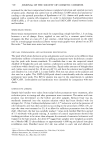
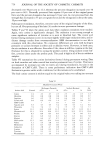
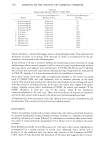
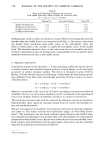
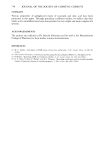
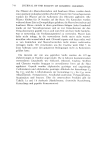
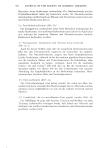
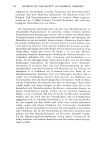
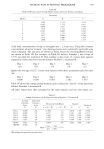
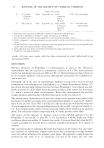
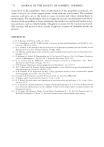
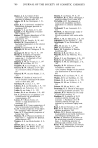
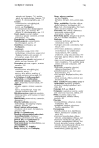
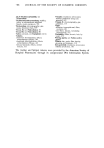
772 JOURNAL OF THE SOCIETY OF COSMETIC CHEMISTS Table 1 (Continued) 16. P-ll 50ml, None Fepowder, 1 g FeCI., 500 No odor change CHaNO2 anhydrous 0.15 ml 0.05 g (Note 6) 17. FC-21 20ml 0.08 Fe powder, 1 g FeCI,, 4H.,O 216 Very faint odor 0.025 g air (questionable) admitted (Note 7) 1. Galvanized iron strips were deliberately scratched to expose the underlying iron. 2. Iron powder, 200 mesh (J. T. Baker). Copper, electrolytic, dust (Fisher). 3. Iron and copper wire were twisted together in a coil to maintain bimetallic contact. 4. FeaO4, "magnetite," commercial material, not necessarily identical to the hydrated FeaO4 in corrosion de- posits. 5. Air was admitted to the system by cooling the tubes until gauge pressure was zero psig and quickly open- ing the valve momentarily and then closing it tightly. 6. FeCI,, anhydrous was obtained from Research Organic/Inorganic Chemical Corp. 7. The FC-21 contained 65 ppm P-11. terials. All runs were made with the tubes i•nmcrsed in water baths held at ap- proximately 60øC. DISCUSSION Previous literature on Propellant 11 dechlorination, as cited in the references, demonstrates that the reaction is a homolyric reduction of C1. The usual products formed in substantial amounts are HC1 and FC-21. Nitromethane has been shown to be an excellent inhibitor of this reaction, although the mechanism of its inhibitory ac- tion is not clear. Essentially, all of the uses of nitromethane inhibited systems have been in aerosol formulations with homogeneous liquid phases, e.g., ethanol formulations. Robey (12) has shown that peroxide initiated reaction between Propellant 11 and ethanol was mar- kedly increased by added H20 when the phase stability of the system was decreased, i.e., when a water-rich phase could separate. Robey also demonstrated the need for oxygen initiation and postulated alkylhydroperoxides as the true initiators. The present study demonstrates the need for oxygen and a separate water phase in the formation of methyl isocyanide from nitromethane/propellant 11 systems (cf. Table I, Runs 9, 10, and 16). Since HC1 is produced in this reaction, the well-known reduction of nitrocompounds to the corresponding amines by the iron/H+ system can readily oc- cur. Any resultant amine will be formed as its salt, which will be soluble in the aqueous phase. The reduction of nitro compounds will, of course, produce more H=O. The source of the carbenic, or divalent carbon in the CHaNC appears to be the Propellant 11 and not FC-21 since FC-21 did not produce CHaNC under any of the conditions where propellant 11 formed isocyanide. It is more than likely that the FC- 21 and isocyanide are derived from a common unstable intermediate, be it radical or carbene. The conclusions above explained the field observations in all respects but one mois- ture analyses on malodorous samples taken from the contaminated storage facilities were not unduly indicative of a separate water phase. This apparent contradiction was resolved by the work of C. C. Seastrom (13) and T. N. Jones, III (14), who
Purchased for the exclusive use of nofirst nolast (unknown)
From: SCC Media Library & Resource Center (library.scconline.org)