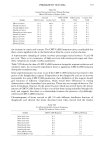
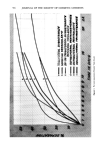
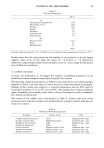
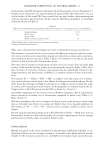
J. Soc. Cosmet. Chem., 28, 755-764 (December 1977) A quantitative human patch testing procedure for low level skin irritants KENNETH A. SMILES 'X' and MARCIA E. POLLACK, Carter- Wallace, Inc., Half Acre Road, Cranbury, N.J. Received February 8, 1977. Synopsis A week-long repeated INSULT OCCLUDED PATCH TEST METHODOLOGY is presented along with an analysis procedure based on relative slopes of IRRITATION DEVELOPMENT. This method allows for quantitative comparison of the primary irritation potential of low level irritants, culminating in statistical statements concerning the differences among samples. The use of the method to determine differences between commercial shaving creams, among various perfumes for a shaving cream formula, and among various roll-on antiperspirants is presented, as well as the identification and solution of an apparent irritancy problem associated with an anti-perspirant formula intended for pump spray delivery. INTRODUCTION Both the dermatologist and formulatot have an interest in determining the inherent ir- ritancy of various materials, medicaments, and cosmetics, which purposefully or otherwise come in contact with human skin. Animal testing, while often able to classify compounds into wide categories of irritancy, has not proved adequately predictable over the small range of irritancy associated with materials intended for human skin (1). Therefore, human testing is required. Various human patch test procedures have been developed to quantify the primary ir- ritation potential of a sample (2-11). All of these basically classify materials into cate- gories of irritancy. If several samples fall within the same category, no statement can be made as to their differences. In order to make statements about relative irritancy on a quantitative basis, the IT50 test was proposed (12). Time until 50 per cent of the sub- jects had definitive irritation was measured. The method proved quite successful, but is hindered by the very long time required to get irritation with many materials of interest. The methodology and analysis procedure schema to follow was developed to assess the statistical significance of observed differences in the primary irritation potentials of similar products which produce low levels of irritation. *Present Address: Schering Corp., 60 Orange St., Bloomfield, N.J. 07003 755

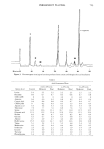
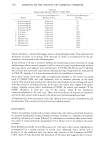
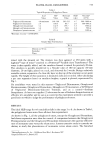
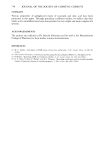
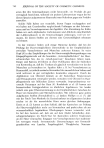
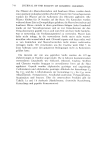
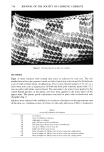
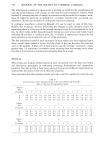
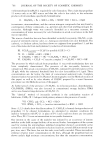
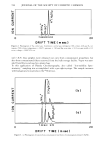
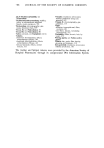
756 JOURNAL OF THE SOCIETY OF COSMETIC CHEMISTS Figure I Occluded patches in place on a subject METHODS Eight or more subjects with normal skin acted as subjects for each test. The test method was a four-day repeated insult occluded patch test as developed by Finkelstein et a/.(4) with several minor modifications. Four cotton flannel squares (2.54 cm on a side) were sewn onto a square piece of 0.08 mm thick poly-ethylene plastic film ( 11.2 cm on a side) with white cotton thread. The materials to be tested were applied to the cotton flannel patches on the plastic and were then applied to the inner aspect of the upper arms. The plastic patch combination was held in place with an elasticized web (Surgifix) (Fig. 1). Subjects were selected who exhibited no evidence of irritation on the appropriate area of the arm, i.e., irritation scores (4) of zero. In the early afternoon of Day 1, treatments Table I Scores for Evaluation of Irritation 0.0 0.5 1.0 2.0 3.0 4.0 5.0 6.0 7.0 8.0 no reaction trace oferythema or dryness slight pink or scaliness pink, 100 per cent of area, flakiness dark pink, up to 50 per cent of area or wrinkly dry red, up to 100 per cent or very dry bright red, 50 per cent of area deep or bright red, 100 per cent of area, cracky dry, slight edema deep or bright red, 100 per cent of area, cracky dry, moderate edema deep or bright red, 100 per cent of area, cracky dry, strong edema
Purchased for the exclusive use of nofirst nolast (unknown)
From: SCC Media Library & Resource Center (library.scconline.org)