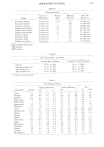
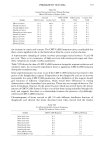
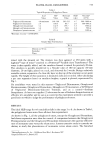
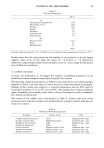
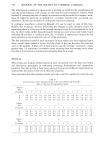
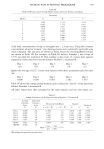
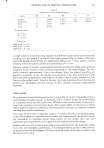
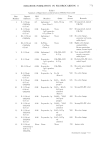
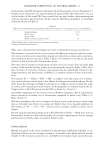
MALODOR FORMATION IN FLUOROCARBON l l 773 demonstrated that HC1 formation will lower the H20 saturation level of Propellant 11, leading to the formation of a separate phase of aqueous HC1 that will tend to wet out on the surface of the vessel. We have carried this one step further, demonstrating that corrosion products and processes will also remove H20 from propellant 11. Examples of this are shown in Table II. Table II Effect of Corrosion Products Upon H20 Analyses in Propellant 11 Containing 0.3 per cent CHaNO2 • 3, Initial H20 ppm 76, 76 FeCla added 8, 4 FeaO4 added 7 Mixture of Fe/Cu powder added l 5 •Approximately 4 days elapsed between treatment and analysis. bAnalyses by Karl-Fischer method. Thus, once corrosion processes begin, any water contamination may go unobserved. The presence of several metals in the system with different positions in the electromo- tive series, is a more active electrolytic system and, therefore, is more active in promot- ing oxidation-reduction reactions (Table I, Runs 1-6) whether or not the second metal is above or below iron in the electromotive series. The exact role of oxygen in initiating the reaction is not yet certain. The unusually high activity of the ferrous ion/iron system in accelerating the reaction (Table I, Run 10) is also uncertain. It is known, however, that oxygen may be cathodically reduced to hy- drogen peroxide and that ferrous ion/H202 is a common initiator of free radical reac- tions. The reaction Fe ++ + H202 -- OH ø + OH- is unlikely to be the source of'Cl' abstrac- tion, since hydroxyl radicals have a low affinity for halogen in polyhalocarbons. On the other hand, the hydrogen of n20 would also be an unlikely source of reduction until, or unless, acid were present in the system. In the propellant 11/ethanol system, the hy- drogen source is the CH2 group, not the OH, as shown by (2) and (3). A possible explanation for the lower activity of FeSO4 compared to FeC12 is the known lower corrosivity of sulfate ion to ferrometals compared to halide ions (Table I, cf. Runs 10 and 12). Still more puzzling is the role of oxygen and ferrous iron in the presence of the large excess of metallic iron. Ferric iron is inactive (Table I, Run 14) or possibly inhibitory in this system, yet Fe *++ + Feø-• Fe ++. Ferrous iron is readily oxidized to ferric ion by oxygen. Known radical promoting systems such as Fe(II)/Fe(III) or Fe(II) + H202 were not run because they would not deal with the reality of a system containing excess iron, oxygen and ferrous ion. Clearly, there is room for further study. CONCLUSIONS Methyl isocyanide is the cause ofmalodor in nitromethane stabilized propellant 11 un- dergoing reduction in iron storage containers. A separate water phase must be present initially for the reaction to proceed, i.e., the n20 concentration must exceed the satu-

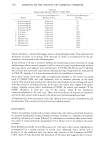
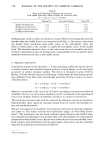
774 JOURNAL OF THE SOCIETY OF COSMETIC CHEMISTS ration level in the propellant. Once dechlorination of the propellant is initiated, any water is forced out of the organic phase, along with the acid formed. The resultant aqueous acid wets out on the metal to cause corrosion and reduce nitromethane to methylamine. The methylamine then scavenges the reactive intermediates from the re- duction of the propellant to form, ultimately, the methyl isocyanide and further reduc- tion products, such as dimethylamine. Oxygen is necessary for the reaction to proceed. The reaction will proceed more readily if galvanic systems of dissimilar metals are present. REFERENCES (1) (2) (3) (4) (5) (6) (7) (8) (9) (10) (11) (12) 13) (14) D. E. Kvalnes, U.S. Patent 3,085,116 (1963). J. E. Heberling, Jr. and W. B. McCormack, A reaction of some perhalomethanes and alcohol,J. Amer. Chem. Sot., 78, 5433 (1956). P. A. Sanders, A mechanism of the reaction between trichlorofiuoromethane and ethyl alcohol, Aerosol Manufacturers Assoc. Proc. Mid Year Meeting, 47 (May 1960). J. L. Marchio and Q. Quick, Odor problems with propellant blends, Soap/Cosmetics/Chemical Specialtie.•, 64 (Sept. 1975). P. Hoffman, G. Gokel, D. Marquarding, and I. Ugi, Isonitrile Chemistry,' Vol. 20 of Organic Chemistry, a Series of Monographs, I. Ugi, Ed., Ch. 2, Academic Press, New York, 1971. F. A. Cotton and G. Wilkenson, Advanced Inorganic Chemi•try-A Comprehensive Text, Wiley- Interscience, New York, 1962, pp. 709-710. F. W. Karasek, The plasma chromatograph, Re•earch/Development, 21, 34 (1975). M.J. Cohen and F. W. Karasek, Plasma chromatography--a new dimension in gas chromatography and mass spectrometry,J. Chem. Sci., 8, 330 (1970). F. W. Karasek, W. D. Kilpatrick, and M. J. Cohen, Qualitative studies of trace constituents by plasma chromatography, Anal. Chem., 43, 1441 ( 1971). J. Casanova, R. E. Schuster, andJ. D. Werner,J. Chem. Soc. (London) 1963, 4280. T. Saegusa and Y. Ito in Isonitrile Chemistry (5) Ch. 4, p. 80. R. F. Robey, Alcohol quality and degradation of aerosol products and packages, J. Soc. Co, met. Chem., 21,183, (1970). C. C. Seastrom (Jackson Laboratory, Organic Chemicals Department, E. I. du Pont de Nemours and Co.), Personal communication on the solubility of H20 and hydrogen halides in liquid halogens and halogenated solvents. T. N. Jones, Ill (Spruance Works, Textile Fibers Department, E. I. du Pont de Nemours and Co.) H20/HC1 Equilibrium in "Freon" 11. Personal Communication. Data available upon request.
Purchased for the exclusive use of nofirst nolast (unknown)
From: SCC Media Library & Resource Center (library.scconline.org)