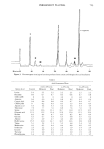
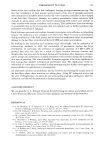
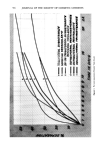
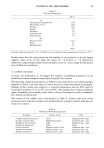
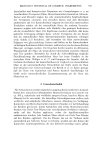
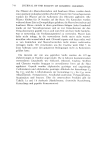
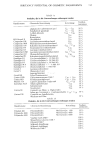
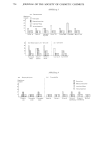
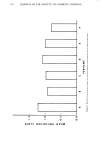
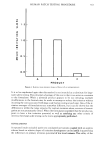
HUMAN PATCH TESTING PROCEDURE 763 Z Z 1.5 1.0 0.5 0.0 A ! B PRODUCT i / Figure 4 Relative mean irritation slopes of three roll-on antiperspirants It is to be emphasized again that this method is not intended as a substitute for large- scale safety testing. The principal advantage of this test is that it can serve as a restraint to the formulator. When a potential product appears to be too irritating, multiple modifications to the formula may be made to attempt to reduce the irritation without incurring the costs associated with large-scale human testing at each step. Also, if the ir- ritation averages of formulations are somewhat different, but it can be shown that the difference is within the range expected by random variation alone, avenues of investi- gation are not prematurely closed. When the formulator is satisfied that the product ap- pears to have a low irritation potential, as well as satisfying any other criteria of interest, then large-scale testing can be more appropriately performed. CONCLUSIONS A repeated insult occluded patch test conducted on humans coupled with an analysis scheme based on relative slopes of irritation development can be useful in quantifying the differences in primary irritation potential of low level irritants. The utility of the

764 JOURNAL OF THE SOCIETY OF COSMETIC CHEMISTS test has been demonstrated with shaving creams, roll-on antiperspirants, and an anti- perspirant pump spray formulation. ACKNOWLEDGMENT The authors wish to express their appreciation to Ms. Phyllis W. Martinez and Ms. Ann Marie Hritz for their invaluable technical assistance. REFERENCES (8) (9) (10) (11) (12) (13) (14) (1) L. Phillips, II, M. Steinberg, H. I. Maibach, and W. A. Akers, A comparison of rabbit and human skin response to certain irritants, Toxico/. App/. Pharm., 21,369-82 (1972). (2) J. H. Draize, Dermal toxicity, Assoc. Food and Drug Officials, U.S. Appra/sa/of the Safety of Chemica/J inFood, Drugs, an Cosmetic.•. Texas State Dept. Health, Austin, Texas, pp. 46-59, 1959. (3) J. H. Draize, G. Woodard, and H. O. Calvery, Methods for the study of irritation and toxicity of substances applied topically to the skin and mucous membranes,J. Pharm. Exp. Therap., 81,377-90 (1944). (4) P. Finkelstein, K. Laden, and W. Miechowski, New methods for evaluating cosmetic irritancy,J. Ine•t. Dermato/., 40, 11-14, (1963). (5) A.M. Kligman, The identification of contact allergens by human assay,J. I,ve.•t. Dermato/.. 47,369-74 (1966). (6) B. Magnusson and K. Hersle, Patch test methods, Acta Derm.--Venereo/., 45,123--28 (1965). (7) L. Schwartz and S. M. Peck, The patch test in contact dermatitis, P•d•b( Hecdth Rep., 59, 546-57 (1944). L Schwartz, L. Tulipan, and D. J. Birmingham, O•cupational Di.•eases of the Skin, Lea & Febiger, Philadelphia, Pp. 58-94, 1957. H. A. Shelanski, Experiences with and considerations of the human patch test method,.]. So•. Co, met. Chem., 2,324-31 (1951). H. A. Shelanski and M. V. Shelanski, A new technique of human patch tests, Proceedi,g.t of ScientificSec- tion, The Toilet Good• A•ociatio,, No. [9, pp. 46-49, 1953. W. Weinberger, The patch test--its technic and interpretation, Arch. Industr. Hyg. Occ/•p. &led., 2, 565- 73 (1950). A.M. Kligman and W. M. Woocling, A method for the measurement and evaluation of irritants on human skin, J. Inve•½. Dermatol,, 49, 78-94 (1967). J. Mandel, Non-additivity in two-way analysis of variance, J. Amer. Statist. A rs., 56, 878- 88 (1961 ). P.J. Frosch and A.M. Kligman, The chamber-scarification test ofirritancy, Contact Dermatitis, 2, 314- 24 (1976).
Purchased for the exclusive use of nofirst nolast (unknown)
From: SCC Media Library & Resource Center (library.scconline.org)