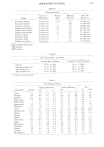
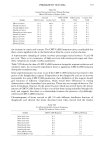
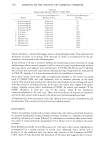
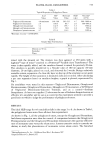
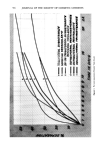
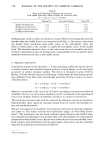
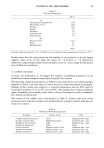
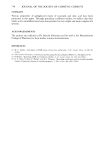
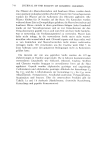
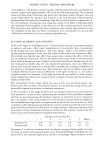
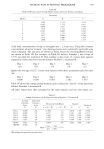
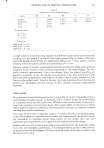
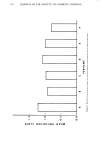
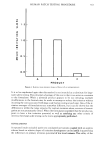
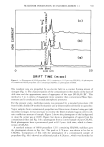
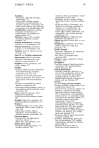
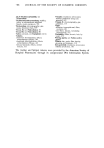
HUMAN PATCH TESTING PROCEDURE 761 Table V Analysis of Variance of Mandel Slopes Source DF SS MS F P Subjects Treatments Error Total Treatment Means A -1.063 B = 1.379 C = 0.593 Tukey Test HSD (0.10) = 0.4512 HSD (0.05) = 0.5368 HSD (0.01) = 0.7379 8 3.0988 0.3873 2.33 0.0710 2 2.5911 1.2955 7.80 0.0044 16 2.6579 0.1661 26 8.3478 on eight subjects. It was found that Samples A and B were quite similar and moderately irritating, but that Sample C produced only slight irritation (Fig. 4). Tukey's Test indi- cated that Samples A and B were not significantly different (P 0.10), while C was less irritating within the confines of this test methodology (P 0.05). Irritancy testing of another antiperspirant formula intended for pump spray delivery produced severe irritation when occluded repeatedly in this methodology. The for- mula contained approximately 70 per cent ethanol. Since the ethanol would be ex- pected to evaporate in use, the patches were allowed to dry, then remoistened with water just prior to application to the subjects in order to more closely simulate use con- ditions in the axillary vault. Tested in this way, the formula produced less irritation and allowed for meaningful irritancy testing of other alcohol-containing antiperspirant formulae. DISCUSSION The presented material demonstrates that it is possible to clearly distinguish products and formulae of similar natures on the basis of their irritancy within the methodology of a repeated insult occluded patch test. Whether these results relate in any way to actual use experience has not been shown. The unique ability of this test is to show, with a degree of statistical confidence, that one product, formula, or compound is more irritating than another similar one. Care must be exercised in using the analysis of variance that the underlying assump- tions of homogeneous variances and normally and independently distributed errors, are reasonable. In situations where these criteria do not obtain, there are non- parametric procedures which can be applied to the randomized blocks design. Samples with very low irritation potentials occasionally fall below the sensitivity of this test--they are essentially nonirritating. A scarifying technique similar to that recently proposed by Frosch and Kligman (14) may extend the range of this type of analysis, but this has yet to be tried.

762 JOURNAL OF THE SOCIETY OF COSMETIC CHEMISTS I I I :.1 d 015 N 01 .I.•'.1. I Jl Jl I
Purchased for the exclusive use of nofirst nolast (unknown)
From: SCC Media Library & Resource Center (library.scconline.org)