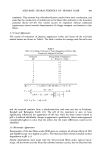
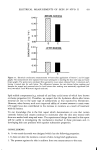
ACID-BASE CHARACTERISTICS OF HUMAN HAIR 403 treatment. They assume that triboelectrification results from ionic conduction, and state that the conduction of mobile ions in the fibers (20) conforms to the boundary potential theory (18-20). Our results cannot be explained without additional experiments aimed towards determination of charge transport mechanisms in hair fibers. 2.5 Visual Appearance The results of evaluation of physical appearance (color and luster) of the acid-base treated tresses are shown in Table I. The table contains the average rank for each tress Table I Effect of Acid-Base Treatment of Visual Appearance of Brown Hair Tresses, and Analysis of the Data • Treatment Average Rank of Appearance pH (1 = Worst, 10 = Best) 2 6.5 3 6.1 4 6.4 5 7.1 6 6.9 7 6.4 8 6.7 9 2.7 10 3.2 11 3.1 •H0: r• = . ..... = r•0 where r is the pH effect, n = 16, k = 10 k (Rj- nR..)2 s' = 12 •-• •=• Ink (k + 1)] - [1/(k - 1)] t', - k = 81.08 Pr [5'' • X 2 (k -- 1, a)] • 0.01 and the essential statistics from a distribution-free rank sum test due to Friedman, Kendall and Babington Smith (21). The pH of the treatment is seen to have significantly influenced the appearance of the hair. Only the three tresses treated at pH _ 9 suffered identifiable change in appearance qualitatively, these tresses appeared considerably lighter in color than the others, but the luster differences could not be identified. 2.6 Microscopic Appearance Examination of the hair fibers under SEM gave no evidence of adverse effects of HCI and NaOH except very slightly at pH 11. The bleached fibers showed notable surface degradation at pH _ 9. Similar observations were made with the wet-mounted fibers under optical micro- scope. All the brown and the blond hair showed normal cuticles, but the bleached hair

404 JOURNAL OF THE SOCIETY OF COSMETIC CHEMISTS treated at pH _ 9 showed ill-defined surface. The lifting of the cuticles did not appear abnormal in any of the fibers. CONCLUSIONS Bleached hair exhibits significantly higher absolute rates of absorption of HCI and NaOH compared with normal hair. The relative rates or diffusion coefficients of bleached hair are significantly higher than those of normal hair for absorption of HCI under all conditions and for absorption of NaOH at 11 pH. The HCI and NaOH absorption behavior of hair is very similar to that of wool. There exists a broad pH range in which hair absorbs little or no HCI and NaOH. For normal hair the range is pH 4-10. Bleaching narrows the range by about 2 pH units from the base side. The density of normal hair fiber remains unaffected by treatment with HCI or NaOH in the pH 4-9 range. Under the extreme conditions of pH 2 and 11, the density increases significantly. Viscoelastic properties also show a similar tendency. They change little in the pH 4-9 range. At pH 2, the elastic modulus decreases and the loss modulus increases. At pH 11, the elastic modulus decreases with no change in the loss modulus. There is some evidence of a slight increase in interfiber friction at pH 11 and of a probable minimum near neutral pH. Triboelectric behavior of hair shows pronounced dependency on pH. The low pH treated hair is susceptible to acquiring negative charge. The charge changes from a large negative value to a large positive value with increasing pH. Under dry conditions, the polarity of the charge shifts from negative to positive in the vicinity of pH 8. Visual appearance of hair remains unaffected from pH 2-8. Hair treated at pH _ 9 suffers noticeable discoloration. Scanning electron and optical microscopic appearance show that normal hair is not affected by pH and that bleached hair undergoes surface degradation at pH • 9. No conclusive evidence of a constrictive effect by acid pH or a distending effect by neutral or alkaline pH could be found. These physical properties are mutually coherent and correspond well with the HCI and NaOH absorption characteristic of hair to suggest that normal hair remains immune to the actions of HCI and NaOH over a broad range of pH, approximately between 4 and 8. REFERENCES (1) V. W. Wilkerson, The chemistry of human epidermis: II. The isoelectric points of the stratum corneum, hair and nails as determined by electrophoresis, J. Bid. Chem. 112, 329-335 (1935/36). (2) H. D. Cook and I. T. Smith, Streaming potential measurements on hair keratin,J. Appl. Polymer Sci., Appl. Polymer Symp., 18, 663-672 (1971). (3) H. C. Parreira, On the isoelectric point of human hair,J. Colloid Interface Sci., 75, 212-217 (1980). (4) H. Freytag, Hautbewirkte •inderungen der pH-werte w /sseriger l•3sungen, J. Soc. Cosmet. Chem., 15, 265-279 (1964). (5) J. Lindberg and N. Gralen, Measurement of friction between single fibers, Textile Res. J. 18, 287-301 (1948).
Purchased for the exclusive use of nofirst nolast (unknown)
From: SCC Media Library & Resource Center (library.scconline.org)