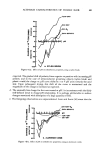
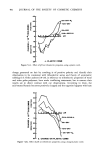
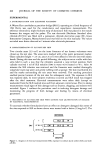
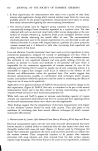
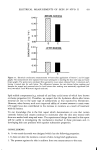
JOURNAL OF THE SOCIETY OF COSMETIC CHEMISTS on the length of the hair fibers on the head (Figure 6). As an explanation of their results, these authors suggested that this increased accumulation of the sebum on longer hair confirms the sebum-rebound hypothesis, i.e. the existence of a feedback mechanism capable of regulating the sebum output of the glands depending on the amount of sebum present in the hair fiber array: the more oil on the fibers, the less the sebum production. In this author's view, a more plausible alternate explanation is that the longer the hair, the less the effective contact area available for sebum loss per unit length of hair. The latter explanation is supported by the many experimental findings that are contrary to the sebum rebound hypothesis (2). Irrespective of the amount present, sebum has been found to distribute uniformly over the whole hair surface owing to the various mechanical manipulations of hair grooming (brushing, combing, rubbing etc.) (14). For the sebum rebound mechanism to operate, the existence of a continuous oil column, wicked up by capillary action between the hair fibers, would be required which by its weight, can signal to the glands to slow down the sebum excretion. As pointed out above, the experimental evidence is contrary to the existence of a continuous sebum column (2). 0.100 0.005 t- o 0.002 I I I I i 0 I I I ! I I I I I 0 1 2 3 4 5 6 7 8 Minutes Figure 7. High Pressure Liquid Chromatograms (HPLC) of extracts from hair samples. HPLC fractions eluted from Bondapak C•8 reverse phase column with acetonitrile: water (70:30), 2.5 ml/min. (A) Standard mixture of ten PAH. (B) Hexane extract of hair from New York. (C) Hexane extract of de Meo virgin hair. (D) Hexane extract of tressed soiled with mixture of sebum and PAH. Ordinate and abcissa denote the absorbance and the elution times respectively.

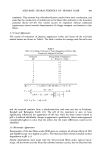
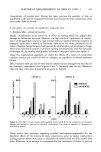
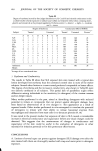
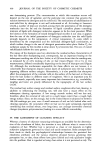
CLEANING OF HAIR 445 C. SOIL ORIGINATING FROM THE ENVIRONMENT Sebum coated hair fibers will act as an ideal substrate for deposition of airborne materials. In addition, ingredients of hair grooming products used between shampo- oings also accumulate on the surface of hair fibers and become part of the soil. Many of these materials will affect the properties of sebum: change its rheology, enhance photochemical oxidation, or interact directly with one or another of the sebum components. The presence of metals has been extensively studied. The relationship between Hg, As, Pb and other metal contents of hair and environmental pollution levels has been well established (15). On the other hand, very little is known about the presence of organic pollutants in hair soil. A few publications deal with the presence of paraffins in skin lipids (16). We investigated whether polycyclic aromatic hydrocarbons (PAH's), which. are common airborne pollutants in urban environments, can be detected in soil extracted from hair (17). Using HPLC, we were able to detect the presence of a number of PAH's in hair clippings collected in barber shops in Brooklyn, N.Y. (Figures 7 and 8) and which were extracted with hexane without any prior cleaning. Hair obtained from the De Meo Co., which originates in rural Italy and is used as our standard hair for experimental purposes, did contain only minor amounts of naphthacene (Table III). lO lO A • o o 0 0 250 350 450 550 650 750 250 350 450 550 650 750 am am Figure 8. Some typical fluorescence emission spectra of HPLC fractions common to PAH standards (curves marked 1) and hexane extract of hair from New York (curves marked 2). Figures A, B, C and D represent spectra of fractions collected from the HPLC column after 3-3.7, 3.7-4.4, 4.9-5.6 and 5.6-7.5 minutes elution times, respectively.
Purchased for the exclusive use of nofirst nolast (unknown)
From: SCC Media Library & Resource Center (library.scconline.org)