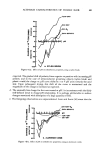
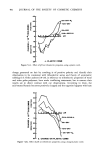
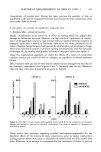
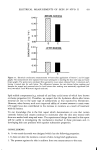
ELECTRICAL MEASUREMENTS OF SKIN IN VIVO.' II 433 0.40 0.30 0.2.0 0.10 0.00 O. 4O 0.30 0.20 0.10 0.00 BEFORE WASHING D C AFTER WASHING D C Figure 11. Electrical conductance measurements 18 hours after application of lotion C and D (upper graph). The measurements were repeated two hours subsequent to washing the skin with soap and water (lower graph). The points were calculated from geometric mean values obtained from 4 volunteers each having 3 treated sites for each lotion. The differences between the two lotions before washing and between the treated and untreated sites for both lotions after washing were statistically significant (0.01 level, two tailed T and Wilcoxon's signed rank test). lipid soluble components (e.g. mineral oil and fatty acids) some of which have known occlusive properties (13). Therefore, we suspect that the hydration effects after lotion removal are due to the same type of substantivity as that reported by Christensen• However, other factors, such as an improved ability of stratum comeurn to retain water (25) might have also contributed to the increase in moisture as a result of treatment with the lotions. To our knowledge this is the first report which demonstrates in vivo that certain cosmetic lotions and creams continue to moisturize after the skin sites treated with them are washed with soap and water. The experimental design discussed in this report will be useful in investigating the mechanisms involved in these processes and, in developing skin care products with superior substantive properties. CONCLUSIONS A. A wire-mesh electrode was designed which has the following properties: 1. It does not alter the moisture content of skin during brief applications. 2. The pressure against the skin is uniform from one measurement to the next.

434 JOURNAL OF THE SOCIETY OF COSMETIC CHEMISTS 3. In combination with unconventional placement (orally) of the common electrode, it allows the detection of minute changes in the water content of stratum corneum. B. Both conductance and capacitance increase with skin hydration. However, capaci- tance is a more sensitive measurement with respect to detecting small changes in hydration or solvent effects on skin. C. Electrical measurments were found to be useful for: 1. following events taking place in skin after application of moisturizers: and 2. finding that some lotions and creams retain moisturizing activity after the sites treated with them are washed with soap and water. D. Results obtained with NaPCA and Urea, two compounds known to increase the water retention by stratum comeurn, suggest that the electrical readings are not always proportional to the quantity of water present. Factors such as water-binding and ion-mobility might be responsible for unusual responses such as are obtained with urea. E. Application of urea in water or in lotion to skin gives a biphasic response. The first phase of the response, reduced capacitance could be due to a reduction in the amount of unbound water. The second phase, increased capacitance, may be related to the plasticizing properties of urea. REFERENCES (1) I. H. Blank, Further observations on the factors which influence the water content of stratum comeurn, J. Invest. Dermatol., 21,259 (1%3). (2) R. Scheuplein and L.J. Morgan, Bound water in keratin membranes measured by a microbalance technique, Nature, 214, 456-458 (1%7). (3) E.J. Clar, C. P. Her and C. G. Sturelle, Skin impedance and moisturization, J. Soc. Cosmet. Chem., 26, 337-353 (1975). (4) S. D. Campbell, K. K. Kraning, E.G. Schibli and S. T. Momii, Hydration characteristics and electrical resistivity of stratum corneum using a noninvasive four-point microelectrode method, J. Invest. Dermatol., 69, 290-295 (1977). (5) P. A. Isherwood, Physiology of the stratum corneum, measurement of water content, Acta Fac. Med. Univ. Brun, 16, 233-239 (1%5). (6) P. T. Pugliese, A critical review of instrumental techniques for evaluating performance of skin care products, Presented at COSMO EXPO, April 24, 1979. (7) J. Wepierre, Study of the hydrating effect of cosmetic preparations by measuring cutaneous impedance in hairless rat, Soap Perfum. Cosmet., 50, 506 (1977). (8) R.J. Jackson, B. D. Ridge and C. C. Forward, The measurement of the moisture content of the skin by a novel impedance technique, Presented at the 11th IFSCC Congress, Venice 1980. (9) R.J. Scheuplein and I. H. Blank, Permeability of the skin, Physiol. Rev., 51,702-747 (1971). (10) G. P. Hiley, Y. S. Pan, D. Robertshan and J. E. Vercoe, Effect of lipid solvents on cutaneous moisture loss, Aust. J. Biol. Sci., 30, 197-201 (1977). (11) P.M. Elias, D. S. Friend, The permeability barrier in mammalian epidermis,J. Cell Bid., 65, 180-191 (1975). (12) P.J. Hartop and C. Prottey, Changes in transepidermal water koss and the composition of epidermal lecithin after applications of pure fatty acid triglycerides to the skin of essential fatty acid-deficient rats, Br.J. Dermatol., 95,255-264 (1976). (13) F. Tranner and G. Berube, Mineral oil and petrolatum: reliable moisturizers, Cosmet. Toilet, 93, 81-82 (1978). (14) R. L. Rietschel, A skin moisturization assay,J. Soc. Cosmet. Chem., 30, 369-373 (1979). (15) Hisao Tsutsumi, Toshiaki Utsugi and Shizno Hayashi, Study on the occlusivity of oil films, J. Soc. Cosmet. Chem., 30, 345-356 (1979).
Purchased for the exclusive use of nofirst nolast (unknown)
From: SCC Media Library & Resource Center (library.scconline.org)