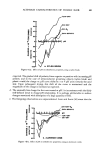
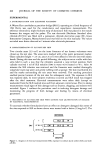
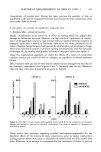
ELECTRICAL MEASUREMENTS OF SKIN IN VIVO.' II 429 8.0 w Z - tO 3. • - Z - o ].6- -- ß 15% GLYCERIN O 10% A 7% " [] .'5% " 0(• I i i i i i I I i ,i 1.6 3.2 4.8 8.4 8.0 HOURS Figure 7. Conductance measurements taken from circular areas of skin on the forearms of six siabjects after application of a lotion containing different amounts of glycerin. The points represent arithmetic mean values of log T/U where T = conductivity in the treated sites and U = conductivity in adjacent untreated sites. the presence of large but roughly equal amounts of water in the formulation, differences in the glycerin concentrations do not affect the readings. 2. Recent work by Jackson (8) demonstrates that phase angle changes measured on a cellophane/glass fiber filter membrane system were a function of the degree of hydration of a glycerin solution used to impregnate the system. 2. The effect of aqueous solutions of glycerin, sodium pyrollidone carboxylic acid (NaPCA) and urea on skin moisturization The effect of aqueous solutions of glycerin (10%), NaPCA (2%) and urea (10%) on skin moisturization as measured by capacitance is shown in Figure 8. Of these, glycerin produced the highest capacitance readings. This is in agreement with the view (17) that under "moderate or high conditions of humidity, glycerin introduces moisture from the atmosphere to the skin." The initial slope of the respective curve in Figure 8 suggests that in the present case glycerin produced hydration during the first few hours after application mainly by diminishing the loss of water from the formulation. However, it appears that glycerin also has several properties which may limit its usefulness as a moisturizer: 1. Under conditions of low relative humidity (e.g. 20%) glycerin tends to lose water (16). 2. Glycerin increases trans-epidermal water loss (18) thereby acting as a vehicle for moisture loss under conditions of low humidity. 3. It forms no bonding with the skin so it is easily washed away (17). In most subjects, urea produced an apparent decrease in moisturization which was manifested in lower capacitance values particularly during the first few hours after

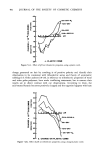
430 JOURNAL OF THE SOCIETY OF COSMETIC CHEMISTS 1.00 -- 0.70 -- 0.40 z 0.10 0.00 -0.20 0.50 ....,..GLYCERIN ( 10% ) No PYROLLIDONE CARBOXYLIC ACID 1.5 3.0 4.5 6,0 7,5 HOURS Figure 8. Capacitance measurements taken from circular areas of skin on the forearms of one subject after application of an aqueous solution of glycerin (10%) sodium pyrollidone carboxylic acid (2%) and urea (10%). The points represent log T/U where T = capacitance in the treated sites and U = capacitance in adjacent untreated sites. application (Figure 8). This finding agrees with those of Campbell (4) who reported that excised plantar stratum comeurn had an increase in resistance as result of soaking in urea. Campbell postulated that urea caused a reduction in the amount of free water within the excised stratum comeurn. This would result in a lowering of ion mobility and hence an increase in resistance. However, our studies show that in vivo this apparent decrease in skin hydration is transient and is followed by a gradual increase in capacitance. (Figure 9). The later effect may be due to the known keratolytic effect of this compound (19-21) which could result in increased ion mobility. It is interesting to note that the biphasic response (apparent decrease followed by an increase in hydration) caused by urea is also observed with urea added to a commercial lotion (Figure 10). The lotion appears to cause a more rapid reversal of the initial urea effect and, perhaps, a heightened moisturizing effect at later periods. The moisturizing effectiveness of a formulation containing 10% urea has also been tested by Tagami, et al. (27). However, those authors did not report the initial decrease in the apparent moisturization observed by us. The following facts might account for the discrepancy:
Purchased for the exclusive use of nofirst nolast (unknown)
From: SCC Media Library & Resource Center (library.scconline.org)