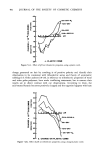
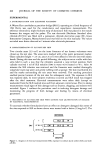
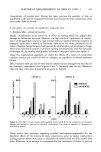
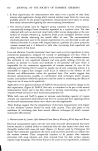
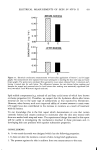
440 JOURNAL OF THE SOCIETY OF COSMETIC CHEMISTS Table I Amount and Composition of Skin Surface Lipids in Two Age Groups •-3 Male (years) Female (years) 8-12 18-80 8-12 18-80 (n = 9) (n = 42) (n = 9) (n = 38) Total group A (n = 103) Lipid level (mg/16 cm 2) 0.40 1.50 0.96 1.57 1.37 (0.21) (0.84) (0.46) (0.82) (0.85) Free cholesterol (%) 10.50 8.81 7.81 8.49 8.72 (5.75) (2.42) (2.93) (3.87) (3.43) Free fatty acids (%) 5.71 24.82 13.49 21.96 20.89 (3.16) (6.93) (5.73) (6.15) (8.81) Triglycerides (%) 47.60 30.74 40.28 34.68 34.65 (5.99) (5.96) (6.61) (5.30) (8.04) Wax and cholesterol esters (%0) 15.26 20.45 17.61 18.60 19.02 (33.3) (2.34) (3.16) (2.95) (3.15) Squalene (%) 13.87 9.30 13.51 11.31 10.92 (2.11) (3.40) (1.15) (5.16) (4.23) Paraffins (%) 6.94 5.84 7.24 4.99 5.75 (3.96) (2.50) (6.00) (2.67) (3.14) •With permission from Ref. 5. 2n denotes the number in each group. 3Parenthesized numbers denote standard deviations. middle and old age: the production of sebum increases, reaches a maximum and then, diminishes (6). Not only does the amount of sebum secretion change with age, but it seems that its composition also varies as people go through the various life cycles (Table I). Furthermore, sex, the time of season and even nutrition appears to have considerable effects (5). Even after the sebum has left the sebaceous duct and becomes distributed over the hair, it does not remain in a static state: its chemical composition 45 40 ,• 35 õ 3o • 25 E 20 15 lO Hair washing Free fatty acids 'x TR' Triglycerides 0 1 3 10 Days after hair washing Figure 3. Changes in the free fatty acid and trigliceride content of hair lipids after hair washing (Reproduced with permission from ref. 5).

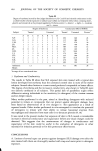
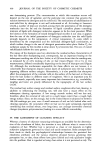
CLEANING OF HAIR 441 and physical properties change with time. Extracellular lipases, which are abundant on the skin surface gradually hydrolyse the triglycerides of the sebum and increase its free fatty acid content (Figure 3). The rheological properties of sebum also undergo alterations with time. The reasons for this are not clear at the moment. Probably the rheological behavior of sebum is very strongly linked with the chemical changes that occur due to lipase activity, oxidation processes and the exposure of u.v. and visible light, which induce a variety of reactions in lipids containing many unsaturated compounds. B. THE KINETICS OF REOILING OF HAIR The resoiling and reoiling process of hair and skin has most important implications on the cleaning of hair. As mentioned before, the amount of sebum on the surface of the hair varies with and depends on the time period since the last cleaning of the hair. A number of workers measured the reoiling curves of hair. A typical curve obtained in our laboratory is reproduced in Figure 4, other examples can be found in the published lOOO 900 800 700 13) E500 E 3OO 200 0 - • I 0 10 20 • I i I r ./ 30 40 50 60 70 80 Hours Figure 4. Sebum content of a head of hair as a function of time after a hair wash. The hair was extracted with ether. literature (7-9). We have analyzed the oiling of hair in terms of two rate processes: those of sebum production and of sebum removal. The former is a zero order process, (i.e. it proceeds at constant rate) (2). The latter, we assumed, follows first order kinetics (i.eo the removal rate is proportional to the amount of sebum present on the hair surface at any moment of time). The appropriate rate equation can be written as
Purchased for the exclusive use of nofirst nolast (unknown)
From: SCC Media Library & Resource Center (library.scconline.org)