ACID-BASE CHARACTERISTICS OF HUMAN HAIR 395 2.1. Fiber Density Fiber density was measured using a density gradient column prepared with toluene (/• = 0.87 g/cm 3) and carbon tetrachloride (/• = 1.60 g/cm3). Only the hair specimens with no microscopically observable medulla were used for density measurements. The specimens were preconditioned at 22øC, 65% RH before introducing into the gradient column. Several hours were allowed for the specimens to reach floatation equilibrium, and their densities were calculated from the calibration curves via polynomial regression. 2.2. Viscoelasticity Viscoelastic properties were measured using a Rheovibron Direct Reading Dynamic Viscoelastometer. The elastic and loss moduli of the fibers were calculated as E' = [(A Fo/d)/(A Lo/Li)] 41 +tan2t$, and E" = [(AFo/d)/(ALo/Li)] tan rS/•/1 + tan 2& where AFo is the amplitude of the dynamic force output, d is the linear density of the specimen, A Lo is the amplitude of the dynamic displacement input, Li is the specimen length, b is the phase angle by which the output lags behind the displacement. The measurements were made with AL0 -- 1.580 X 10 -3 cm, dynamic frequency = 110 Hz, and at 22øC and 65% RH. 2.3. Interfiber Friction Interfiber friction was measured by the well-known fiber-twist method (5). In the procedure, a pair of fibers were twisted together n(=-2) times at a small constant angle /3, a tension T•(=6.06 gram-force) was applied to each fiber and the force T2 required to set and maintain the fiber in motion relative to one another was measured. Measurements were made in both against-scale (tip-tip) and with-scale (root-root) directions and at two levels of humidity (65% RH and wet). 2.4. Triboelectric Behavior Triboelectric behavior was measured using a Faraday pail and cage connected to an electro(coulomb) meter. In the procedure, the hand-held tress sample was stripped of any unbalanced charge using a deionizing bar, brushed or combed 20 strokes with a similarly deionized brush or comb and dropped into the Faraday pail. The magnitude and the polarity of the resultant charge was recorded. A nylon brush, an aluminum comb and a plastic (nylon) comb were used in these experiments. Measurements were made at the following intervals and conditions: a. Immediately following the final cycle of treatment, tresses dried under N 2 flow: O-HR-Dry-N2. b. Immediately thereafter, tresses dried in an oven at 55øC: O-HR-Dry. c. After conditioning in a standard atmosphere (22øC, 65% RH) for 24 hours: 24 HR-65% HR. d. Two days later, tresses dried in the oven at 55øC: 72 HR-Dry.

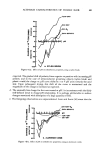
396 .JOURNAL OF THE SOCIETY OF COSMETIC CHEMISTS 2.5. Visual Appearance The tresses were arranged in a random order against a white background. Each member of a panel of 7 women and 9 men was asked to assign each tress a rank between 1 (the worst) and 10 (the best) depending on its color and luster. 2.6. Microscopic Appearance Fiber specimens from the brown, the blond, and the bleached hair tresses were examined under a scanning electron microscope for definition of the cuticle structure. Wet-mounted fiber specimens were observed under an optical microscope for cuticle lifting. RESULTS AND DISCUSSION 1. ABSORPTION OF HCI AND NaOH From the HCI and NaOH absorption curves (i.e., volume vs. time) for the brown, the blond, and the bleached hair, the following quantities were calculated: a. quantity of HCI and NaOH absorbed at equilibrium, m•(m moles/g of hair) b. initial absolute and relative velocity constants, K and K', as defined by m(t) = K x• } m(t)/m• -- K' x/7 t _ 20 min. The absolute velocity constants (K) are shown in Figure 1. The bleached hair exhibits higher K compared with the normal hair. The lower disulfide cross-link density in the bleached fiber, as evidenced in data from amino-acid analysis of the bleached hair as well as in some published literature (6), perhaps permits rapid swelling to enhance the absorption processes. 0.8 i- 0.6 I- z rr ( 0 I- •o 0.4 o• oT G 0.2 ,.•-- 0 I- • 0 :• • 0.4 0 I• • 0.6 0.8 7 8 9 10 11 , ß 'ß • BROWN ß •. "BLOND ß t• BLEACHED Figure 1. Absolute velocity constants for initial stages of HCI and NaOH absorptions.
Purchased for the exclusive use of nofirst nolast (unknown)
From: SCC Media Library & Resource Center (library.scconline.org)