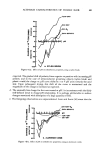
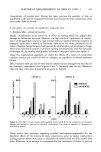
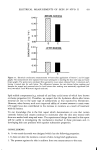
ELECTRICAL MEASUREMENTS OF SKIN IN VIVO.' II 427 Occlusive cosmetic materials such as petrolatum are known to moisturize by preventing moisture loss from skin (13,14). Wepierre (7) found, after applying petrolatum or lanolin to the backs of fuzzy rats, an apparent decrease in moisturization signified by an increase in electrical impedance. The effect was temporary (1• to 4• hours), dose-related with respect to amplitude and duration, and it was attributed to the high electrical resistance of those test materials. The discrepancy between our results and those reported by Wepierre could be due to one or a combination of the following factors: 1. The quantity of sample applied to the skin was much smaller in our experiments 2.6 mg/cm 2 compared to 12 mg. or 39 mg/cm 2. The latter may act as an electrical insulator. 2. In our experiments one electrode was placed on the test site while the reference electrode was placed in the mouth. As a result of this arrangement, the resistance of the petrolatum treated skin is expected to be minimal in comparison to the situation in which the two electrodes are placed side by side over the petrolatum coated area. The latter method of electrode placement also raises questions regarding the pathway of current. 3. It has been shown (15) that following application of occlusive cosmetics, physical changes take place at the skin-ointment interface which tend to convert the ointment film into a more loosely organized structure. It is possible that the experimental conditions and the electrode used by us favored such processes thereby reducing the electrical resistance. These experiments demonstrate that electrical measurements can be useful in detecting an increase in skin hydration produced by occlusive materials such as petrolatum. However, the question remains as to what extent the measurements are influenced by the resistivity of the test material (3). Hence, while the technique can be used to evaluate the effect of certain additives on the moisturizing properties of an occlusive cosmetic ingredient (as will be shown below), data obtained with two different occlusive materials (e.g. petrolatum compared to lanolin) must be interpreted with caution. The results presented in Figure 5 deserve further discussion. Conductance measure- ments suggest that about one hour after exposing skin to solvent (untreated with petrolatum), the quantity of moisture became equal or higher than in adjacent control sites. On the other hand, the capacitance was still markedly lower in the dried skin than in the normal, thereby indicating less hydration. Since both, capacitance (6, 8, 27) and conductance (4, 27) have been shown to be quantitatively related to the amount of moisture, it may be that the discrepancy between the two parameters reflects the presence of factors other than water content. There may be a diminished ability of stratum comeurn to bind water as suggested by Campbell (4) who reported that the electrical resistance in excised plantar stratum corneum became lower after drying with a solvent and rehydration with saline solution. Another possible factor is a change in ionic mobility caused by a redistribution of the ionic charges associated with corneocytes. It has been proposed by Clar (3) that changes related to ionic charges on corneocytes can be measured by determining impedance as function of current frequency (alpha relaxation time).

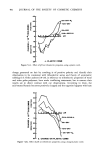
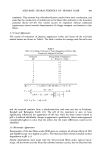
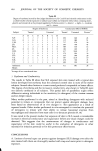
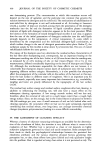
428 JOURNAL OF THE SOCIETY OF COSMETIC CHEMISTS C. SKIN MOISTURIZATION PRODUCED BY LOTIONS AND SELECTED INGREDIENTS 1. The effect of glycerin on the moisturing properties of lotions Figure 6 shows the effect of several commercial preparations on the skin hydration as measured by conductance during seven hours after application. The data suggest that the magnitude of the response was at least in part, related to the amount of glycerin 0.65 - 0.52 0.39 0.26 Q Z 0.13 _ ß LOTION D 0 LOTION C • LOTION B - 0 LOTION A I I 1.5 :• .0 I I I O0 4.5 6.0 7.5 HOURS Figure 6. Conductance measurements taken from circular areas of skin on the forearms of ten subjects, after application of different lotions identified on the graph as A, B, C, and D. The points represent arithmetic mean values of log T/U where T = conductivity in the treated sites and U = conductivity in the adjacent untreated site. contained in the preparations, i.e., 0.0, 1.5, 3.0, and 3.2% in lotions A, B, C, and D respectively. In order to confirm the hypothesis that glycerin may markedly affect moisturization, we retested aliquots of Preparation C containing increased glycerin (7%, 10%, and 15% W/W). Corresponding quantities of water were deleted from the emulsions. The results, shown in Figure 7, demonstrate a dose-response relationship between the glycerin content and the conductance. It is interesting to note that with concentrations of glycerin above 7%, relatively little increase in conductance is observed. Several lines of evidence suggest that the dose-response observed with increasing amounts of glycerin is due to the known property of this compound to function as a humectant (16), i.e., its ability to hold water: 1. Measurements taken immediately after application to the skin before the lotion could lose the excess water) are equal for all four preparations. This indicates that in
Purchased for the exclusive use of nofirst nolast (unknown)
From: SCC Media Library & Resource Center (library.scconline.org)