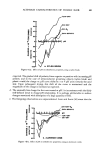
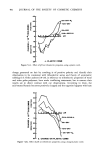
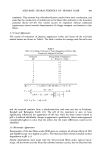
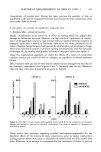
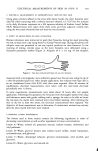
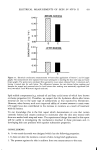
ELECTRICAL MEASUREMENTS OF SKIN IN VIVO.' II 425 (Figure 3 lower bars) from areas of skin dried by either a brief solvent extraction or by daily exposure to SLS, were lower than in adjacent control sites. An opposite pattern was observed with the wet electrode (Figure 3 upper bars). The differences between values in the dry sites and the normal sites were also substantially greater when measured with the dry electrode. The positive dry to normal skin ratios (d/n) with the wet electrode indicate that during the measurements more moisture was transferred to the dry sites than to the normal sites. This effect was expected in view of the increased permeability caused by the exposure of skin to solvent. However, the fact that d/n ratios for the wet electrode are smaller than those for the wire-mesh electrode shows that measurements taken with the latter are more likely to reflect the state of skin hydration existing prior to the measurements. For the wet electrode measurements we used a potassium chloride electrolyte cream. Others (3,7) have used a special electrolyte consisting of a mixture of propylene glycol and saline in equilibrium with the ambient relative humidity. Evidence has been presented based on a gravimetric procedure (3) that this type of electrolyte does not influence skin hydration. The experimental design used by us might prove to be useful in re-evaluating the effect of different electrolyte solutions on the hydration of stratum oeorIleum. Further work was done in an attempt to verify if either the partial occlusion produced by the wire-mesh electrode or the small vacuum force used for controlling its pressure against the skin could cause an increase in skin hydration or loss of water respectively. We found that when the electrode was kept in contact with the skin, a gradual increase in capacitance and conductance took place. An increase in these parameters has been related to an increase in skin hydration (4, 5, 8, 27). On the other hand, application of the electrode for 15 seconds, as in normal use, caused a negligible increase (Figure 4). A B 0 ] 2 5 4 5 6 MINUTES Figure 4. Skin capacitance measurements taken with the wire mesh vacuum controlled electrode. Curve A was obtained with the electrode held on the skin continuously for about 6 min. The curves identified as B show repeated measurements from the same site with brief electrode applications (15 seconds) at 15-second intervals. This observation agrees with calculations based on the coefficient of water diffusion through the stratum comeurn (4, 9) which show that complete occlusion of skin for 15 seconds has a minimal influence on the hydration level. Moreover, since repeated electrode applications at 15 second intervals did not result in a cumulative effect it seems that the small changes revert to normal in less than 15 seconds.

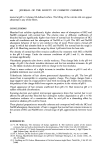
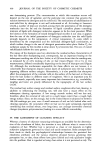
426 JOURNAL OF THE SOCIETY OF COSMETIC CHEMISTS Based on these facts we conclude that brief applications of the wire-mesh electrode do not cause any accumulation of moisture under the electrode or any change in the transit of water through the stratum corneum. The results presented in Figure 3 might have some significance regarding the mechanism through which solvents alter the barrier properties of skin. Hiley (10) suggested that the increase in the moisture loss known to take place following exposure to solvent is due to stimulation of sweat gland activity. Others, (11,12) attribute the increase to an elevation in transepidermal water loss. In our experiments, measurements taken with the wire-mesh electrode following solvent extraction, are much lower than those observed concurrently in adjacent skin sites, or in the same subject when perspiring or in the foot pads of cat after stimulation with pilocarpine (unpublished data). Therefore, we suspect that the increase in water loss (see below) after exposure of skin to solvent (acetone-ethanol 1:1 V/V) is due to a rise in transepidermal water loss rather than to stimulation of sweat gland activity. B. EVALUATION OF SKIN MOISTURIZATION PRODUCED BY APPLICATION OF PETROLATUM A light application of petrolatum (2.6 mg/cm 2) results within minutes in a gradual increase in conductance and capacitance indicating an increase in moisturization. Moreover, the increase is more pronounced in sites dried with acetone-ethanol (Figure 5). The latter effect is believed to be due to containment of moisture probably resulting from an increase in transepidermal water movement caused by the removal of lipid barriers and protein denaturation. 0.70 0.48 0.26 log E/C ß 0.02 -0.18 -0.4C • • • I • • • I • I 0 9 .'38 57 76 95 MINUTES Figure 5. Conductance (G) and capacitance (C) measurements taken with the wire mesh electrode in solvent (acetone-ethanol 1/1, v/v) dried skin sites. One of the two sites and a control site were treated with petrolatum before the measurements were made. The other solvent exi•osed area and its adjacent control site were left untreated. The points on the graph represent the logarithmic value of the ratios of extracted (E) to control (Ct).
Purchased for the exclusive use of nofirst nolast (unknown)
From: SCC Media Library & Resource Center (library.scconline.org)