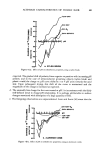
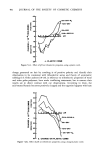
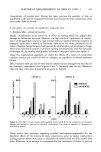
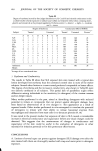
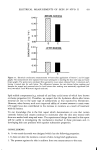
442 JOURNAL OF THE SOCIETY OF COSMETIC CHEMISTS dm - A - km, (1) dt where m, t, A and k represent the amount of sebum present at any time on the hair after a cleaning has taken place, the time since the last hair cleaning, the production rate of sebum and the rate constant of sebum removal process from hair owing to processes other than hair washing (e.g. rubbing on pillows, combing, brushing, etc.), respectively. Integration of Equation (1) with the boundary conditions: at t -- O, m -- O, gives the amount of sebum on the hair as A m = -• (1 -- e-i'). (2) Equation (2) was solved numerically with sets of data obtained in our laboratory and from the published literature (Table II). Assuming that an average scalp surface (10) is Table II Numerical Values of Parameters of Reoiling Curves as Calculated by Equation Sebum production fate, A Experiment (mg/head/hour) k (mg/hour) A • 1.50 0.0316 B • 1.62 0.02 C 2 1.73 0.03 D 2 0.88 0.02 E 3 2.99 0.05 •Data determined from ref. 8. 2Data obtained from ref. 7. 3Data obtained from ref. 6. about 775 cm 2 and a head of hair contains 1.60 x 10⁵-1.74 x 10⁵ hair follicles (11) and, therefore, sebacous glands, the results suggested that the rate of sebum production per gland, as calculated from our equation, is about 6-9 ng/gland/minute, in good agreement with direct experimental measurements (4). Furthermore, it also appears from these calculations that in a four-day period, some 60-70% of the sebum produced is lost from a head of hair, presumably owing to combing, brushing and rubbing against objects, e.g., pillows. Another interesting result is that the rate of sebum loss from a head of hair depends on the treatment the hair has received during the previous cleaning operation. Gloor, et al. (7) showed that the nature of shampoo used has an effect on the subsequent rate of sebum removal from its hair, and so does the method of drying (8): hair dried in air lost its sebum at a slower rate than hair dried with a hot-air drier (Figure 5). The literature, especially the German cosmetic and dermatolog- ical journals, abounds with observations which collectively suggest that the composi- tion of the shampoo and the subsequent post-shampoo treatment have a major influence on the reoiling rate of hair. At the present time, the various factors that can influence the rate of sebum loss between shampooings and thus determine the residual sebum level on the surface of

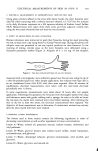
CLEANING OF HAIR 443 Hair Wash 80 • 60 o • 50- g 40- E • 30- 20. 10 t 0 • 0 • 4 Days after hair wash Figure 5. Scbum content o• heads o• haJ• o• paneJJsts •ep•esents no•maJJzed amounts o• sebum (1•% = 1.81 m•/cm • JJpJds) abcJssa-tJme Jn da?s. •ach point [ep•esents the mean •aJue o• 16 paneJists a•e• 16-3b. •he ba•s denote the standard e•o• o• the mean. Solid JJne--haJ• d•Jed with a• eJect•ic haJ• d•Je• permission •om •e•. 8). the hair are not at all clear. Among these are probably: the effective surface area of the hair exposed to the outside (which depends on the fiber density and length of the hair) the surface characteristics of the hair fibers (surface energy, roughness, etc.) the adhesion of the soil to hair the rheology of the sebum and its alteration with time. As an example, it is interesting to cite the measurements of Gloor and his colleagues (13) who showed that the amount of sebum recovered from a unit mass of hair depended •5 • lb 1'5 2'0 2'5 Length of hair (in cm) Figure 6. The regression curve relating hair lipid content and hair length. Ordinate--amount of lipid on unit mass of hair abcissa--hair length on head in cm. The samples were collected one week after a hair wash on 47 male panelists. (Reproduced with permission from ref. 13).
Purchased for the exclusive use of nofirst nolast (unknown)
From: SCC Media Library & Resource Center (library.scconline.org)