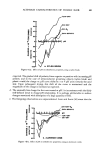
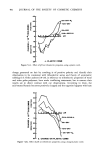
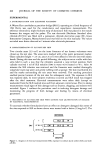
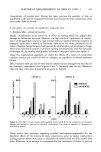
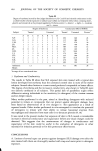
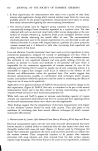
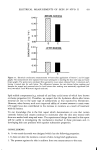
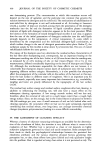
ACID-BASE CHARACTERISTICS OF HUMAN HAIR 397 z 0.15 0.10 I- z I- o .r m 0 • o o ..d • 0.05 '" 0 _ O. lO n- 0.15 Figure 2. Relative 0.05 2 3 4 5 6 7 6 ß ß ß ß ß ß ß 1011 pH ß ß •, ,• BROWN BLOND % % •, BLEAGHED velocity constants for initial stages of HC1 and NaOH absorptions. The relative velocity constants (K') are shown in Figure 2. The following inferences may be made from these results. First, the K' for HCI absorption show no definite dependence on pH, suggesting that the diffusion coefficient for the process may be independent of concentration. Second, K' for the HCI absorption by the bleached hair appear to be substantially higher than the corresponding values for the normal hair. Since bleaching is known to increase hydrophilicity of the fiber surface (7) and also increase the diffusion constant (8) and swelling (9, p. 183), the above results are perhaps attributable to faster saturation of the surface with protons followed by their faster diffusion into the bleached hair compared with the normal hair. We have made a similar observation in reference to methylene blue dye absorption by normal and bleached hair. In the pertinent experiments, spectrophotometric measurement of methylene blue dye depletion from a finite 1 x 10 -5 M dye-bath buffered to 7 pH, showed that at a liquor ratio of lg:667 ml the initial relative velocity constant is'0.208 min -•/2 for 1-hour peroxide-bleached hair which is substantially greater than the value of 0.158 min -•/2 for the normal hair optical microscopic examination of the cross-sections of the fibers dyed to equilibrium gave indication of significant radial diffusion of the dye into the bleached fibers in contrast with the peripheral- or ring-dyeing of the normal fibers. Finally, the relative velocity constants for the base absorption by the bleached hair do not seem to differ much from those for the normal hair except at 11 pH. This is perhaps a reflection of the susceptibility of the bleached hair fibers to rapid tertiary-structural disintegration under such alkaline conditions. The equilibrium absorptions of HCI and NaOH, shown in Figure 3, resemble those of wool (10, p. 188, 11, p. 354). The characteristic sigmoidal shape of the absorption curve shows the existence of a broad pH range where little or no absorption takes place. For the normal hair, the range is between pH 4 and 10. The HCI absorption behavior is very similar to that reported by Breuer and Prichard (12) for normal hair. The bleached hair appears to absorb slightly less HCI this effect of bleaching is qualitatively consistent with the available information on the acid-binding capacity (13), but its magnitude appears to be insignificant under the conditions involved here (i.e., pH _ 2). The

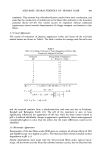
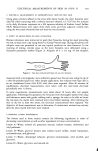
398 JOURNAL OF THE SOCIETY OF COSMETIC CHEMISTS co 800 r x • •øø r u. T 400 r o 200 400 600 9 10 11 pH \ BROWN ß BLOND ß ß ß ß ,• BLEACHED Figure 3. Equilibrium HC1 and NaOH absorptions by human hair. NaOH absorption characteristics of the bleached hair, however, differs significantly from that of the normal brown hair. It registers absorptions of a notable quantity of NaOH at a pH as low as 9 and increasing quantities thereafter. As with HCI absorption, the observed effect of bleaching on NaOH absorption is consistent with the published literature (13). 2. EFFECTS ON PHYSICAL PROPERTIES 2.1 Fiber Density The effects of HCI and NaOH treatments on the brown hair fiber density are shown in Figure 4. The results appear to be coherent with the HCI and NaOH absorption behavior (Figure 3). Between pH 4 and 9, hair absorbs very little HCI and NaOH and causes no change in its structure and hence its density. At pH 2 and 11, large quantities 1.335 1.330 1.325 I ß ß ß , 2 4 7 9 11 pH Figure 4. Effect of pH on hair fiber density.
Purchased for the exclusive use of nofirst nolast (unknown)
From: SCC Media Library & Resource Center (library.scconline.org)