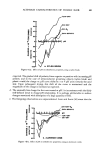
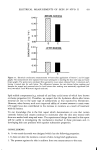
ACID-BASE CHARACTERISTICS OF HUMAN HAIR 399 of HCI and NaOH are absorbed to cause structural changes and the density increases from the normal value of about 1.329 g/cm 3 to about 1.333 g/cm 3. Analysis of variance and multiple range tests of the density data have shown this change to be highly significant. The nature of this structural change is not known with certainty, but acid and alkaline hydrolysis may be assumed to be the mechanism. It is noteworthy that hydrolysis of wool fibers with proteolytic enzymes such as trypsin, papain, pepsin and ticin is shown to cause the density to increase from the normal value of 1.306 g/cm 3 to 1.32-1.33 g/cm 3 (14). Such treatments are far more severe than the HCI and NaOH treatments of the present investigation. 2.2 Viscoelasticity The effects of HCI and NaOH treatments on elastic and loss moduli of the hair fibers are shown in Figure 5. Like the density data, these results cohere well with the HCI and 450 440 ß • 430 ß 18 , =1 • •6•)• 410 i 14 2 4 7 9 11 pH Figure 5. Effect of pH on viscoelastic properties. NaOH absorption behavior (Figure 3). The hair fiber remains unaffected by treatments between pH 4 and 9, but at pH 2 and 11 significant structural changes seem to take place, giving rise to higher deformational compliance. The substantial decrease in E' is accompanied by an increase in E" at pH 2 but not at pH 11, suggesting that the molecular mechanisms induced by the acid treatment are different from those by the alkali. Analysis of variance and multiple range tests of the E' and E" data have shown the aforementioned effects to be statistically significant.

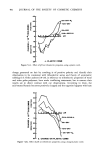
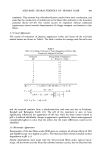
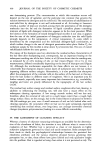
400 JOURNAL OF THE SOCIETY OF COSMETIC CHEMISTS These results may be considered to be consistent with the numerous observations made by others on deformational response of wool (15, pp. 56, 57, 131) and on swelling of hair (9, pp. 164, 182). 2.3 Interfiber Friction The effects of HCI and NaOH treatments on inter fiber frictional force (T2) are shown in Figure 6. The against-scale (tip-tip) friction is higher than the with-scale (root-root) 11.0 o II • lO.O ß g.o II ß WET T-T WET R-R DRY T-T %%oo.....- 8.0 ' ' ' ' ' 2 4 7 e 11 pH Figure 6. Effect of pH on inter-fiber friction. friction and wet friction is higher than the dry friction, as expected the former represents the directional frictional effect and the latter arises from lateral swelling of the wet fiber. Similar observations are recorded in the literature in reference to wool (10, p. 28) and hair (9, pp. 185-187). There is some evidence of increase in friction by treatment at pH 11 and a minimum in the vicinity of pH 7. The alleged astringent effects of acid pH on hair finds little support in the data. 2.4 Triboelectric Behavior The effects of HCI and NaOH treatments on triboelectric behavior are shown in Figures 7(a)-7(d). Several inferences may be drawn from these results: a. The polarity and magnitude of triboelectric charge on hair show definite depen- dence on pH. The acid-treated hair acquires excessive negative charge in every instance. There exists a tendency for the charge to gradually change from a large negative value to a large positive value with increasing pH. The polarity switches from negative to positive in the vicinity of pH 8. b. The method of drying seems to have no influence on the charge-pH relationship. c. Preconditioning the tresses at 65% RH reduces the magnitude of the charge as
Purchased for the exclusive use of nofirst nolast (unknown)
From: SCC Media Library & Resource Center (library.scconline.org)