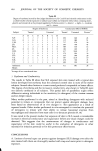
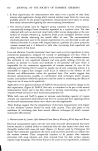
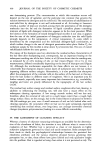
446 JOURNAL OF THE SOCIETY OF COSMETIC CHEMISTS Table III Identification of PAHs in Hair Extracts by Elution Order Relative Retention Times • PAH in order of elution Standard mixture (from Table I) (triplicate) #1 Extracts 2 //2 //3 //4 fluorene 0.18-0.19 -- phenathrene 0.19-0.22 -- anthracene 0.29-0.31 0.29 fluoranthene 0.36 -- pyrene -- 0.61 benzo(mno)fluoranthene 0.73 -- triphenylene 1.00 -- benz(a)anthracene 1.26-1.28 -- chrysene -- 1.54 naphthacene -- 2.11 benzo(k)fluoranthene 2.60-2.71 -- benzo(e)pyrene 3.28-3.39 -- perylene 4.30-4.39 -- benzo(a)pyrene -- -- benzo(ghi)perylene -- -- dibenz(ah)anthracene -- -- 0.22 -- -- -- -- __ 0.60 -- -- -- -- __ -- -- 1.55 1.55 2.11 -- __ __ -- -- ¾eak retention time/benz(a)anthracene retention time. 2//1 hexane-Soxhlet extraction of hair from New York. //2 hexane-ultrasonic extraction of same sample as//1. //3 dichloromethane-ultrasonic extraction of same sample as//1. //4 dichloromethan-ultrasonic extraction of deMeo hair. III. CLEANING HAIR WITH DETERGENT SOLUTION (SHAMPOOS) In essence, the removal of soil from hair is governed by the same basic processes that had been previously identified as being responsible for detergency (18). For fluid oily soils the main cleansing forces are the surface tension gradients that bring about the roll-up mechanism (Figure 9). The conditions during hair washing are very different, however, from those encountered in laundering of textile fabrics, notably only short times are available for the washing operation at low temperatures. Under these conditions, the rheological properties of the soil will become important, especially if the intervals between shampooings are several days and the soil on hair also contains substantial amounts of particulate soil. The lypolisis of triglycerides, of wax and cholesterol esters, the crystallization, the oxidation, processes and the embedment of particulate matter from the environment into the soil, are all processes that will decrease the fluidity of the originally oily sebum and will, therefore increase its resistance against being "rolled up" by capillary forces. Hair sebum aged by exposure to the environment for one to two days probably can be regarded more as a solid rather than an oily soil, since it is "... not deformable within a period of time, that is short relative to the duration of the washing process, by its own surface forces or by a combination of surface forces and the mechanical force put into the system by agitation" (18). Our knowledge of the mechanism of removal semi-solid, waxy soils from rough surfaces, such as hair cuticles represent (Figure 10), is very scanty. The few available experimental data suggest that different detergents do not roll-up aged sebum but rather remove the various components of soil to varying degrees. The

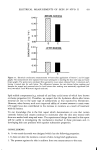
CLEANING OF HAIR 447 Figure 9. Micrographs of a soiled fiber immersed in surfactant solution at various time intervals. (Reproduced by permission form Unilever Educational Booklet--Surface Activity, by R.J. Taylor general Editor, Elizabeth McHeath. removal efficacy of these components appears to depend on the level of crystallization and the pre-history of the sebum. Gloor, et al. (19) found that a surfactant mixture consisting of 70% Texapon TH © and 10% Softique 767 © removes considerably more triglycerides than free fatty acids from the skin surface. In a careful and comprehensive study using favorable washing conditio•os (e.g. cotton fabrics, 50øC and a heavy duty
Purchased for the exclusive use of nofirst nolast (unknown)
From: SCC Media Library & Resource Center (library.scconline.org)