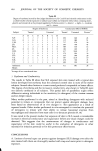
418 JOURNAL OF THE SOCIETY OF COSMETIC CHEMISTS Table III Degree of erythema (scored by four judges identified as A, B, C and D) and electrial conductance in skin as observed after several exposures to sodium lauryl sulfate and treatment with a lotion containing water, glycerin and mineral oil as the principal ingredients. Erythema scores: 0 = absent, 1 = slight, 2 = moderate and 3 = severe. Degree of Erythema Conductance (Micro MHOS) Subject Treated Untreated Treated Untreated Pre-test • A B C D A B C D N.P. 2 2 2 2 3 3 3 3 650 690 26 G.G. 0 1 0 1 3 2 3 2 115 980 55 V.M. 1 2 1 1 3 2 3 3 717 670 20 J.R. 2 2 1 2 3 3 2 3 305 700 45 M.D. 1 1 2 2 0 1 1 0 588 638 16 J.S. 0 0 0 1 0 0 1 0 184 420 24 H.M. 2 1 2 1 3 3 3 3 427 1610 27 c.J. 1 2 1 0 2 3 2 2 279 954 29 E.O. 1 1 1 0 3 3 2 3 326 940 20 V.S. 2 2 1 1 3 3 2 3 307 1110 19 R.K. -- ....... 470 749 25 V.F. 2 2 2 1 2 3 3 3 699 659 24 Arithmetic 1.3 2.3 422 843 28 Means •Average of two contralateral sites. 5. Erythema and Conductivity The results in Table III show that SLS exposed skin sites treated with a typical skin lotion developed less erythema than the untreated control sites in most of the twelve subjects. Several other lotions or creams tested produced comparable or better effects. The degree of erythema and the increase in conductivity, also shown in Table III, were not directly correlated in all subjects. This partial lack of parallelism might reflect differences among individuals in the sensitivity (to detergent) of the stratum corneum and/or deeper tissues. Many studies performed in the past, aimed at identifying detergents with reduced potential to irritate or compounds that can protect against detergent damage, have been based on observations of in vivo changes in skin appearance as a result of repeated insults. Other studies performed in vitro attempted to correlate the potential of detergents to irritate with their ability to release lysosomal enzymes from macrophages and histamine from mast cells or to denature proteins (8, 10). It was noted in the present studies that exposure of skin to SLS caused a considerable increase in electrical conductance and capacitance before any visual changes could be detected. This suggests that the measurement of changes in conductance and capacitance of the skin could be useful in the evaluation of detergents or other materials for irritation potential or for skin protectant effectiveness. CONCLUSIONS A. Lotions of several types can protect against detergent (SLS) damage even after the sites treated with them are thoroughly washed with soap and water prior to detergent exposure.

ELECTRICAL MEASUREMENTS OF SKIN IN VIVO.' I 419 B. Conductance and capacitance measurements can be useful for monitoring the progression of damage and healing in skin after detergent insult. ACKNOWLEDGEMENT The authors wish to thank Dr. George Cohen, Manager of the Physical Chemistry Department, Bristol-Myers Products, Hillside, NJ and Mr. Alexander Szabo of Pitney Bowes Inc., Stamford, Conn. for their technical advice. REFERENCES (1) F. A. J. Thiele and K. E. Malten, Some measuring methods for the evaluation of orthoergic dermatitis, Arch. Belg. Dermatol., 28, 23-46 (1973). (2) A. G. Matoltsy, A. Schragger and M. N. Matoltsy, Observation on regeneration of the skin barrier,J. Invest. Dermatol., 38, 251 (1%2). (3) J. E. Wahleberg, Impairment of skin barrier function by depilatories, J. Invest. Dermatol., 59, 160 (1972). (4) S. Monash and H. Blank, Location and formation of the epithelial barrier to water vapor, Arch. Dermatol. (Chicago), 78, 710 (1958). (5) K. E. Malten and F. A.J. Thiele, Some theoretical aspects of orthoergic (=irritant) dermatitis, Arch. Belg. Dermatol. 28, 9-22 (1973). (6) D. T. Rovee, C. A. Kurowsky and J. Labun, Local wound environment and epidermal healing, Arch. Dermatol., 106, 330 (1972). (7) G. P. Serban, S. M. Henry, V. F. Cotty and A.D. Marcus. In vivo evaluation of skin lotions by electrical capacitance. II. Evaluation of moisturized skin using an improved dry electrode, J. Soc. Cosmet. Chem., 32,421 (1981). (8) G. Imokawa. Comparative Study on the mechanism of irritation by sulfate and phosphate type anionic surfacants,J. Soc. Cosmet. Chem., 31, 45-66 (1980). (9) G. Imokawa and T. Takuchi, Surfactants and skin roughness, Cosmet. Toilet., 91, 32-46 (1976). (10) C. Prottey and T. Ferguson, Factors which determine the skin irritation potential of soaps and detergents,J. Soc. Cosmet. Chem., 26, 29-46 (1975).
Purchased for the exclusive use of nofirst nolast (unknown)
From: SCC Media Library & Resource Center (library.scconline.org)