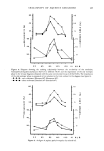
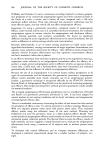
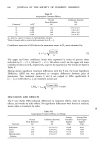
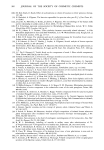
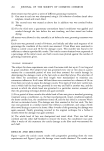
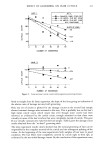
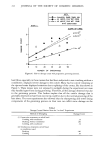
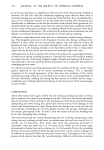
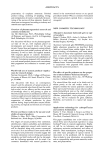
166 JOURNAL OF THE SOCIETY OF COSMETIC CHEMISTS 60 1 5 .•. 40 .•1'" "'•. ..... • .... ß 1 0 • • 20 5 •: ß -' 60_ _15 u. 40 2O _1o I I I I i i I i i i 4,5 6,5 8,5 10,5 12,5 1 5 H.L. el. Figure 10. As figure 8 replace perhydrosqualen by sweet almond oil. 60 • 15 /\ 40 p ..... • 1 0 20 : 5 60 1 5 - _ 40 _10 . 20 [ [ I I • [ I I I I 4,5 6,5 8,5 10,5 12,5 1 5 H.L.B. Figure 11. As figure 8 replace perhydrosqualen by Miglyo! 812 ©.

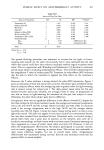
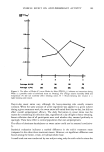
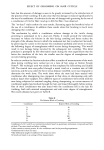
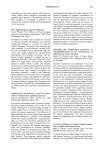
OCCLUSIVITY OF AQUEOUS EMULSIONS 167 corresponding to the isotropic oil phase are comparable to those obtained with the emulsions, there exists thus a direct correlation between the occlusive capacity of an O/W emulsion applied to the surface on the gelatin and that of the corresponding oily isotropic phase. For the emulsions studied, occlusivity was maximal for a given HLB value. The values of this HLB are depending on the nature of the oils and surfactants. However this optimal HLB corresponds to the ternary phase diagram in which the surface of the isotropic oil phase was the greatest. The extent of this phase in a diagram is linked to the facility of micelie formation. As described by Adrangui et al. (1979) there is an optimal HLB for each oil in which the organization of the two surfactants makes easier water miscibility (11). At this HLB, after evaporation of emulsion water, the formation of inverse miscelles is easiest. In these conditions isotropic oily phase forms easily on the gelatin. Isotropic oily phase presents a great resistivity because oil is the continuous phase producing occlusivity. For other HLB this phase appears with difficulty and occlusivity decreases. REFERENCES (1) I. H. Blank, Factors which influence the water content of the skin, J. Invest. Dermatol., 18, 433-440 (1952). (2) I. H. Blank, Further observations on factors which influence the water content of the stratum corneum, J. Invest. Dermatol., 21,259-269 (1953). (3) L. Gaul and G. B. Underwood, Relation of dew point and barometric pressure to chapping of normal skin, J. Invest. Dermatol., 19, 9-19 (1952). (4) G. Barnett, Emollient creams and lotions, in "Cosmeth Science and Technology" 2nd ed., M. S. Balsam and E. Sagafin, Eds. (Wiley-Interscience: New York, 1972), Vol. 2, pp 27-104. (5) J. B. Shelmire, The influence of oil-in-water emulsions on the hydration of keratin,J. Invest. Dermatol., 26, 105-108 (1956). (6) R. M. Handjani-Vila, B. Rondot and F. La Champt, Perspiratio insensibilis control by specific associations of lipids, Cosmet. Perfum., 90, 39-41 (1975). (7) R. M. Handjani-Vila, B. Rondot and F. La Champt, Measurement of the moisturizing effect, Cosmet. Toilet., 91, 25-30 (1976). (8) M. Adrangui, F. Puisieux, M. Seiller, E. Morszanyi, A.M. Orecchioni, Diagrammes eau-surfactif-huile i base de perhydrosqual•ne et de Miglyol 812 ©, Pharm. Acta. Helv., 54, 214-219 (1979). (9) D. Schwartz, M•thodes statistiques i l'usage des m•decins et des biologistes, Eds. Flammarion, Paris 1963 pp 181-183. (10) H. Tsutsumi, T. Utsugi and S. Hayashi, Study on the occlusivity of oil films,J. Soc. Cosmet. Chem., 30, 345-356 (1979). (11) I. Lo, F. Madsen, A. T. Florence,J. P. Tr&guier, M. Seiller and F. Puisieux, Mixed non-ionic detergent systems in aqueous and non-aqueous solvents, in "Micellization, solubilization and microemulsions," K. L. Mittal Eds., vol. 1 pp 455-466.
Purchased for the exclusive use of nofirst nolast (unknown)
From: SCC Media Library & Resource Center (library.scconline.org)