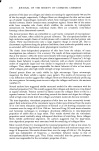
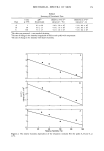
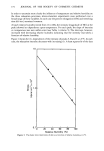
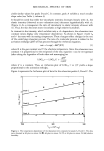
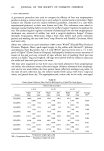
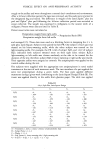
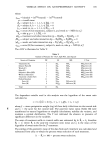
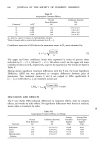
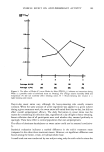
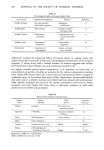
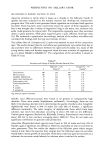
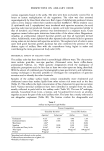
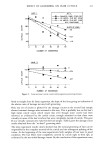
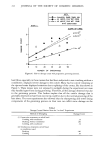
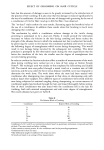
MECHANICAL SPECTRA OF SKIN 177 shearing of the mucopolysaccharide-water gel is responsible for the relaxation peaks B and C. Peaks B and C have similar thermal and relative humidity dependencies. In all spectra obtained however, separate relaxation peaks were observed, strongly suggestive of the existence of two separate relaxation processes. Recall that results obtained with hyaluronic acid-water gels suggested that shearing results in disruptions of hydrogen bonds (14). Mucopolysaccharides contain a number of different sites capable of hydrogen bonding (15). Thus, the relaxation processes responsible for peaks B and C could conceivably reflect the disruption of hydrogen bonds at different sites. The thermoelastic behavior of these skin samples at high r.h. (16) and the value of the elastic modulus obtained (--• 10 6 dyne/cm 2) is very similar to purified elastin. Thus, it is reasonable to propose that low-strain stretching of skin results in the elongation of elastin fibers, in agreement with results cited above. Taken together the results suggest a low-strain viscoelastic model of skin. The model proposed consists of a series of Voigt viscoelastic elements (13) (springs and dashpots in parallel) in which elastin corresponds to the elastic spring and the mucopolysaccha- ride-water gel to the viscous dashpot. In unstrained skin, collagen fibers are only partially aligned. With increasing strain the fibers further align and then at higher strains, stretching occurs. Thus, in this low-strain model, collagen does not bear stress. According to the model, stretching results in the elongation of elastin and displace- ment of the fibers relative to the gel which in turn results in shearing of the intrafibrilar gel matrix. The viscoelastic model is shown schematically in Figure 5. [ J )•ollagen L I Hydrated Viscoelastic Domain Figure 5. A schematic diagram of the proposed model of the viscoelastic behavior of skin. Mathematically the relaxation peaks may be approximated by k exp-t(k/r/), where k is the spring constant, •/the dashpot viscosity and t the real time (13). The time constant r is the ratio of the viscosity to spring constant. Thus, the relaxation intensity is a measure of k and r a measure of 0//k). The experimental lack of variation in r with relative humidity may be explained by several alternative hypotheses. (1) Neither •/or k change with relative humidity. (2) The viscosity and spring constant increase identically with relative humidity. (3) Viscoelastic response occurs only within "domains," the number of which decreases with decreasing relative humidity. Each water-rich, viscoelastic "domain" is characterized by constant •/and k values. Outside of the "domain" there is no viscous element (i.e. no gel) and only k increases with decreasing relative humidity. The first case can be ruled out since the absence of changes in •/and k would imply that both r and the intensity were unchanged with relative humidity, clearly in conflict with

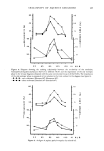
178 JOURNAL OF THE SOCIETY OF COSMETIC CHEMISTS the results of Figure 2. In the remaining two instances the intensity would increase while r remained constant as required by the experimental results. Only in the latter instance however, would the relative humidity dependencies of the elastic and viscoelastic intensities differ, as suggested by the results shown in Figures 2 and 3. Thus, the results suggest that viscoelastic "domains" occur in skin when sufficient water is present to insure that the protein fibers are surrounded by a mucopolysaccha- ride-water gel. As water is removed the gel dissappears and hence, the number of viscoelastic "domains" are decreased. In conclusion, the results suggest that the viscoelastic response of skin at low-strain results from shearing of the mucopolysaccharide-water gel. The shearing force results from the movement of elastin fibers relative to the gel and is confined to hydrated "domains" whose number decreases with relative humidity. Outside of these "domains" the low-strain mechanical properties of skin are governed by elastin alone. REFERENCES (1) G. L. Wilkes, I. A. Brown and R. H. Wildnauer, The biomechanical properties of skin, in CRoe Critical Reviews in Bioengineering (CRC Press, Cleveland, 1973), pp 453-495. (2) R. D. B. Fraser and T. P. MacRae, Molecular structure and mechanical properties of keratins, in Society for Experimental Biology Symposia XXXIV, The Mechanical Properties of Biological Materials, J. F. V. Vincent andJ. D. Curry, Ed. (London, 1980), pp 211-246. (3) J. C. W. Chien, Solid-state characterization of the structure and property of collagen, J. Macromol. Sci-Revs. Macromol. Chem. C12, 1-80 (1975). (4) A. Berg, Z. Eckmayer and S. Smith, Elastin, Cosmetics & Toiletties, 94, 23-38 (1979). (5) T. C. Laurent, Structure of Hyaluronic Acid, in Chemistry and Molecular Biology of the Intracellular Matrix, E. A. Balazs, Ed. (Academic Press, New York, 1970), pp 703-732. (6) L. Roden, Structure and metabolism of the proteoglycans of chondroitin sulfates and keratin sulfate, Ibid, pp 797-821. (7) J. Diamant, A. Keller, E. Baer, M. Litt and R. G. C. Arridge, Collagen: Ultrastructure and its relation to mechanical properties as a function of aging, Proc. R. Soc. Lond. B., 180, 293-315 (1972). (8) Y. Lanir, A structural theory for the homogeneous biaxial stress-strain relationship in flat collagenous tissues,J. Biomech., 12, 423-436 (1979). (9) R. M. Kenedi, T. Gibson, C. H. Daly and M. Abrahams, Biomechanical characteristics of human skin and costal cartilage, Fed. Proc., 25, 1086-1087 (1966). (10) Y. Lanir and Y. C. Fung, Two-dimensional mechanical properties of rabbit skin. II. Experimental results,J. Biomed., 7, 171-182 (1974). (11) J. B. Finlay, Thixotropy in human skin,J. Biomech., 11,333-342 (1978). (12) R. Potts and M. M. Breuer, The mechanical spectrum of skin. I. The experimental technique and measurement at room temperature,J. Soc. Cos. Chem., 32, 339-353 (1981). (13) J. D. Ferry, The Viscoelastic Properties of Polymers, (J. Wiley & Sons, New York, 1980). (14) D. A. Gibbs, E. D. Merrill and K. A. Smith, Rheology of Hyaluronic Acid, Biopolymers, 6, 777-791 (1968). (15) C.J. Hooley, N. G. McCrum and R. E. Cohen, The viscoelastic deformation of tendon, J. Biomech., 15,521-528 (1980). (16) R. Potts and M. M. Breuer, unpublished results.
Purchased for the exclusive use of nofirst nolast (unknown)
From: SCC Media Library & Resource Center (library.scconline.org)