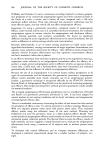
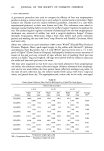
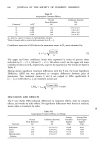
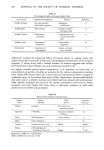
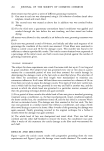
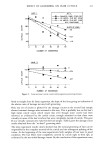
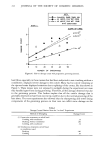
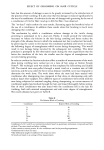
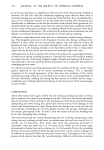
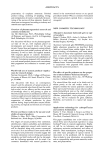
196 JOURNAL OF THE SOCIETY OF COSMETIC CHEMISTS Table II Psychological Studies on Human Axillary Odor Odor Source Experimental Approach Results Reference Axillae (T-shirts) Sex discrimination Distinguish 12 Individual recognition male/female Axillae (pads) Rate intensity Intensity correlates 13 with male odors Axillae (T-shirts) Interpersonal Unpleasantness with 37 perception socially undesirable traits Aliphatic acids Assessment of Odors modify 16 people test judgments Androstenol Assessment of women--attractive 17 photographs men--friendlier objectively evaluate the behavioral effects of human odors, i.e. axillary odors, will require the proper emotional setting and a physiological measurement of the subjects response. A recent study with a limited number of subjects suggests that axillary secretions from a donor female can cause menstrual synchrony (15). As regards possible psycho-sexual implications, it is important to know that an extraordinary proportion of adults are anosmic for the various components of axillary odor. About 40% cannot detect the urinous odor of androstenone which is judged as unpleasant more so by women than men (19,20a). Surprisingly, women preferentially also used a seat in a dentist's waiting room which had been sprayed with androstenone (20b). Specific anosmias also exist for the musky androstenol (12%) and the sweaty isovaleric acid (3%) (Table III). Thus there is individual variation in both odor production (see below) and perception. Table III Primary Odors Related to Human Odors Primary Primary Od or Anosmia Odor Odorant Source (percent) Sweaty Isovaleric Skin bacteria on 3 Apocrine secretion Spermous 1-Pyrroline Enzymatic oxidation 16 of Semen Fishy Trimethylamine Uremic breath 6 Malty Isobutyraldehyde -- 36 Urinous 5ce-Androst-16-en-3-one Axillae 49(36)* Musky c0-Pentadecalactone -- 12 5c•-Androst-16-en-3-ol Axillae 12 (6)* *Reported sex difference--male (female) [Table modified from Amoore, ref. 38]

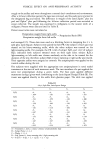
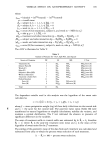
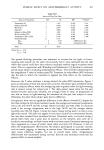
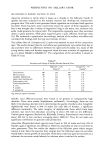
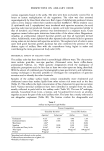
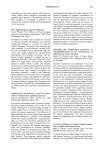
PERSPECTIVES ON AXILLARY ODOR 197 RELATIONSHIP OF RESIDENT BACTERIA TO ODOR Apocrine secretion is sterile when it issues as a droplet at the follicular mouth. It quickly becomes colonized by the resident bacteria and develops the characteristic pungent odor. This odor is also generated when organisms are incubated with apocrine secretion. There has been some controversy about the nature of these organisms. At first it was thought that a variety of organisms living in the warm, wet, secretion rich axilla could generate the typical odor. The responsible organisms were then narrowed down to gram positives, while gram negatives gave a quite different, fetid-type odor (21). We undertook a quantitative bacteriologic analysis of the axillary microflora and correlated the findings with the type and intensity of odor. The axillary flora of 12 females and 12 males was assessed on each of five consecutive days. The results showed that the microflora was quantitatively very stable from day to day and there were no differences between the right and left axillae. In a study of 200 young adults, males and females supported about the same numbers of organisms per sq. cm. about 500,000 to 800,000/cm 2. The composition of the microflora is shown in Table IV (22a). Table IV Prevalence and Density of Axillary Resident Bacterial Flora Males (N = 128) Females (N = 77) % Density* % Density* Total Aerobes 100 5.84 100 5.95 Micrococcaceae 100 5.51 100 5.56 Lipophilic diphtheroids 85 5.40 66 5.36 Large colony diphtheroids 26 4.43 25 4.57 Gram negative rods 20 3.36 19 3.32 Total Propionibacteria 70 3.71 47 4.23 P. aches 47 3.86 30 4.26 P. avidurn 34 3.62 21 4.18 P. granulosum 8 3.61 5 3.65 *log mean per square centimeter Aerobic cocci (Micrococcaceae) were found in all persons at comparatively high densities. These were mainly Staphylococcus epidermidis. Accordingly, these are not likely to be playing a decisive role in determining the quality of axillary odor. Lipophilic diphtheroids were found in 85% of males but only 66% of females, a significant difference statistically. The other category of diphtheroids, those which form large colonies, was much less abundant, occurring in about 25% with no sex difference. Various gram negatives (Escherichia, Klebsiella, Proteus, Enterobacter) were found in about 20% but in low numbers, averaging about 1000/cm 2. They do not make any significant contribution to apocrine odor production. Anaerobes (Propionibacterium species) were found in 70% of males and only 47% of females, again a significant sex difference. However, anaerobes are also not involved in odor generation. They live within the depths of the follicular pores where oxygen tension is low. Since the apocrine duct empties into the follicular canal, the secretion would bathe a dense growth of anaerobes. If the latter could use apocrine secretion as a substrate, the secretion would already be odorous when it reached the surface.
Purchased for the exclusive use of nofirst nolast (unknown)
From: SCC Media Library & Resource Center (library.scconline.org)