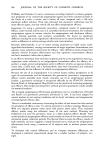
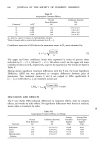
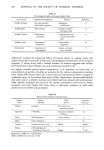
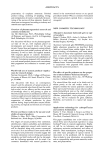
194 JOURNAL OF THE SOCIETY OF COSMETIC CHEMISTS Table I Mammalian Scent Glands Gland Mammal [apocrine-se baceous] Odorant Reference Rabbit "odor" anal/apocrine cis-undeo4-enal 29 Beaver castor castoramine 30 Elephant temporal/apocrine 31 Deer interdigital short-chain-acids 32, 33 subauricular isovaleric acid 34 tarsal aldehydes 35 Musk deer sebaceous muscone 27 Human apocrine bacterial action -- on secretion Marmoset monkey circumgenital butyrate esters of 36 long chain alcohols Bactrian camel occipital isovaleric acid 45 androst-16-en-3-one erous chemicals in axillary odor and understanding the factors which control their generation. ODOR ANALYSIS The present interest in the characterization of human odors has paralleled the development of sophisticated analytical techniques, primarily combined gas chroma- tography/mass spectrometry (gc/ms), which have made it possible to routinely separate and identify submicrogram quantities of organic compounds. Total body volatiles have been sampled by placing individuals in glass tubes and sweeping with air to concentrate the odors (3). A telephone booth-like chamber was also used to sample human volatiles and over 100 chemicals were identified (4). These experiments examined the possibility that body odors might be unique enough to serve as personal signatures. Techniques for the concentration of vaginal, oral, skin and axillary odors have also been developed (3,5). In addition, devices have been made for monitoring skin volatiles for mosquito attractants (6). The sampling and identification of volatiles from different body sites and their application for the diagnosis of disease has recently been reviewed (7). Our approach to the study of skin odors has been to duplicate the natural odors in vitro by incubating the resident bacteria with the appropriate skin secretion. The contribu- tion of the scalp yeast, Pityrosporum ovale, to scalp odor has been determined by this approach (8). GENERAL BIOLOGY: It has long been appreciated that axillary odor is traceable to the apocrine glands which are attached to hair follicles (9). Apocrine glands are larger and more numerous in the axilla than anywhere else indeed, except for the axilla, pubic area, and ear canal they are mere vestiges in humans. Apocrine glands, like sebaceous glands, are under androgen

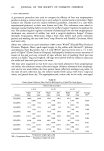
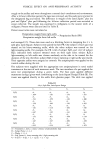
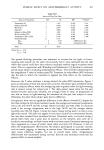
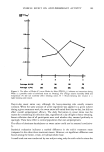
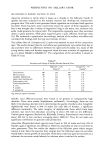
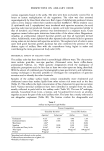
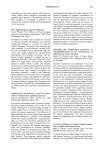
PERSPECTIVES ON AXILLARY ODOR 195 control. They do not function before puberty and gradually regress in old age, reflecting the blood level of testosterone. Males have larger and more numerous apocrine glands than females and as a whole have higher odor levels. The secretory coil of the apocrine gland is considerably larger than the eccrine sweat gland and produces its product continuously. Despite this, the amount of apocrine secretion made daily is miniscular, less than 1 ul in the whole axillary organ. Microdroplets of milky apocrine secretion can be made to appear at the follicular orifices by stimuli which cause contraction of the myoepithelium, the smooth muscle sheath surrounding the long, capacious ducts. Experimentally, injection of epinephrine will squeeze pre-formed sweat to the surface. Strong emotions have the same effect. Still, the sudden appearance of apocrine droplets does not result in a wave of pungent odor. The secretion is odorless and sterile when it first emerges through the follicular opening. The axillary odor is generated by the action of resident bacteria living on the surface. It is surprising how little we know about this odor and its effects on human behavior. Comfort suggested that it might communicate sexual and social messages (10). From antiquity come stories suggesting that it is a sexual stimulant, a signal of virility to receptive females (11). In modern, Western cultures axillary odor has only negative connotations. When presented to uninstructed females, it is uniformly regarded as offensive and disagreeable. The unacceptability of body odor in properly groomed individuals may reflect training and cultural influences since there is some evidence that in poorer, less developed countries it is viewed very differently, perhaps according to the original design as a positive sexual message. Published studies indicate that when presented with three odorous T-shirts, individuals can discriminate odors of the shirts on the basis of sex. They can also distinguish their own odor (12). Another study, using cotton pads worn overnight in the axilla, found a positive correlation of odor intensity with male subjects (13). Couples wearing T-shirts were subsequently asked to identify their own shirt, their partners and to rate the pleasantness of the odors. Approximately one-third were able to identify their own odor and that of their partner and distinguish male/female differences. Female odors were more often judged as pleasant in contrast to male odors (14). Aliphatic acids and androstenol because of their possible relation to human vaginal and axillary odors have also been evaluated. Female subjects applied a mixture of aliphatic acids to their chests prior to retiring. No differences in the amount of sexual activity were found between this group and a control group which used either alcohol, water or a perfume (15). In another study, female subjects were asked to wear face masks impregnated with either the acids or androstenol while judging the suitability of males for a specified job. The male candidates were rated more favorably in the presence of androstenol while aliphatic acids reversed their ratings (16). In a further study of androstenol also using face masks, subjects were asked to rate photographs of people on a bipolar scale--unsexy-sexy, cold-warm, etc. Photographs of women were judged sexually more attractive in the presence of androstenol by both men and women (17). The results of psychological studies are summarized in Table II. These studies deal with subjective opinions on a compound, androstenol, which has a sexual connotation, i.e., a sexy perfume contains musk. In addition, as with animal bioassays, it is necessary to present the stimulus in the proper context. Thus a study to
Purchased for the exclusive use of nofirst nolast (unknown)
From: SCC Media Library & Resource Center (library.scconline.org)