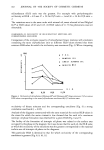
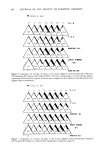
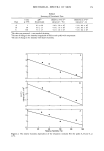
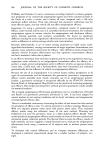
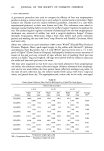
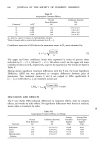
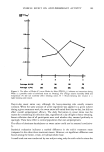
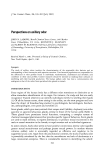
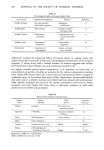
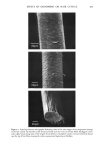
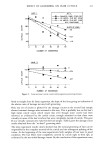
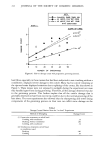
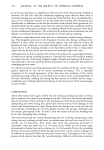
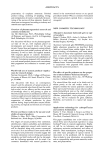
212 JOURNAL OF THE SOCIETY OF COSMETIC CHEMISTS HAIR 1. KEY • SHAMPOO, RINSE• TOWEL DRY ---..•...-- AS ABOVEz PLUS WET COMB --•-- AS ABOVE,, PLUS WET COMB WITH CONDITIONER SLOPE OF LINE.5: t I i I I 0 10 20 30 40 50 -2 •.0 x-10 -2 2./., x 10 NUMBER Of GROOMINGS Figure 6. Side-on damage count with progressive grooming (tresses). hair fibres, especially in those tresses that had been subjected to wet-combing without a conditioner, displayed severe damage to the cuticle. Many had no cuticle remaining at the tips and some displayed striations due to splitting of the cortex, like that shown in Figure 3. These tresses were not exposed to sunlight during the experiment nor were they handled apart from during grooming. Therefore, all the damage observed was due to the grooming process. This further implies that all the cuticle damage that is generally observed on hair from root to tip could be due to the normal grooming of the hair alone. The tress experiments also showed that the shampooing and towel drying components of the grooming process on their own can inflict some damage on the Table I Damage Counts Obtained from the "on-head" Experiments Method of Detangling Damage Count (i) Consecutive treatments on whole head: Combing, with conditioner Brushing, without conditioner Combing, with conditioner (ii) Simultaneous treatments on half head, no conditioner used: Brushing Combing .16 1.86 .29 2.06 .58

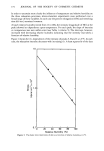
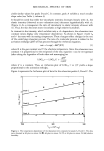
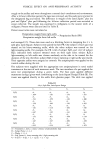
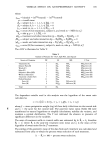
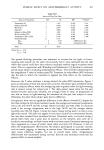
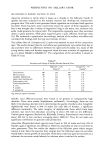
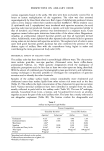
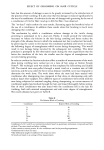
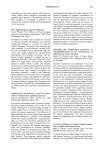
EFFECT OF GROOMING ON HAIR CUTICLE 213 hair, but the amount of damage is seen to be greatly increased by the introduction of the process of wet-combing. It is also clear that this damage is reduced significantly by the use of a conditioner. A reduction in the rate of damage with grooming by the use of a conditioner of 13% for Hair 1 and up to 82% for Hair 2 was observed. The "on-head" trials confirm the tress results, illustrating again the beneficial value of the use of a conditioner. In addition these results show that brushing is much more damaging than combing. The mechanism by which a conditioner reduces damage to the cuticle during grooming is postulated to be a dual one. Firstly, it would provide the lubrication necessary to reduce the friction in the hair during combing and hence reduce the strength of the abrasive forces to which the weakened wet hair is subjected. Secondly, by preserving the cuticle in this manner the conditioner probably also serves to reduce the following degree of entanglement which occurs during shampooing. This would result in less damage being incurred by the subsequent wet combing. This latter postulate is prompted by the observation made during the tress experiments that the better the condition of the hair, the smaller was the degree of entanglement that occurred during grooming. In order to confirm the friction reduction effect a number of measurements of the work done during combing were carried out on a tress of hair using an Instron Tensile Tester ©. The technique used was similar to that employed by Schoenberg and Scafidi (10). The treated tress was pulled through a metal comb at a constant rate of 1000 mm/min, and the area under the force versus distance travelled curve was integrated to determine the work done. The work done when the tress had been treated with conditioner after shampooing was compared to that done on shampooing only with sodium lauryl ether sulphate. Four different types of conditioners were tested with the tress being subjected to minimal tangling during shampooing, an excess amount of conditioner applied and worked through the hair, and rinsed thoroughly before testing. One of these conditioners was also tested with the conditioner left in the hair for combing, both with minimal entanglement and with some degree of entanglement. The results obtained are given in Table II. Table II The Relative Work of Combing Conditioner Relative Work of Combing A 28 B 29 C 27 D 35 None 100 B 46* B 77** Conditioners A, B, C and D are commercial products based on quarternary ammonium compounds and fatty alcohols. They were rinsed out before combing. A also contains a cationic protein. It is the conditioner used in the preceding experiments. *Conditioner left in hair (no rinse) *Hair deliberately tangled. Conditioner left in hair (no rinse) All results are based on an average of four measurements.
Purchased for the exclusive use of nofirst nolast (unknown)
From: SCC Media Library & Resource Center (library.scconline.org)