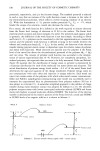
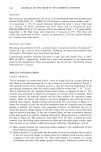
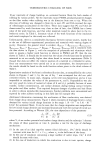
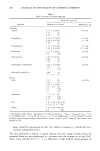
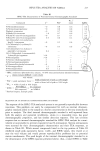
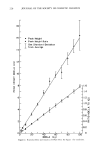
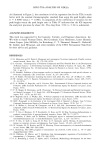
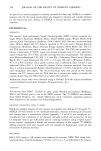
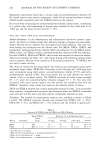
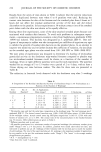
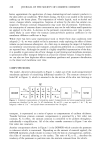
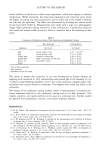
198 JOURNAL OF THE SOCIETY OF COSMETIC CHEMISTS Table I Work Functions of Various Materials Material Work Function (eV) Measured in Vacuum Measured in Air Polymers Teflon © Polyethylene Polypropylene Polystyrene Polycarbonate Poly(methyl methacrylate) Polyamide (nylon©6,6) Metals Gold Aluminum 6.71 +- 0.28 (8) 5.75 (2) 4.26 (4) 5.24 -+ 0.24 (8) • 6.04 +_ 0.47 (8) 2 4.90 (2) 5.43 - 0.16 (8) • 5.49 -+ 0.34 (8) 2 4.77 +_ 0.20 (8) 4.8 (24) 3 3.85 +- 0.82 (8) 4.80 (2) 4.26 (4) 4.30 +- 0.29 (8) 4 4.70 (2) 4.1 (24) 3 4.08 (4) 4.3 - 4.5 (2) 5.2 (8) 5.45 (27) 5.30 - 5.38 (8) 5 4.0 - 4.9 (8) 5 4.3 (26) 5.1 (25) 3.7 +- 0.2 (8) 3.38 (28) 4.25 (28) Iron 3.91, 3.92, 4.62, 4.68 4.70, 4.72, 4.77 (28) Nickel 3.67, 4.06, 4.87 (28) 4.5 (26) 1.03 (8) 4.8 (8) • 7.2 (8) 2 9.1 (8) • (37.2) (8) 2 7.45 (8) 4.40 (8) 2.90 (8) 4 4.46 (28) • Low density 2high density 3calculated as the centroid energy E = (E d .... d- E .... ptor)/2, Ed .... = 6.1 eV for PMMAand 7.1 eV for PS andE .... ptor = 2.0 eV for PMMAand 2.5 eV for PS found in metal/ polymer contact-charge-exchange measurements 4termed "acrylic" in (8) 5range for the literature data quoted by (26). decay should be exponential so that 1/t• dt•/dt is constant (t•/2 should also be a constant independent of The data presented in Figure 4 clearly indicate that the charge density decays for untreated fibers are non-exponential (t•/2 decreases with the increase in cr•) and 1/cr• 2 dt•/dt is not constant for 0 t t•/2. Moreover, a high residual charge remains on

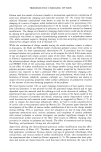
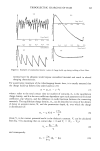
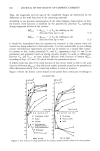
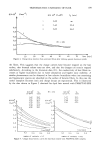
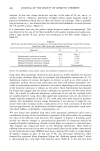
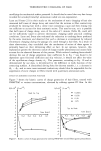
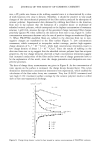
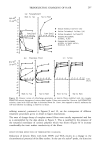
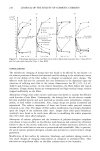
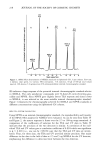
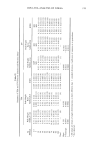
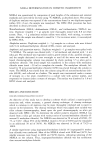
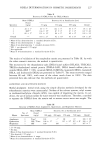
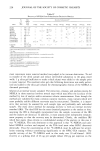
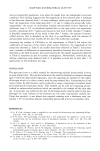
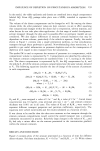
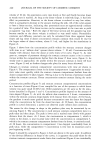
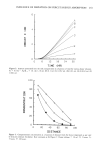
TRIBOELECTRIC CHARGING OF HAIR 199 Q/A'109 (C'cm-2) Q/A 109 (C-eft 2) T« (min) 6.0 5.0 4.0 3.0 2.0 1.0 2 3.62 50.8 3 5.09 26.0 i i ! i i i ! • 10 20 30 40 50 60 70 Time [min] Figure 4. Charge decay kinetics from untreated fibers after rubbing against aluminum probe. the fibers. This suggests that the charge carriers have become trapped on the hair surface, that thermal release rates are slow, and that the charges can remain trapped indefinitely. According to the literature data (21), the conductivity of hair fibers in- creases at higher humidities due to water absorption and higher ionic mobility. A similar phenomenon can be observed at low relative humidities when ion-containing and hygroscopic species are adsorbed on the surface of keratin fibers. In this case the carrier transport becomes ionic and charge decays are exponential. This is illustrated by the data shown in Figure 5 obtained for dyed hair treated with PMAPTAC-SDS Q/A-iO 9 (C, cm -2) 6.0 5.0 4.0 3.0 2.0 1.0 Q/A -109 T« (c.am -2) (see) RH = 23,% 1.62 28.3 2.62 27.8 3.25 26.7 Q/A-109 4.78 27.1 (C/cm- 2) 4.94 27.6 • 5.48 29.7 6.0 6.25 29.7 5.0' 2.0 1.0. ,Time [min•] ß 0 ! i 0.2 0.4 0.6 0.8 number of contacts : 1-7 Q/A -109 (oe.em -2) (Ts•e) 5.57 29.5 6.10 32.3 5.09 42.9 5.41 /43.9 Time [min] i I I I • 0.2 0.4 0.6 0.8 number of contacts : 8-11 Figure 5. Charge decay kinetic curves for dyed hair treated with PMAPTAC-SDS complex.
Purchased for the exclusive use of nofirst nolast (unknown)
From: SCC Media Library & Resource Center (library.scconline.org)