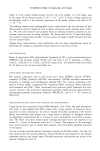
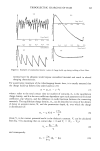
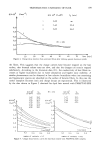
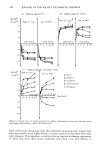
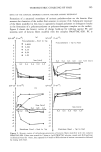
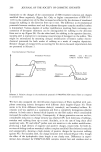
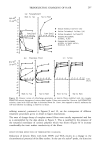
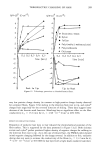
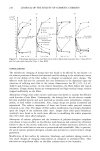
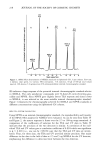
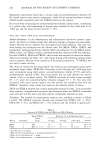
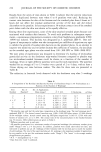
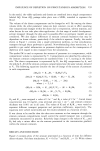
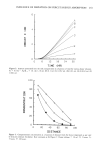
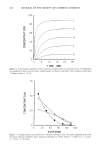
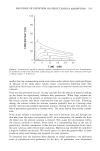
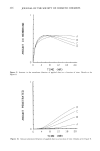
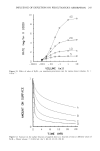
196 JOURNAL OF THE SOCIETY OF COSMETIC CHEMISTS Thus, the magnitude and the sign of the transferred charges are determined by the differences in the work functions of the contacting materials. According to our previous interpretation of the tribe-charging characteristics of hair, the keratin work function is modified by the piezoelectric potential Vpp appearing during tangential friction of the cuticles: oeff. keratin •- 0kerat,n -}- q Vpp for rubbing in the direction from root to tip (11) eft. kerat,n : 4)keratin -- q Vpp for rubbing in the direction from tip to root (12) It should be remembered that the piezoelectric potential is only present when the cuticles are being subjected to frictional stress. It is thus undetectable in non-rubbing contact electrification experiments and will not be present on a relaxed fiber surface. In contrast to this, surface potentials Vs] and Vs2, appearing in Eqs. (1) and (2) are permanent and gradually build up during electron transfer. In order to differentiate .4. eft. between Vpp and Vs•,2, we have defined effective work function of keratin S'k•t.• according to Eqs. (11) and (12) which include the piezoelectric factor. It follows from this that if the work function of the contact probe is close to the work function of keratin (0keratin), this additional surface potential caused by the piezoelectric effect determines which of the contacting surfaces is donor or acceptor. Figure 3 shows the kinetic curves (based on the points from continuous recordings at Q/A el0 9 (C.cm -2) 3 2 1 Time [mini 0 10.2 0.30.40.5 -1 0 Stainless Steel -2 ß Nylon ß Teflon -3 & Poly(methy1 . methacrylate) •4 & Rely(carbonate) -5 ß Chitosan ROOT TO TIP Figure 3. The kinetics of charge generation by rubbing Untreated Hair } •/A-i09 7t (C'cm-2) 6 5. 3' 2 1 ß . 0 0.1 0.2 0.3 0.4 0.5 -1 o Aluminum -2. \ m Polystyrene -3 --5' --6. TIP TO ROOT untreated keratin fibers with various probes.

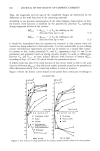
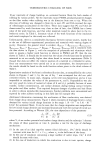
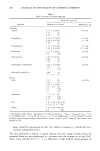
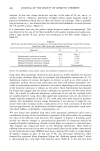
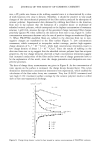
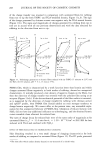
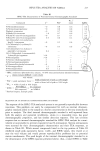
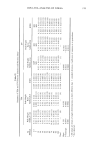
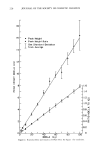
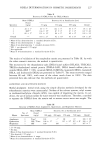
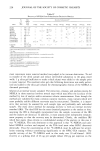
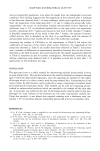
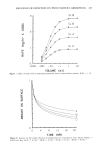
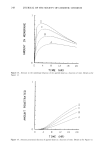
TRIBOELECTRIC CHARGING OF HAIR 197 10-sec intervals) of charge build-up on untreated keratin fibers for both modes of rubbing by various probes. All the materials except PMMA produced positive charges on the fiber surface when rubbing was in the direction from root to rip. When the direction of rubbing was changed to from rip to root, PC and ChA reversed the sign of rribocharges accumulated on the fibers. These data suggest that PC and ChA are characterized by work functions very close to that of hair, that PMMA has a lower value of the work function, and that other materials tested lie above hair in the rri- boelectric series. In Table I, literature values of the work functions of the insulators and metals employed in this study are collected. Unfortunately, there is a considerable discrepancy between various sources, mainly due to the use of different experimental procedures and materials with varying degree of purity. However, the general trend is evident, qbt½•on© 0polyethylene, 0polypropylene, 0polystyrene, 0gold 0polycarbonate 4)PMMA 0polyamide, 0aluminum and is consistent with the data shown in Figure 3, with the exception of polyamide and aluminum which seem to possess a higher work function in relation to PMMA and PC than the one shown in Table I. It should also be noted that the values of work functions for polymers measured in air are usually higher than those found in vacuum experiments (Table I) though that does nor affect the relative position of a material in a rriboelecrric series. Since our measurements were carried our in an air atmosphere, the interpretation of the results should be based on the work function values given in the third column of Table I. Quantitative analysis of the kinetic rriboelecrrificarion data, as exemplified by the curves shown in Figures 2 and 3, by the use of Eq. 7 was attempted but did not yield consistent results. In many cases, charging curves were non-exponential, and so it was impossible to calculate the values of the parameters cr:• and k. Repeatability was also nor very good (in terms of numerical values of k and o-o•), probably because of mass transfer, surface contamination, and surface abrasion during sliding contact between the probe and fiber surface. This required frequent changes of probes and hair fibers in order to obtain reproducible measurements. Similar problems were encountered and reported by other authors working in this field [see for example (8)]. Additional information concerning the mechanism of fiber conductivity was derived from charge decay measurements. Figure 4 shows examples of discharge kinetic curves obtained for various initial charge densities in the range 1.16' 10 -9 to 5.41 ß 10 -9 C/cm 2 for unrreared fibers. It can be seen that the charge migration was insignificant for low initial charge densities and increased dramatically with the increase of initial sur- face potential. According to Watson (29), the time dependence of the parameter 1 dV 1 do. •--"" • dt (13) V• • dr 0.• where V, 0. are surface potential and surface charge density and the subscript 1 denotes the values of these quantities at time 0, provides a test for the type of discharge mechanism: (1) In the case of an ideal trap-free system (ideal dielectric), 1/O'12 d0'/dr should be constant with time for 0 t t•/2 , where tl/•, is the half-time of the decay. (2) In the case of insulators containing a large number of carrier traps, 1/0.• 2 d 0./dt should decrease with time. (3) In the case of dielectrics in which the conduction is due to ionic species, charge
Purchased for the exclusive use of nofirst nolast (unknown)
From: SCC Media Library & Resource Center (library.scconline.org)