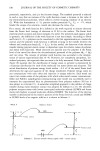
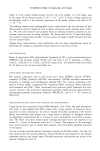
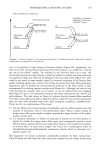
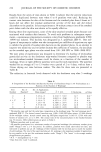
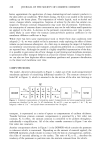
190 JOURNAL OF THE SOCIETY OF COSMETIC CHEMISTS potentials, respectively, and q is the electron charge. The standard potential is selected in such a way that an increase of the work function causes a decrease in the value of the electrochemical potential, which reflects a lower escaping tendency of an electron (2). With this formulation (1-5), positive surface potentials Vs•, Vs2 = +V, which hinder the escape of an electron, would also decrease the value of For a metal, the work function 0 is defined as the work required to remove electrons from the Fermi level (energy of electrons at O K) to the surface. The Fermi level represents both acceptor and donor energies of a metal. For polymers (and organic solids in general), the definition of the work function is not that simple. According to Davis and Lewis (3-5), a polymer can be considered in the first approximation as a molecular crystal, and the polymer work function is defined as lying in the middle between the valence and conduction bands (E c + Ev/2). In this model, the direction of the electron transfer during polymer-metal contact is dependent upon the relative values of polymer and metal work functions. Metal electrons are injected into the polymer if the Fermi level of the metal lies above the electrochemical potential of the polymer (0m and vice versa. The concept of polymer work function was successful in the interpre- tation of various experimental data (6-8). However, for completely amorphous, dis- ordered polymers, this approach does not seem to be fully warranted. Duke and Fabish's theory (9) assumes that the distribution of energy states in polymer is represented by a Gaussian distribution for each of the molecular ion states (donor and acceptor). The actual distribution of polymer energy levels within --0.4 eV of the metal Fermi level determines the sign and quantity of the charge transferred. Polymer energy states do not communicate with each other and injection is energy selective. Each metal can inject into certain states of the polS, mer with which other metals cannot communicate. Duke and Fabish's sampling/non-communicating state model was successfully used to interpret the experimental data on photoemission from polymer surfaces (10) but is also subject to criticism (11). A somewhat simplified approach to the problem of charge transfer during metal-insulator contact was adopted by Gibson (12,13). He identifies polymer acceptor states with lowest unoccupied molecular orbitals (LUMO) and donor states with highest occupied molecular orbitals (HOMO). The direction of the electron transfer is determined by the relative position of the Fermi level of a metal and HOMO or LUMO levels of an organic solid as it is shown in Scheme 1. Metal A Organic Solid Metal B _ • LUMO E1 Fermi Level A E 2 HOMO • Scheme 1. Electron transfer during organic solid--metal contact. B E 1 B E 2 Fermi Level

TRIBOELECTRIC CHARGING OF HAIR 191 Gibson used this model of electron transfer to demonstrate quantitative correlations of solid state triboelectric charging and molecular structure (12-14). Linear free energy relations (Hammet correlations) were shown to exist for the process of triboelectric charging of a variety of organic solids [substituted salicyl anils (14), polystyrenes (14), polyethylenes (15), poly(arylomethylstyrenes) (13)] by metals. It was thus possible to alter triboelectric charging properties of polymers in a predictable manner by chemical modification. The change in triboelectric charging characteristics could also be achieved by doping with appropriate low molecular weight donors and acceptors. For example, octadecanol was shown to impart electrodonating properties to a polyethylene matrix (16), while increased negative charging (increase in electron-accepting properties) was observed for collagen mixed with p-chloranil (17). While the mechanism of charge transfer during the metal-insulator contact is subject to discussion, the Duke and Fabish model of polymer-polymer contact event seems to account better for some experimental observations (9). It postulates that the charge exchange between two polymers will occur at all energies for which filled donor states of one are aligned with empty acceptor states of the other. That also implies, similar to Gibson's representation of metal-insulator contact (Scheme 1), that the direction of the polymer-polymer charge exchange would depend on the relative energies of LUMO and HOMO levels of the contacting materials. Very few works have been published on the effect of surface modification on the charge transfer during metal-polymer and polymer-polymer contact (12,18). Changing the surface properties by chemical deriv- atization was reported to have a profound effect on the triboelectric charging phe- nomena. Oxidation or ozonolysis of polystyrene and polyethylene, which leads to the formation of ketone, aidehyde, quinone, carboxyl, etc., functionalities was shown to impart electron-accepting properties while surface sulfonation of polystyrene resulted in the increase of electron-donating properties of the polymer. We have reported earlier (19) on some charging characteristics of hair against various metals and polymers. It was pointed out that the generated charge density and its sign depended upon the material used for rubbing as well as the direction of rubbing. The experimental data could be qualitatively explained in terms of the band model of the electronic structure of polymers and metals, assuming certain characteristic values of work functions for each material under consideration, as suggested by Davis (3-5). In order to explain the directional triboelectric effect, we had to invoke piezoelectricity of cuticle cells as was proposed earlier by Martin (20). The present paper describes the investigation of the effect of various surface modifications of hair on the charge transfer during rubbing. This is important, since the adsorption on hair of long chain alkyl quaternary ammonium salts, cationic polymers, and complexes of cationic polymers with anionic polymers or anionic detergents can produce significant changes in the electrochemical surface potential of the fiber. This results in different charging char- acteristics in relation to polymers and metals. The effect of treatments such as dyeing, bleaching, and permanent waving was also explored. Apart from altering the electrochemical potential, surface modification may also affect the conductivity of fibers (21). Therefore, the primary purpose of our studies was to find qualitative correlations between density and sign of generated tribocharge, fiber conductivity, and various modes of surface modification of hair. Our interpretation of the experimental data is based on Davies' approach (3-5). We assume that both poly- mers and metals are characterized by work functions which determine the value of the
Purchased for the exclusive use of nofirst nolast (unknown)
From: SCC Media Library & Resource Center (library.scconline.org)