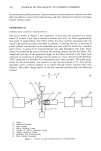
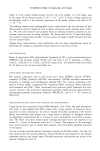
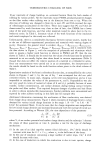
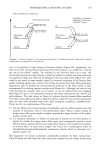
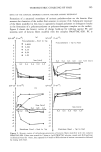
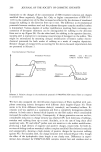
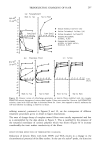
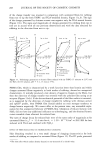
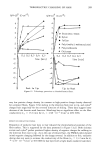
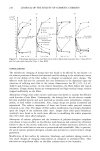
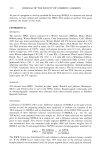
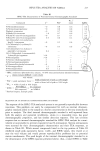
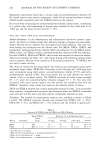
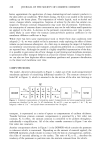
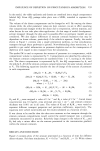
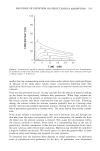
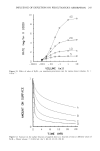
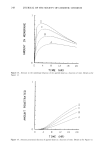
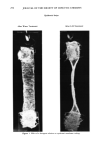
192 JOURNAL OF THE SOCIETY OF COSMETIC CHEMISTS electrochemical surface potential. Surface treatments and piezoelectric potential can also affect the effective value of the work functions and thus influence the direction of charge transfer during contact. EXPERIMENTAL TRIBOELECTRIC CHARGING MEASUREMENTS The device shown in Figure 1 was employed. A hair tress was mounted in a metal frame (4) in such a way that it formed a smooth layer 0.03 cm thick (approximately four layers of single fibers). The fibers within the tress could be positioned with the cuticle edges pointing either downward or upward. A rubbing element in the form of a half cylinder was attached to an adjustable arm that could be rotated by a variable speed motor. A speed of 70 rotations/minute was used throughout this work. Static charge was produced by contact between the rubbing element and the hair fibers. The magnitude and sign of the generated charge on the fibers mounted in the frame were measured as a function of rubbing time by means of a static detector probe (Keithley 2503) connected to a Keithley 616 electrometer and a chart recorder. The entire setup, except for the electrometer, was housed in a dry box maintained at 25-30% relative humidity under a positive pressure of air passed through several columns filled with Drierite. The surface charge density on the hair tress was calculated from the following relation: cr = Q C'E (6) A A 2 3 4 5 6 07 cm 7 8 1. Motor 2. Rubbing Element 3. Hair Sample 4. Metal Holding Frame 5. Target of Static Detector Rrobe 6. Static Detector Probe ?. Keith!ey 616 Electrometer 8. Omni Scribe Recorder Figure !. A device to study triboelectrification of keratin fibe•.

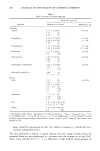
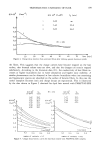
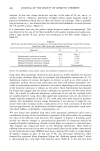
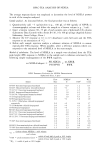
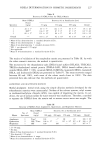
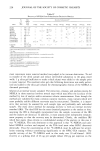
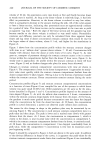
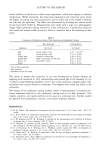
TRIBOELECTRIC CHARGING OF HAIR 193 where g is the surface charge density (C/cm2), Q is the charge, A is the surface area of the target of the detector probe (3. 142 x 10 -2 cm2), E is the voltage read by the electrometer, and C is the internal capacitance of the probe, adapter and cable (2.45 x 10⁻¹⁰ F). The rubbing element was exchangeable so we could evaluate the electrification of hair fibers using a variety of materials such as teflon, aluminum, gold, stainless steel, nylon, etc. We also used solution-cast polymer films as rubbing materials mounted on alu- minum, stainless steel, or teflon cylinders. We found that for 20-30 •m thick films, the cylinder material has no effect on the process of charge transfer between the film and the keratin fibers. Charge decay measurements were performed with the same experimental setup by following the changes in generated charge density as a function of time. FILM PREPARATION Films of polystyrene (PS), polycarbonate bisphenol-A (PC), poly(methylmethacrylate) (PMMA), and chitosan acetate (ChA) were cast from 5 wt % solutions in CHC13, CH2C12 - C2H4C12 (1:1), CHC13, and H20, respectively. The polymer films were dried for 24 hours in the vacuum oven before use. SURFACTANTS AND POLYMER SAMPLES The cationic surfactants used in this study were: decyl (DTAB), dodecyl (DTAC), tetradecyl (TTAB), hexadecyl (HTAB), and octadecyl (OTAB) trimethyl ammonium bromides or chlorides and steralkonium chloride (SC). The anionic surfactants were: sodium dodecyl (SDS), tetradecyl(TTS), hexadecyl (SHS), octadecyl (SOS) sulfonates, and eicosanoic acid (EA). These compounds were practical grade chemicals and were used as received. The quaternary ammonium polymer employed was poly(methacryl- amidopropyltrimethyl ammonium chloride) [PMAPTAC, mw 4.3 X 10⁵ relative to PEO (22)]. PREPARATION OF HAIR SAMPLES FOR TRIBOELECTRIC MEASUREMENTS Virgin brown hair, purchased from deMeo Brothers, New York, was used throughout this work. It was washed with SDS, rinsed with a large amount of deionized water, and dried at room temperature. In order to modify the surface properties of the keratin fibers, hair swatches were placed into a large excess of polymer or detergent solution of appropriate concentration for 2-6 hours at room temperature, and stirred occasion- ally. The fibers were then rinsed under running deionized water and exposed to an excess (2-3 liters) of deionized water for 2-4 hours. The purpose of the prolonged pure water exposure was to obtain fiber samples with irreversibly adsorbed polymers or detergents. To cast a cationic polymer-anionic detergent complex on the fiber surface, the hair was first treated with the cationic polymer, rinsed with H20, then exposed to the anionic surfactant solution and rinsed again. Detailed procedure descriptions are given in the legends of Figures 9 and 10.
Purchased for the exclusive use of nofirst nolast (unknown)
From: SCC Media Library & Resource Center (library.scconline.org)