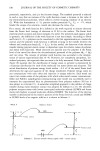
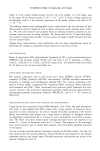
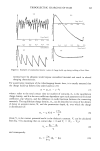
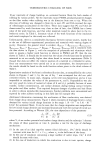
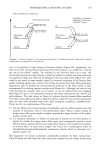
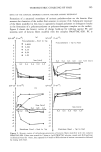
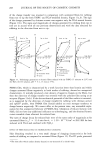
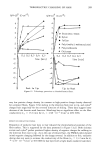
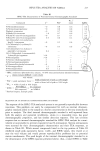
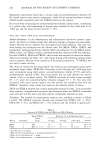
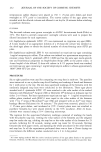
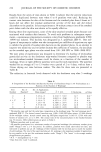
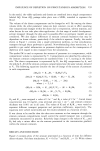
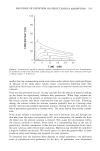
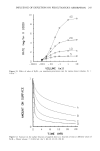
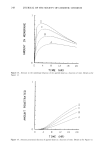
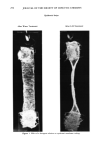
208 jOURNAL OF THE SOCIETY OF COSMETIC CHEMISTS of the charge transfer was reversed in comparison with untreated fibers for rubbing from root to tip (for both THPC- and TGA-modified keratin, Figure 1 la,b). The sign of the charge generated by chitosan acetate was negative only for TGA-treated keratin (Figure llb). The signs and magnitudes of charges generated by rubbing from tip to root are in accord with all our previous observations and with the data obtained for rubbing in the direction from root to tip. (3) Q/A .10 9 Root to Tip Tip to Root (C.om-2) 6 1 0 in] , i•n] -4 56 t 0 Stainless Steel 0 Nylon (b) Root to Tip ß Teflon ß Poly(methyl methacrylate) & Polycarbonate ß Chitosan Tip to Root . . li•e [m•n] i .• .• .• .'f Figure 11. Tribocharge generation on keratin fibers reduced with (a) THPC (15 minutes at 23øC) and (b) TGA (10.6% solution, pH = 9.2, 15 min at 37øC). PMMA film, which is characterized by a work function lower than keratin and which charges untreated fibers negatively in both modes of rubbing, showed an unexpected characteristic. It initially produced a low density of negative charges on the fibers, but then the direction of charge transfer was reversed with the polymer film acting as an acceptor (Figure 1 la,b). If the electrochemical potential of the fiber surface is increased, as is suggested by the direction of charge transfer for rubbing with chitosan acetate and nylon © probes, then PMMA film should exhibit an even stronger tendency to charge keratin negatively. We cannot offer, at the present time, any reasonable expla- nation for this unexpected behavior of PMMA film. Oxidation of reduced keratin with H20 2 did not have any additional influence on tribocharging, and the obtained kinetic curves resemble those obtained for reduced hair. The rates of charge decay for reduced hair were of the same order of magnitude as for untreated fibers (tv•6 • = 11.4 min for (rl = 3.20 ß 10 -9 C/cm 2 at 28% RH for hair reduced with TGA and oxidized with H202). EFFECT OF FIBER BLEACHING ON TRIBOELECTRIC CHARGING Hair bleaching resulted in a very small change of charging characteristics for both modes of rubbing as compared to untreated fibers (Figure 12). The PC probe generated • The time after which surface density decayed to one-sixteenth of its initial value.

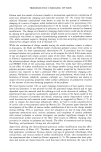
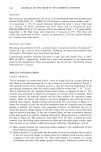
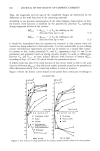
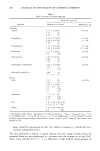
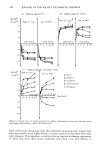
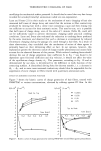
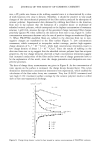
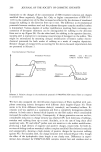
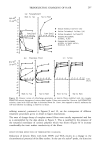
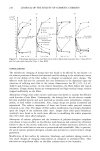
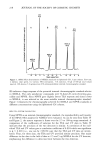
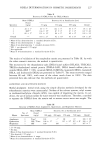
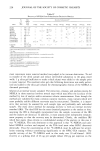
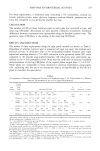
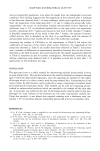
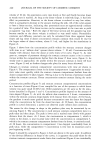
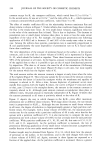
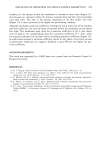
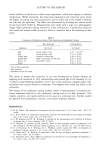
TRIBOELECTRIC CHARGING OF HAIR 209 Q/A.10 9 (C.om -2) -1 -2 -3 -4 -5 -6 Q/A.10 9 (C.em -2) 4 inless S•eel o ill . 11/ ' o' _, •] _ IX o.• o.2 -6 Roo• •o Tip Tip •o Roo• Figure 12. Tribocharge generation on bleached keratin fibers. very low positive charge density (in contrast to high positive charge density observed for untreated fibers, Figure 3) for sliding in the direction from root to tip, and nylon © charged hair negatively for the reversed direction of sliding. These data suggest some decrease of the keratin work function. Bleaching has no significant effect on the fiber conductivity (t•/: = 15.6 min for gl = 4.98 ' 10 -9 C/cm 2 at 29% RH). EFFECT OF OXIDATIVE DYEING Deposition of oxidative hair dyes in hair reduced the electrochemical potential of the fiber surface. This is supported by the data presented in Figure 13a,b. Both chitosan acetate and nylon © probes produced higher density of negative charges for rubbing in the direction from root to tip. As in the case of reduced hair, the PMMA probe showed initial negative charging followed by the charge reversal. In addition to this, oxidative dyeing does not seem to increase the conductivity of the fibers (tv: = 13.2 min for g• = 4.35 ' 10 -9 C/cm 2 at 30% RH for hair dyed with a light shade oxidative haircolor).
Purchased for the exclusive use of nofirst nolast (unknown)
From: SCC Media Library & Resource Center (library.scconline.org)