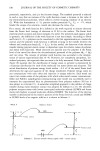
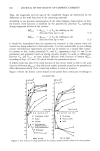
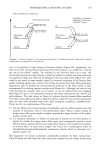
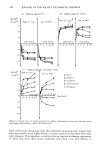
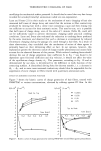
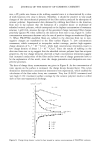
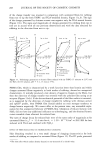
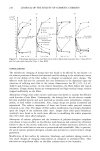
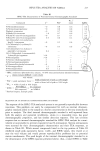
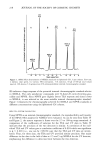
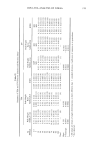
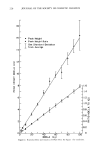
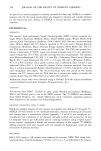
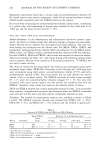
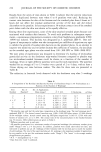
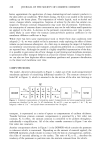
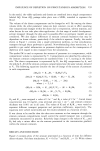
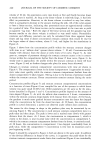
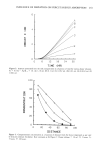
210 JOURNAL OF THE SOCIETY OF COSMETIC CHEMISTS (a) (b) Q/^.10 9 3 / /Y I I o Stainless Steel t ] øNylon F /•,•D•41/.• '? .3 .• .5 ,] -1 • / l• methacrylate) -6 { Root to Tip • Tip to Root Rot o x Tip to Root Figure 13. Tribocharge generation on hair fibers dyed with (a) Dark shade haircolor Nice'n Easy • 121) and (b) Light shade haircolor (Nice'n Easy •99). CONCLUSIONS The tribeelectric charging of human hair was found to be affected by two factors: (1) the relative positions of keratin and material used for rubbing in the tribeelectric series and (2) the ability of the fiber surface to dissipate accumulated static charges. The effective work function for untreated hair was determined to be dependent upon the direction of rubbing and close to the values characteristic for PC (3.85-4.8 eV, Table I) and chitosan acetate. At low relative humidities, the fibers behave like typical insulators. Charge density decays are nonexponential and high residual charge remains trapped indefinitely on the fibers. Adsorption of long chain alkyl cationic surfactants was shown to increase the effective work function of hair fibers. Consequently, the driving force for the electron transfer between modified keratin and such materials as stainless steel, polyethylene, polypro- pylene, or hard rubber is diminished. Also, charge decays are greatly accelerated and exponential. The relative importance of these two factors under practical cosmetic situations is not clear. The degree of fiber surface modification was strongly dependent upon the length of the surfactant alkyl chain. Longer chain alkyl quats (hexadecyl, octadecyl) were found to be much more effective in modifying the surface properties than their short chain alkyl analogues. Adsorption of cationic polymers and the formation of polymer-detergent complexes were shown to have an effect on the effective work function and conductivity of keratin similar to that of the cationic surfactants. In the case of these treatments, however, the increase of the work function was not so pronounced and controllable. Also, in practice, the use of cationic polymer-detergent complex does not lead to a control of static charge generation. Modification of hair surface by reduction, bleaching, and oxidative dyeing results in very small changes of charging characteristics as compared to untreated fibers. They also have an insignificant effect on the fiber conductivities at low humidity.

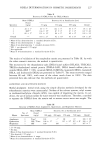
TRIBOELECTRIC CHARGING OF HAIR 211 Probably the most important general conclusion which can be drawn from the presented data is that the combination of two factors, an increase in surface conductivity and a decrease in the electrochemical surface potential gap between the rubbing material and keratin, can provide an antistatic effect. Since the electrochemical surface potential of the fiber strongly depends on the type of modification it was subjected to, there is no single comb material which would at the same time match the electrochemical surface potential of untreated hair and that of hair modified with cationic surfactants, cationic polymers, fluorosurfactants, and silicon polymers or surfactants. It should also be stressed that the process of triboelectric charging of hair tresses during combing is much more complex as compared to the simple rubbing described in this paper. In the present experiments, the fibers were subjected to similar elongation and stress in all charge generation experiments, since the distance between the rubbing probe and the plane formed by the fibers arranged in a tress was constant. During combing, such parameters as fiber elongation, stress, and magnitude of fric- tional forces between the comb and fiber undergo variations during the movement of a comb from the upper point of a tress towards the fiber tips. Consequently, non- uniform distribution of triboelectric charge density along the length of the fiber tress is usually observed (21). This might also affect the correlation between surface modi- fication and triboelectric charging and lead to quantitatively different results than those presented in this paper. REFERENCES (1) G. XYd. Castellan, Physical Chemistry (Addison-Wesley Publishing Co., Reading, Mass, 1971), p 384. (2) D. A. Seanor, Triboelectrification of polymers--a chemist's viewpoint, Phydcochem. Aspects Polym. Surf., Proc. Int. Syrup., 1, 477 (1983). According to this reference, the electrochemical potential of electrons is strictly equal ro qb + qV s. This is, however, nor compatible with the further statement that "electrons flow from the metal of lower work function (higher chemical potential) to the metal of higher work function . . ." (p 480) if qb assumes positive values. (3) D. K. Davies, The examination of the electrical properties of insulators by surface charge measure- ment,.]. Sci. Iratram., 44(7), 521 (1967). (4) D. K. Davies, Charge generation on dielectric surfaces, Brit..]. Appl. Phys. (.]. Phys. D.), 2, 1533 (1969). (5) T. J. Lewis, "The Movement of Electrical Charge Along Polymer Surfaces," in Polymer Surfaces, D. T. Clark and XYd. J. Feast, Eds. (John Wiley and Sons, Chichister, 1978). (6) T. J. Fabish, H. M. Saltsburg, and M. L. Hair, Charge transfer in metal/atactic polystyrene contacts, .]. Appl. Phys., 47, 930 (1976). (7) T. J. Fabish, H. M. Saltsburg, and M. L. Hair, The distribution of localized electronic states in atactic polystyrene,.]. Appl. Phys., 47, 940 (1976). (8) XYd. D. Greason and I. I. Inculet, Insulator work function determination from contact charging with metals, Conference Records--IAS Annual Meeting, Vol. 10, 18-B (1975). (9) C. B. Duke and T. J. Fabish, Contact electrification of polymer: A quantitative model, .]. Appl. Phys., 49(1), 315 (1978). (10) Y. Murara, Photoelectric emission and contact charging of some synthetic high polymers, .]pn..]. Appl. Phys., 18(1), 1 (1979) Y. Murata, T. Hodoshim, and S. Kittaka, Evidence for electron transfer as the mechanism of contact charging of polyethylene with metals, .]pn..]. Appl. Phys., 18, 2215 (1979) Y. Murata, and S. Kittaka, Evidence of electron transfer as the mechanism of static charge generation by contact of polymers with merals,.]pn..]. Appl. Phys., 18(2), 421 (1979) S. Kittaka, and Y. Murata, Contact charging and photoemission of anthracene single crystal, .]pn. .]. Appl. Phys., 18(2), 295 (1979). (11) G. A. Cottrell, J. Lowell, and A. C. Rose-Innes, Charge transfer in metal-polymer contacts and the validity of'contact charge spectroscopy,'.]. Appl. Phys., 50(1), 374 (1979).
Purchased for the exclusive use of nofirst nolast (unknown)
From: SCC Media Library & Resource Center (library.scconline.org)