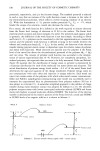
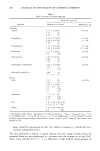
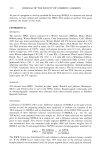
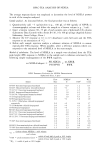
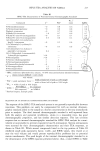
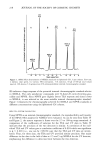
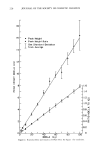
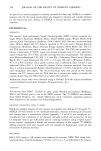
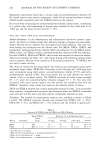
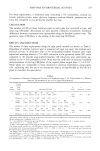
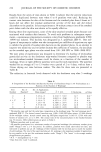
226 JOURNAL OF THE SOCIETY OF COSMETIC CHEMISTS Subsequent experiments found that a column wash of acetone/methylene chloride (10/ 90) would remove some matrix components, while 60 ml acetone/methylene chloride (60/40) would completely elute the NDELA placed on the column. Recoveries from evaporating the acetone/methylene chloride column eluent, transferring to a culture tube, and evaporating to dryness were evaluated at five levels from 50 to 1,000 ng, and the mean recovery was 82 _+ 16%. MELA, DELA, TRELA, THEIR SALTS, AND MORPHOLINE Method development. In the ethanolamine and ethanolamine derivative cosmetic ingre- dients, the matrix is simple enough that elaborate cleanup techniques are unnecessary. Simple dilution prior to analysis was investigated and found sufficient. The only vari- ation among the techniques was the diluent used. For MELA, DELA, TRELA, and morpholine, methanol/methylene chloride (4/96) was sufficient. For the MELA amide, DELA amide, and TRELA amides, methanol/methylene chloride (2/98) was sufficient. For salts of MELA, DELA and TRELA, ethyl acetate was required to solvate the arialyre. These latter matrices are often "wet" and require drying with anhydrous sodium sulfate prior to analysis. Because of the simplicity of the sample preparation, 14C-NDELA was not used to assess recovery. The choice of solvent for the ethanolamine salt matrices was investigated using trieth- anolamine lauryl sulfate (TRELALS). Recoveries at the 200-ng/g and 1,000-ng/g level were investigated using ethyl acetate, acetone/methylene chloride (25/75), and meth- anol/methylene chloride (2/98). The latter solvent did not fully dissolve the matrix instead it left a two-phase system. The NDELA recoveries for ethyl acetate averaged 85 + 8, while the acetone/methylene chloride averaged 79 + 16. Not only were recoveries with ethyl acetate higher, but the solvent tail interfered less with the NDELA. Therefore, ethyl acetate was chosen as the dilution solvent of choice. DELA and TRELA samples may contain appreciable amounts of water. To accommodate these samples, a supplemental procedure was developed where the NDELA is adsorbed onto silica gel and the water and other volatile components removed in vacuo. Validation. The method for ethanolamine matrices were validated as shown in Tables I and II. The NDELA recoveries through each method from TRELA (101 + 20%), DELA (98 + 9%), and MELA (89 + 6%) indicate that the method is quantitative. Table I Recovery of NDELA from the MELA and DELA Matrices Mean NDELA Recovery (%) at Fortification Level Found Matrix Specimens (ng/g) 50 ng/g 300 ng/g 1,000 ng/g Overall MELA 1 ND a 90 83 94 89 + 6 b DELA 2 ND, 33 -+ 8 c 103 --- 3 c 92 -+ 2 c 99 --- 12 c 98 -+ 9 d Not detected (25 ng/g). Mean of three determinations - standard deviation (S.D.). Mean of two determinations _+ range. Mean of six determinations + standard deviation (S.D.).

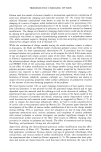
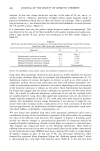
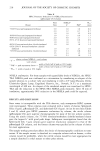
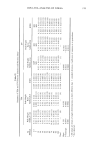
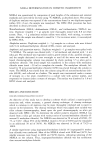
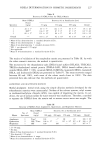
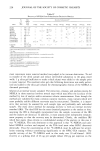
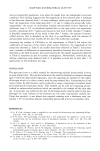
NDELA DETERMINATION IN COSMETIC INGREDIENTS 227 Table II Recovery of NDELA from the TRELA Matrix Specimen Mean NDELA Found (ng/g) Recovery (%) at Fortification Level 33 ng/g 332 ng/g 995 ng/g Overall 1 26+3• 2 ND b'a 3 60 + 5 b Overall __e 87 -+- 7 b 104 + 3 • 95 -+- 7 b 95 + 1() c 136 -+- 15 • 87 -+- 3 • 97 + 9 • 107 --+ 26 • 131 --+ 13 • 86 + 5 • 89 + 0 b 102 + 24 c 118 + 27 c 92 + 10 c 93 + 8 • 101 + 20 • Mean of four determinations _+ standard deviation (S.D.). Mean of two determinations -+- range. Mean of six determinations + standard deviation (S.D.). ND = not detected (25 ng/g). Not applicable. Mean of 18 determinations + standard deviation (S.D.). The results of validation of the morpholine matrix are presented in Table III. As with the other cosmetic matrices, the method is quantitative. The recoveries for the ethanolamine salts [DELA lauryl sulfate (DELALS), TRECALS, TRELA-cohydrolyzed animal protein (TRELA-CAP), DELA laureth sulfate plus co- camide DELA (DLS + CD), cocamide MELA (CoMELA), lauramide MELA, lauramide DELA, and linoleamide DELA] are presented in Table IV. The mean recoveries ranged between 80 and 128%, with most of the values much closer to 100%. The data presented here also indicate that the methods are quantitative. AMPHOTERIC AND QUATERNIUM MATRICES Method development. Initial trials using the simple dilution methods developed for the ethanolamine matrices were unsuccessful. Neither of the solvent systems, ethyl acetate or methanol/methylene chloride (4/96), was capable of dissolving the matrix. In ad- dition, the use of sodium sulfate for water removal was insufficient. Therefore, a method to separate the NDELA from the matrix and to remove excess water was sought. The Table III Recovery of NDELA From Amphoteric, Quaternium, and Morpholine Matrices Mean NDELA Recovery (%) at Fortification Level No. of Found Matrix Specimens (ng/g) 100 ng/g 200 ng/g 250 ng/g 500 ng/g Overall Amphoteric 1 Trace s 103 --• 98 117 106 -+ 10 • Quaternium 2 ND, d Trace 106 -+- 17 e -- 107 -+ 12 e 107 •- 8 e 106 -+ 14 f Morpholine 1 ND 100 108 -- 113 107 -+- 7 c 25-50 ng/g. No data. Mean of three determinations -+ standard deviation (S.D.). Not detected (25 ng/g). Mean of two determinations -+- range. Mean of six determinations -+- standard deviation (S.D.).
Purchased for the exclusive use of nofirst nolast (unknown)
From: SCC Media Library & Resource Center (library.scconline.org)