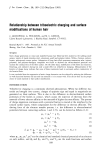
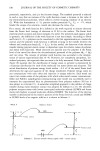
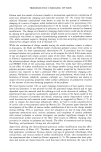
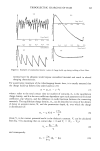
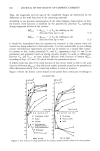
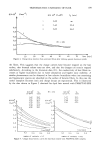
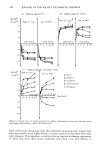
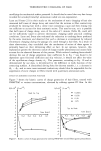
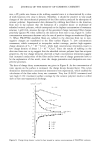
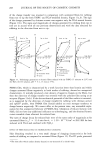
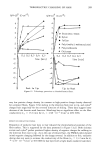
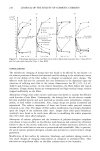
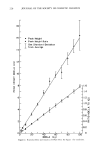
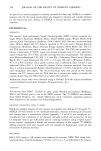
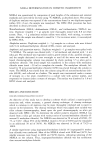
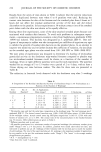
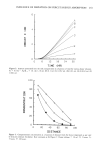
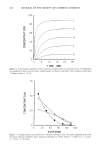
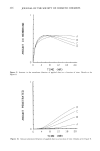
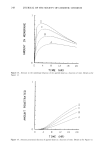
248 JOURNAL OF THE SOCIETY OF COSMETIC CHEMISTS z m z z B 0 4 8 12 16 20 TIME (HR) Figure 13. Amount in the membrane (fraction of the applied dose) as a function of time. Details as for Figure 12. 0 4 8 12 15 20 TIME (HR) Figure 14. Amount penetrated (fraction of applied dose) as a function of time. Details as for Figure 12.

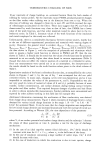
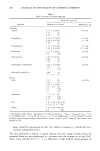
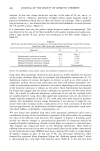
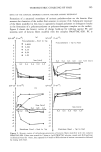
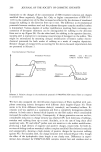
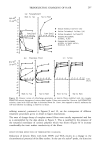
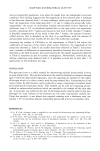
INFLUENCE OF DEPLETION ON PERCUTANEOUS ABSORPTION 249 tendency for the amount within the membrane to increase at early times (Figure 13). As time goes on, amounts within the stratum corneum drop and the curves eventually cross each other. The drop in the amount remaining on the skin surface over time (Figure 12) is more pronounced the higher the partitioning tendency. Although the highest partition coefficient investigated was 8 times that of the smallest partition coefficient, the ratio of values of amounts within the membrane are not nearly this high. The membrane peak value for a partition coefficient of 40 is only about twice as high as the corresponding value for a partition coefficient of 5. Also, while the amounts penetrated do increase with an increasing partition coefficient (Figure 14), an eight times increase in partition coefficient results in only about a two-times increase in penetration. Depletion as a negative feedback is more effective the higher the par- tition coefficient. ACKNOWLEDGEMENTS This work was supported by a FASP leave and a grant from the Research Council of Rutgers University. REFERENCES (1) R. T. Tregear, Physical Functions if Skin (Academic Press, New York, 1966), pp 1-52. (2) T.J. Franz, The finite dose technique as a valid in vitro model for the study of percutaneous absorption, Curt. Probl. Dermatol., 7, 58-68 (1978). (3) E. Menczel and H. I. Maibach, Epidermal-dermal retention in human percutaneous absorption: Benzyl alcohol and testosterone, J. Invest. Dermatol., 54, 386-394 (1970). (4) G. Krantz, H. Schaefer, and A. Zesch, Hydrocoritisone (cortisol) concentration and penetration gradient, Acta Dermatovener (Stockh), 57, 269-273 (1977). (5) J. L. Zatz, "Percutaneous Absorption: Computer Simulation Using Multicompartmented Membrane Models (MMM)," in Percutaneous Absorption, R. Bronaugh and H. Maibach, Eds. (Dekker, NY), in press.
Purchased for the exclusive use of nofirst nolast (unknown)
From: SCC Media Library & Resource Center (library.scconline.org)