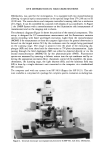
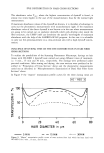
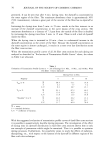
60 JOURNAL OF THE SOCIETY OF COSMETIC CHEMISTS Microscope spectrophotometry is very suitable to fulfill these demands. Its advantages result from the high resolution potential of a microscope, which reaches down to the one-micrometer range, and the flexibility to measure transmittance (or absorbance), reflectance, and fluorescence over a wide spectral range. It was quite surprising that in the hair cosmetic literature almost no reference was found that microscope photometers had been used to study dye distribution in hair fiber cross sections, although this technique has been known for many years. In 1968 E. M. Ni- cholls (5) studied red hair with microspectrophotometry. However, because of diffi- culties in producing hair fiber cross sections of uniform thickness, he only carried out his measurements on fiber snippets of 5-mm length. In textile research, especially in the synthetic fiber industry, this technique has been used already. In 1955 W. Luck (6) studied the diffusion of different dyestuffs into Nylon 6 filaments with a microscope photometer. The microscope was equipped with a scanning table and the photometer allowed monochromatic measurements at prese- lected wave lengths. R. H. Peters, J. H. Petropoulos, and R. McGregor (7) measured dyestuff concentra- tion in polymer fibers of cellulose acetate and nylon with a microdensitometer. In this work it was stated that difficulties arise not so much from the photometry but from the lack of success in producing uniform cross sections with a microtome in a reproducible manner. A further publication by J. G. Blacker and D. Patterson (8), as cited by G. Rattee and M. M. Breuer (9), deals with the measurement of dye distribution in cylindrical fibers. A magnified image of a dyed filament cross section was projected onto a screen and then scanned by a narrow slit. Y. K. Kamath, S. B. Ruetsch, and H.-D. Weigmann (12) have only recently studied the fading of dispersed dyes in nylon on cross sections using a microspectrophotometric method, and at the December 1984 Annual Meeting of the Society of Cosmetic Chemists in New York where we presented this paper, S. K. Han, Y. K. Kamath, and H.-D. Weigmann (13) also described their technique for measuring diffusion of dye- stuffs into human hair. Four years ago when the German Wool Research Institute purchased a microscope pho- tometer, the system was used to quantitatively evaluate the "tippy" dyeing of wool, which is due to extensive weathering. This work was carried out by Doris Klee in the form of a Ph.D. thesis (10,11). Recent developments in the field of microscope spectrophotometers, which now allow largely automatic measurements, have led us to study the possibilities of determining the dye distribution in hair fiber cross sections. The intention of this work is to show the possibilities of this technique. The investiga- tion was therefore restricted to only one direct dyestuff. From the dyeing parameters only the time of treatment was varied to show the sensitivity of the photometric system. MATERIAL For the dyeing of hair fibers, standard tresses consisting of 15% untreated, blond Euro- pean hair and 85% untreated, white angora goat hair (mohair) were used. The standard

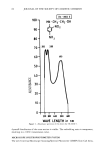
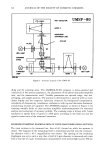
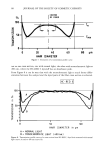
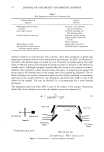
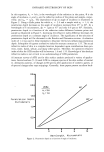
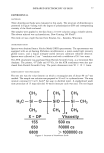
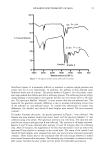
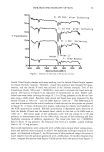
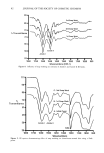
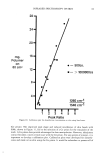
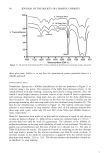
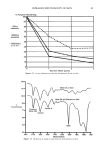
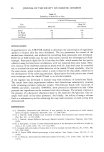
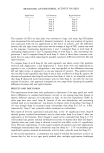
DYE DISTRIBUTION IN HAIR CROSS SECTIONS 61 tresses were supplied by Hohenschild and Gottschalk, Berlin. They are used by other European cosmetic firms as a standard material for dyeing experiments. The "apparent hair diameter" was approximately 70 ptm. DYEING The dyeing of the tresses was carried out with the direct dyestuff HC-Red 3 [1-(2-hy- droxy-ethylamino)-4-amino-2-nitrobenzene], the formula of which and whose absor- bance characteristics are shown in Figure 1. The dyeing itself was performed in the studio of a cosmetic firm. The dye paste consisted of 0.5% dyestuff. The hair/liquor ratio was aproximately 1:1. The pH of the dyeing paste was between 8 and 9. The dyeing was performed at room temperature with treatment rimes of 5 min., 15 min., and 30 min. After thorough rinsing, drying and conditioning, the cross sections for the photometry measurements were produced. PREPARATION OF CROSS SECTION In the case of photometry of cross sections of hair fibers it is most important that the sectioning is carried out absolutely perpendicular to the fiber axis. The hair fibers must therefore be embedded into resin in a parallel alignment. A subsample of 200 to 300 hair fibers of the dyed material is inserted into a plastic tube of aproximately 2-mm diameter and 30-mm length. The positioning of the hair collection within the plastic tube is such that between 20-mm and 30-mm length of the hair fibers is protuding from one end of the plastic tube. These fiber ends are then treated very carefully with a fast-setting, two-component glue (DEVCON ©) so that all hair fibers are covered with the glue. In this treatment air bubbles are very often produced within the glue. These must be eliminated, in some cases by even pricking them with a needle. In the mean- rime the glue has increased its viscosity, which is desirable because each hair fiber can then develop its own film. In this way, later on the cross sections will stay apart. The protruding end of the hair collection is now drawn slowly into the plastic tube. The glue is allowed to harden during a further period of 30 minutes at room temperature. The plastic tube with the inserted hair fibers is then introduced into a cylindrical wax block of 8-mm diameter. For this purpose it is advisable to drill a hole 0.2 mm smaller in diameter than the plastic tube into the centre of the wax block into which the plastic tube is then pressed. The wax block is then mounted into a sledge-type microtome. The adjustment of the block must be absolutely perpendicular to the fiber axes. After numerous trials a thickness of the cross sections of 40 p,m has been proved to be optimal. •7ith thinner cross sections the transmission of the light is too high, with thicker cross sections too low. However, the adsorption characteristics of the dyestuff can in some cases afford slightly different cross section thicknesses. Furthermore, it is advisable to use only cross sections of successive cuttings. The accuracy of the cross section thickness is ___ 2 The curs are then transferred to a microscope glass and are embedded in aniseed oil. This medium has a refractive index of 1.515 which is very similar to that of keratin, making the undyed parr of the fiber section almost invisible. Additionally, an open aperture of the photometer microscope delivers a low-contrast image so that only the
Purchased for the exclusive use of nofirst nolast (unknown)
From: SCC Media Library & Resource Center (library.scconline.org)