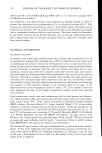
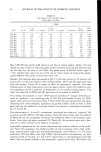
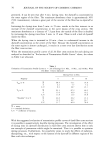
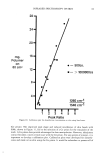
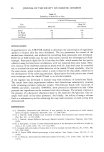
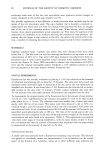
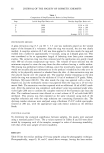
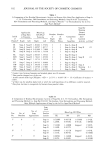
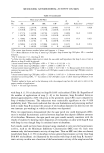
92 JOURNAL OF THE SOCIETY OF COSMETIC CHEMISTS Table I Comparison of Soap/Fluorescein Ratios in Soap Residues Soap Initial Soap/Dye Ratio w/w Residue Soap/Dye Ratio w/w G 2000 2350 -+ 195 E 2000 1920 +- 285 J 2000 1905 -+ 143 H 2000 2141 + 137 Average: 2079 m 210 SPECTROSCOPIC METHOD A glass extraction ring (3.5 cm ID X 3.5 cm) was randomly placed on the ventral aspect of the forearm of a volunteer. After the ring was secured, the site was clearly marked. A soap/dye solution (0.5 ml) was then applied to the skin inside the ring and worked into a lather for approximately 15 seconds, using an L-shaped glass rod. This was considered to be an appropriate length of lathering time from prior consumer studies. The extraction ring was then removed and the application site gently rinsed with 100 ml of room temperature tap water. The volume of water selected was the minimum required to rinse the soap from the skin without leaving a visible residue. The rinsing was performed without rubbing, since this would add a major variable and would not actually add any information as to the product's rinsability but only as to its ability to be physically removed or abraded from the skin. A clean extraction ring was then placed exactly over the original site. The soap/dye residue remaining on the skin inside the ring was extracted by the addition of 10 ml of methanol (UV grade, Fisher, Fairlawn, NJ):water (80:20). The skin inside the ring was agitated with a clean L- shaped rod, and the methanolic extract was pipetted from the ring into a 25-ml volu- metric flask. The extraction was then repeated with an additional 10 ml of 80% meth- anol. After the extraction was completed, each subject's arm was examined under ultra- violet light (280 nm) to confirm the complete removal of the fluorescein dye from the skin. The combined extracts were diluted to a total volume of 25 ml with fresh 80% methanol. This process was then repeated on the same volunteer using each of the soap/dye solutions and with the soap solutions not containing fluorescein dye. The dye/soap residue solutions were analyzed using a Beckman 35-UV visible spectropho- tometer at 280 nm, with the appropriate soap only extract solution as the reference blank. STATISTICAL ANALYSIS To determine the statistical significance between samples, the results were analyzed using a standard paired T-test. The p values reported in Tables II and III were deter- mined by comparing each of the samples, arranged in order of decreasing rinsability, with that of the next sample of lower rinsability. RESULTS Table II lists the residue ranking of 10 soap samples using the photographic technique. Photographically, soaps G, B, and C rinsed above average, leaving the least residue.

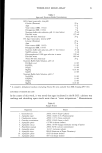
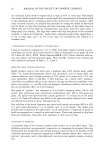
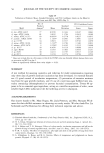
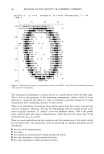
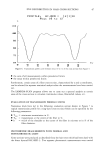
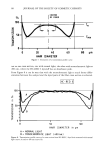
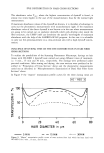
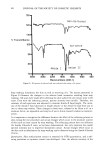
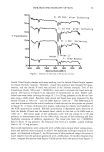
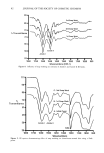
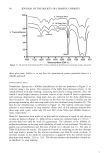
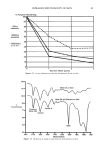
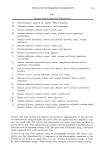
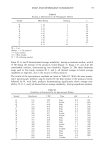
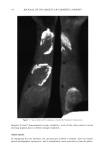
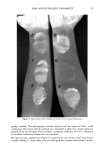
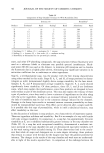
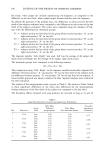
SOAP AND DETERGENT RINSABILITY 93 Table II Rinsing as Determined by the Photographic Method Sample Mean Rating Ranking p G 1.22 1 .01 B 2.17 2 .05 C 2.84 3 .10 H 4.33 4 .50 A 4.66 5 .60 E 5.50 6 .90 D 7.49 7 .10 I 7.92 8 .10 F 8.40 9 .05 J 9.11 10 - X = 5.36 Median = 5.50 sample E. 1 = Least residue. 10 = Most residue. N = 28 trials/soap product. Soaps H, A, and E demonstrated average rinsability, leaving a moderate residue, with E (5.50) being the median of the products tested (Figure 1). Soaps I, F, and J all left considerable residues demonstrating less rinsability (Figure 2). The three deodorant soaps used in this study, samples D, I, and J, all showed average to below average rinsability as expected, due to the nature of these products. The results of the spectroscopic methods are listed in Table III. With the more quanti- tative spectroscopic method, soap G clearly left the least residue of the products tested, followed by B, with both products demonstrating significantly above average rins- ability. D, F, I, and J all showed below average rinsability, leaving significant residues. Table Ill Rinsability as Determined by the Spectroscopic Method Sample Absorbance + SD Type pH p G B A C H O K R P N E L M D F I J 143 197 215 222 228 231 .296 .330 .333 .351 .362 .388 .405 .421 .526 .537 .602 .629 .028 Soap 8.8 .001 .013 Syndet 5.4 .800 .018 Soap 9.8 .550 .016 Soap 9.4 .500 .010 Soap 9.6 .500 015 Soap 9.8 .001 027 Syndet 5.7 .050 032 Syndet 5.5 .500 019 Soap 9.6 .100 028 Soap 9.6 .600 027 Soap 9.7 .500 019 Syndet 7.2 .300 024 Soap 9.7 .600 .031 Cornbar 9.7 .001 .019 Soap 10.0 .500 .024 Soap 9.6 .005 .016 Soap 9.6 .800 .010 Combar 9.4 -
Purchased for the exclusive use of nofirst nolast (unknown)
From: SCC Media Library & Resource Center (library.scconline.org)