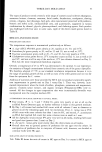
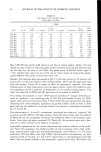
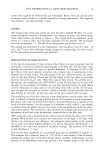
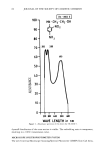
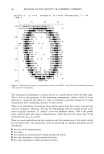
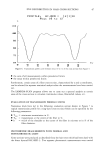
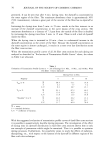
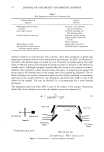
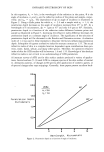
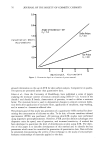
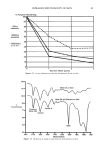
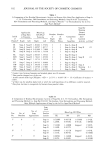
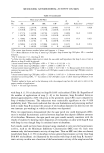
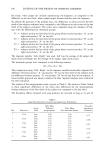
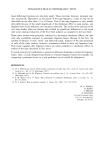
INFRARED SPECTROSCOPY OF SKIN 75 In this equation, h.• = h./n• is the wavelength of the radiation in the prism, 0 is the angle of incidence, n• and n 2 are the refractive indices of the prism and sample, respec- tively, and n2• = n2/n •. The dependence of dp on angle of incidence is illustrated in Figure 2. Using a ZnSe prism for which n• = 2.4 and a sample with n 2 = 1.4, the penetration depth decreases as the angle of incidence increases from 45 ø to 60 ø. At a wavelength of 6 micrometers, dp = l•m at 45 ø and only 0.6 •m at 60 ø. Similarly, penetration depth is a function of the refractive index difference between prism and sample as illustrated in Figure 3. Increasing the refractive index difference decreases the penetration depth at a constant angle of incidence. The significance of the selection of penetration depth will be discussed in the Results and Discussion section. A refractive index of 1.4 was used in these examples to illustrate the factors influencing penetration depth. Scheuplein (4) quotes a refractive index for stratum corneum as 1.55. The actual refractive index of skin is a complex function dependent upon contributions from pro- teins, water, lipids, sebum, and many other species. Therefore, the operative refractive index of skin for ATR studies will be between 1.4 and 1.55. Knowledge of the absolute refractive index is not critical to an understanding of ATR parameters. A literature survey of ATR use for skin surface analysis produced a variety of applica- tions. Several authors (5-8) used ATR to compare spectra of the skin surface of normal vs. dermatitis patients, of changes in IR spectra after application of cosmetic agents, or of spectral changes after tape strippings. Generally, these papers present excellent back- 2.51 2.0 m 1.5 m Penetration Depth Micrometers 1.0- 0.5 m ZnSe 45/ n I = 2.4 • n 2 = 1.4 • I ! I I 3 6 9 12 Wavelength, Micrometers Figure 2. Penetration depth as a function of angle of incidence.

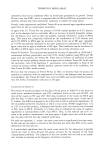
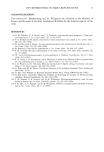
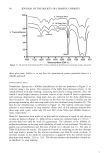
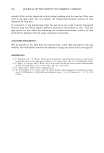
76 JOURNAL OF THE SOCIETY OF COSMETIC CHEMISTS 2.5-- 2.0- • Angle of Incidence = 45 ø n 2 = 1.4 •'•nSe• P. rism 0,5- • nl = 4.0 I I I I 3 6 9 12 Navelength. Micrometers Figure 3. Penetration depth as a function of prism material. 1.5 I Penetration Depth, Hicrometers 1.0= ground information on the use of ATR for skin surface analysis. Comparative or qualita- tive spectra are presented rather than quantitative data. Gloor eta/., from the University of Heidelburg, have published a series of papers studying the moisture content of stratum corneum using ATR (9-12). A ratio of the Amide I and Amide II bands, characteristic of proteins, is used to define a moisture factor. The moisture factor is used to demonstrate changes in stratum corneum hydra- tion levels after application of occlusive films, application of emulsions, soap washing, and in normal vs. dermatitis-affected skin. The primary goal of this study was generation of a quantitative ATR method for deter- mining the concentration of silicones on skin. To do this, a Fourier transform infrared spectrometer (FTIR) was purchased. All previous skin/ATR studies were performed using dispersive spectrophotometers. However, FTIR provides definite advantages over dispersive units for speed, ease of operation, and increased sensitivity. A method has been developed to quantirate the level of dimethicones on skin using ATR. The objec- tive of this paper is to describe development of this method and to identify the key parameters which must be controlled for generation of quantitative data. Data will also be presented demonstrating the utility of this technique in the study of structure/per- formance relationships of materials applied to the skin.
Purchased for the exclusive use of nofirst nolast (unknown)
From: SCC Media Library & Resource Center (library.scconline.org)