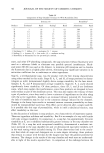
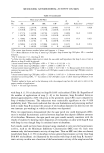
THREE-DAY MOLD ASSAY 53 The types of products tested covered a wide range of cosmetics and toiletries (shampoos, sunscreen lotions, cleansers, mascaras, facial masks, foundations, toothpastes, shaving creams, colognes, hair dressings, bath gels, skin moisturizers) preserved with parabens, benzoic and sorbic acids, imidazolidinyl urea, and quaternaries, supported in various combinations by ethanol, glycols, phenoxyethanol, and chelating agents. Each product was challenged with fbur and, in some cases, eight of the eleven mold species listed in Table II. RESULTS AND DISCUSSION PRELIMINARY RESEARCH The temperature response is summarized qualitatively as follows: ß A. niger ATCC #16404 grows slowly at 20, rapidly at 25, 30, and 35øC. ß Geotrichumd%i grows poorly at 20, well at 25 and 30, not so well at 35øC. ß Fusarium accuminatum grows well at 20, 25, and 30, but very poorly at 35øC. ß Cladosporium resinae grows best at 25øC (complete counts on Day 3), not as well at 20 and 30 ø, and not at all in any of the media at 35øC (no colonies observed on Day 5). This was the most temperature-fastidious organism. Overall, a temperature of 25 to 30øC was determined to be optimal. In our experience, the majority of fungal contaminants isolated from cosmetics are of the genus Aspergillus. We therefore adopted 27.5øC as our standard incubation temperature because it is in the range of optimal growth of this as well as most of the other genera and not too far from the optimum for C. resinae. Addition of nutrients over those provided by MYA did not produce statistically signifi- cant improvement in growth rate on Day 3 versus Day 5. There was, however, incre- mental improvement when the levels of sulfate, phosphate, potassium and magnesium, glucose, vitamins (yeast extract), and organic nitrogen (Polypeptone-BBL) were in- creased. All the changes in agar composition that were incrementally favorable were incorporated into the complex medium HC. A COMPARISON OF FUNGAL GROWTH IN SEVERAL MEDIA ß Four strains, # 3, 4, 5 and 7 (Table II), grew very poorly or not at all on the acidified Potato Dextrose agar no further reference is made to this growth medium. ß By Day 3 all strains had reached full count with all colonies 2 mm in diameter or greater on all the remaining agars with two exceptions. First, C. resinae was at 95% of full count with some colonies less than 1 mm on HC, and second, F. accuminatum on HCA had reached full count but some colonies were as small as 1 mm. ß All the Aspergillus strains except #5 grew very well in all media, reaching full count and good size (greater than 2 mm) on Day 2. ß G. jgci and C. resinae grew more slowly than the other strains on all media. ß Overall there was no general pattern of preference for one agar over the others. In anticipation of problems due to carryover of benzoic acid, however, we decided to continue work with HC agar. SIMULATED ASSAY OF MODEL PRODUCTS Talc. Table III shows the ratio of counts in HC agar on Day 3 to counts in MYA agar on

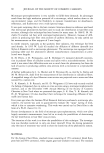
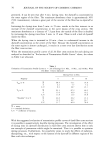
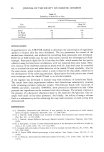
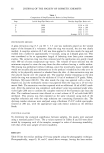
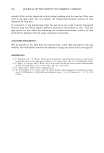
54 JOURNAL OF THE SOCIETY OF COSMETIC CHEMISTS Table III Talc Assays in HC and MYA Agars Count Ratio, H3/M5) Mold A. n, A, sp, A, n, Talc Talc G. fici 16404 C. res•nae 6177B A. oryzae P. notatum BL-89 Mean Talc #1 .99 1.10 .90 1.03 1.24 .86 .99 1.016 Talc #2 .91 1.60 1.25 .91 .93 1.13 .88 1.087 Talc #3 1.12 1.21 .89 .96 .75 .97 1.06 .994 Talc #4 1.02 1.29 .97 1.03 1.04 1.20 1.03 1.083 Talc #5 1.36 1.04 .91 1.14 .86 .90 1.04 1.036 Talc #6 1.02 1.22 .94 .96 1.36 1.19 .99 1.097 Talc #7 1.22 .81 .86 .85 1.16 1.08 .88 .980 Talc #8 1.05 .91 .82 1.18 1.18 1.25 .99 1.054 Talc #9 1.01 .91 .99 1.45 .87 .96 .85 1.006 Talc #10 .92 1.17 .64 1.00 1.14 1.06 .79 .960 Strain Mean 1.062 1.126 .917 1.051 1.053 1.060 .950 1.031 Day 5 (H3/M5) for several mold strains in ten talcs of various origins. Ideally, this ratio should be unity if the new three-day assay method is neither more nor less sensitive than the five-day test. As seen in the Table, the grand mean of H3/M5 (lower right) is 1.031. Neither this value nor any of the talc or strain means are statistically signifi- cantly different from unity or from each other (10). Shampoo. The shampoo base was assayed at pH 5.5 with and without 0.2% benzoic acid and at pH 7.0 with and without 0.8% methyl paraben. MYA and HC agars were used with and without Tween 80 to assess its effect on preservative carryover. The most striking result of these experiments was that agars without Tween 80 yielded no colo- nies regardless of pH or presence of preservative in the product being assayed. This result was observed in MYA and HC agar with a//the strains in Table II. Two strains, the resistant A. niger 16404 and the fastidious P. notatum were then as- sayed in "products," one consisting only of 10% SLS and another of only 5% LDA. Again, there were no recoveries on Day 5 when Tween 80 was omitted from the agars, indicating that either shampoo ingredient can grossly inhibit mold recovery in both agars and that the inhibition of growth of these two strains is counteracted completely by 2% Tween 80. Two other strains, G. fici and F. accuminatz/m, inoculated into these two "products" did not grow in either MYA or HC agar without Tween 80, but in these cases the addition of Tween 80 did not completely counteract the inhibitory effect of the shampoo ingre- dients. Even when the agars contained 2% Tween 80, the recoveries were only a frac- tion (10 to 50%) of those in the absence of "product." A plausible explanation for the curious observation that massive addition of the surfac- tant Tween 80 counteracts the inhibitory effect of minor amounts of two other surfac- tants, sodium lauryl sulfate and lauroyldiethanolamide, can be offered (11). The latter surfactants, SLS and LDA, have high CMCs (critical micelle concentration). At their carryover levels in the agar, 0.1 and 0.05% respectively, in the experiments described above, they are present mainly in the monomeric, surface-active form. We believe this
Purchased for the exclusive use of nofirst nolast (unknown)
From: SCC Media Library & Resource Center (library.scconline.org)