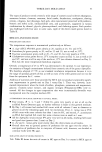
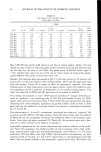
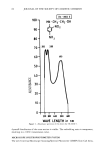
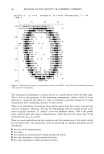
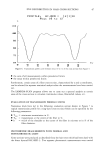
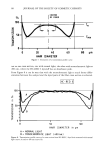
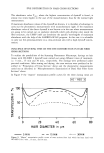
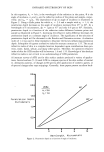
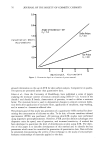
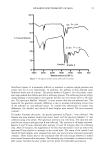
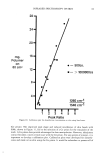
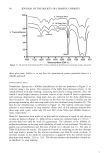
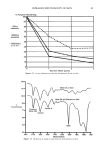
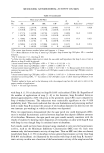
INFRARED SPECTROSCOPY OF SKIN 85 500cs 30000cs 1000000cs % Polymer Remaining 100 90 80 70 60 50 40 30 20 10 0 0 I 2 3 Number Wash Cycles Figure 12. In vivo substantivity data for dimethicone fluids on skin. 123 - 112- 100- 89- % Transmittance 77- 66,. 54- Mink Oil on Skin Carbonyl (Mink Oil) Amide I Amide II Mink Oil and Silicone on Skin SiMe 43 I I I I I [[ I [ I I 1850 1750 1650 1550 1450 1350 1250 1150 1050 Wavenumbers Figure 13. IR spectra of mink oil and mink oil with silicone on skin. I 950

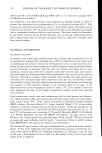
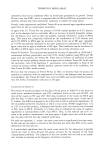
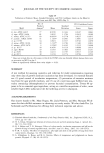
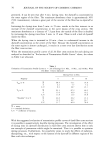
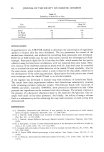
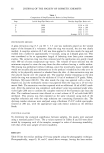
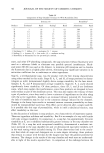
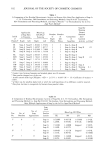
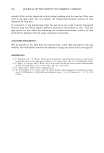
86 JOURNAL OF THE SOCIETY OF COSMETIC CHEMISTS Table II Durability of Mink Oil on Skin % Mink Oil Remaining Test Mink Oil Condition Mink Oil and Silicone Initial 100 100 1st Wash 26 43 2nd Wash 16 30 3rd Wash 12 23 CONCLUSIONS A quantitative in vivo ATR/FTIR method to determine the concentration of ingredients applied to human skin has been developed. The key parameters for control of the method were identified, and methods for controlling these parameters were developed. Either Ge or ZnSe prisms may be used. Each prism material has advantages and disad- vantages. Penetration depth for Ge is less than for ZnSe, which means that the spectra collected using Ge have fewer interferences with test materials from skin bands. How- ever, because of the shallower penetration depth with Ge, dose level must be controlled not to overload the area and make detection of the Amide II band unreliable. Also for the same reason, prism-to-skin contact is more critical for Ge than ZnSe, which led to the development of the softening procedure. Quantitation for both prisms uses a band ratio technique with the Amide II band as an internal standard. A test regimen was developed to measure soap wash resistance of dimethicone fluids. The results from these experiments indicate that dimethicone substantivity increases with increasing polymer molecular weight. Dimethicone fluids with viscosities of 30000cs and above, especially 1000000cs, show potential as substantivity aids. Other personal care ingredients can be evaluated with this technique. The primary criterion is the presence of a distinctive absorption band in the molecule's IR spectrum. One ex- ample with mink oil has been presented. And finally, the utility of using a silicone fluid as a substantivity aid for enhancing the soap wash resistance of mink oil has been demonstrated. REFERENCES (1) J. Fahrenfort, Attenuated total reflection. A new principle for the production of useful infrared spectra of organic compounds, Spectrochim. Acta., 17, 698 (1961). (2) N.J. Harrick, Study of physics and chemistry of surfaces from frustrated total internal reflection, Phys. Rev. Lett., 4, 224 (1960). (3) N.J. Harrick, Internal Reflection Spectroscopy (Harrick Scientific Corporation, Ossining, New York, 1979). (4) R. J. Scheuplein, A survey of some fundamental aspects of the absorption and reflection of light by tissue, J. Soc. Cosmet. Chem., 15, 111-122 (1964). (5) S. Comaish, Infra-red studies of human skin in vivo by multiple internal reflection, Br. J. Derre., 80, 522-528 (1968). (6) W. P. Ferren, MIR infrared spectroscopy in skin analysis, Amer. Perfum. Cosmet., 84 (12), 27-36 (1969). (7) N. A. Puttnam, Attenuated total reflectance studies of the skin,J. Soc. Cosmet, Chem., 23, 209-226 (1972).
Purchased for the exclusive use of nofirst nolast (unknown)
From: SCC Media Library & Resource Center (library.scconline.org)