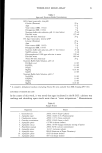
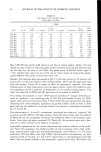
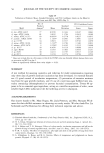
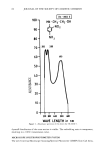
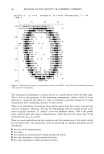
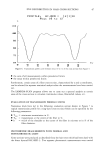
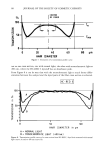
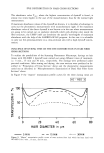
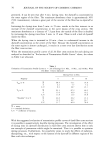
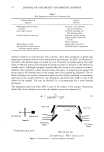
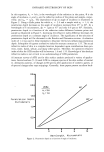
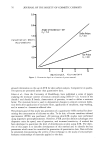
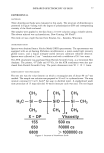
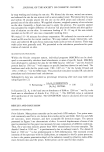
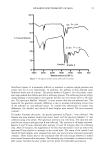
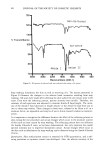
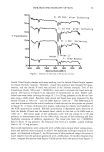
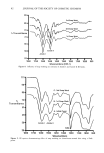
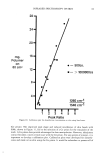
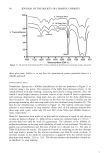
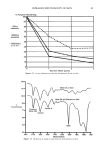
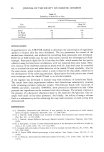
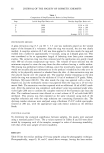
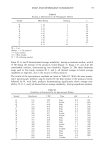
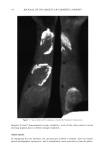
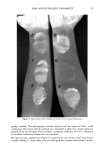
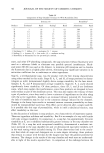
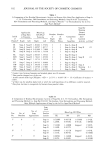
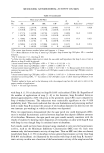
70 JOURNAL OF THE SOCIETY OF COSMETIC CHEMISTS presented. It can be seen that after 5 min. dyeing time, the dyestuff is concentrated in the outer region of the fiber. The maximum absorbance there is approximately 30% (70% transmission), whereas a great part of the interior of the fiber has no dyestuff at all. Increasing the dyeing time from 5 min. to 15 min. results in the first instance in an increase of the dyestuff concentration in the outer region of the cross section. The maximum absorbance at a distance of 7.5 p•m from the outside of the fiber is doubled by increasing the dyeing time from 5 min. to 15 min. There is still a lack of dyestuff inside the fiber. When the dyeing time is increased to 30 min., there is a substantial increase in the dyestuff concentration in the center of the fiber. Because the dyestuff concentration in the outer region is almost unchanged, it results in a more even dye distribution across the fiber cross section. When the transmission profile curves of all 20 fiber cross sections for each dyeing are analyzed as described in "Evaluation of Transmission Profile Curves" above, the values in Table I are obtained. Table I Evaluation of Transmission Profile Curves (n = 20) of Dyeings for 5 Min., 15 Min., and 30 Min. With HC-RED 3 Direct Dyestuff Dyeing Time in Min. Property 5 15 30 Train in % X 68.4 41.1 34.9 S 6.3 7.7 7.4 C.V. 9.2 18.7 21.1 -- T m in % X 93.1 87.2 46.5 S 11.0 10.9 16.2 C.V. 11.8 12.5 34.8 -- "Shoulder" b in % X 42.6 36.2 21.2 S 13.5 16.7 16.7 C.V. 31.7 46.0 78.6 X = mean. S = standard deviation. C.V. = coefficient of variation. With the suggested evaluation of transmission profile curves of dyed fiber cross sections it is possible to quantitatively describe dyeing processes. The investigation of the effect of dyeing time on dyestuff distribution in hair fiber cross sections shown here is only one example of parameters which might be examined. Thus it is possible to optimize dyeing processes. Furthermore, the possibility exists to study the effects of radiation, shampooing, etc., with respect to the fastness of the dyestuff in different regions of the fiber with this technique.

DYE DISTRIBUTION IN HAIR CROSS SECTIONS 71 ACKNOWLEDGEMENT Two authors (G. Blankenburg and H. Philippen) are indebted to the Minister of Science and Research of the State Northrhine-Westfalia for the financial support of this work. REFERENCES (1) D. W. Wheeler, D. A. Moyler, and J. T. Thirkettle, Instrumental colour assessment--Some prac- tical experiences, J. Soc. Cosmet. Chem., 27, 15-45 (1976). (2) P. R. Bunkall and M. Quinn, Instrumental colour measurement and control, J. Soc. Cosmet. Chem., 20, 265-281 (1969). (3) M. den Beste and A. Moyer, An instrumental description and classification of natural hair color, J. Soc. Cosmet. Chem., 19, 595-609 (1968). (4) M. Bornstein, Color and its measurements, J. Soc. Cosmet. Chem., 19, 649-667 (1968). (5) E. M. Nicholls, Microspectrophotometry in the study of red hair, Ann. Hum. Genet. (London), 32, 15-26 (1968). (6) W. Luck, Diffusionsmessungen in polyamidfasern I, Melliand Textilberichte, 36, 927-928, 1028-1033 (1955). (7) R. H. Peters, J. H. Petropoulos, and R. McGregor, A study of the diffusion of dyes in polymer films by a microdensitometric technique, J. Soc. Dyers Colourists, 77, 704-714 (1961). (8) J. G. Blacker and D. Patterson, Molecular mechanisms of disperse dyeing of polyester and nylon fibers, J. Soc. Dyers Colourists, 85, 598-604 (1969). (9) G. Rattee and M. M. Breuer, The Physical Chemistry of Dye Adsorption (Academic Press, London and New York, 1974). (10) D. Klee, Neue Methoden zur Bewertung bewetterter Wollen, Ph.D. Thesis, RWTH Aachen (1982). (11) D. Klee and U. Altenhofen, Objektives Verfahren zur Bewertung der Tendenz von Wolle zum Spit- zigoe•irben, Melliand Textilberichte, 65, 260-266 (1984). (12) Y. K. Kamath, S. B. Ruetsch, and H.-D. Weigmann, Microspectrophotometric study of ozone fading of disperse dyes in nylon, Textile Res. Journal, 53, 391-402 (1983). (13) S. K. Han, Y. K. Kamath, and H.-D. Weigmann, Diffusion of semipermanent dyestuffs in human hair, J. Soc. Cosmet. Chem., 36, 1-16 (1985).
Purchased for the exclusive use of nofirst nolast (unknown)
From: SCC Media Library & Resource Center (library.scconline.org)