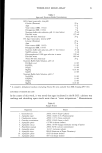
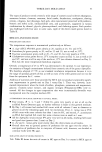
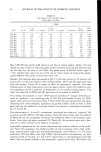
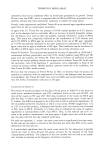
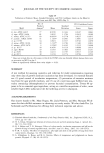
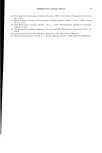
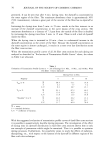
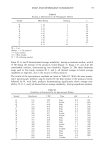
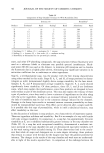
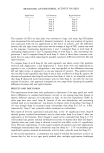
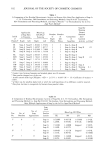
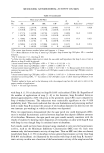
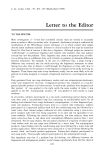
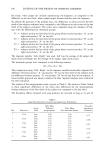
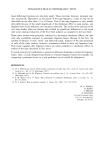
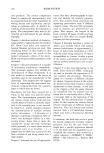
MEASURING ANTIMICROBIAL ACTIVITY ON SKIN 103 Table II (continued) Mean Log CFU/Plate •b Test % No. SE JM MR CW - SD Reduction c p-Value d 1 e 1.4641L 2.2457R 1.8358L 2.0780L 0.3736 57.7 0.028 0.9191R 2.0973L 0.7273R 2.2601R +0.4118 2 t 1.4717L 1.4329R 1.6270L 1. 1625L 0.4896 66.0 0.020 1.3067R 1.2821L 0.3333R 0.9541R --+0.4359 3 g 1.7699L 1.4834R 0.1590L 0.5411L 0.4479 64.4 0.021 0.6307R 1.4278L 0 R 0.2007R ñ0.3930 4 h 0.5604L 1.4535R 0.5188L 0.6931L 0.4351 63.8 0.014 0 R 1.4819L 0.1590R 0 R +0.3448 • The contact time between streaked plates and forearms = 2 hours. b • = Mean difference of the Soap A mean log CFU/plate-Soap B mean log CFU/plate. SD = standard deviation. -- c The % reduction = (1-1/antilog d) 100. d p-Value was the smallest alpha level at which the one-sided null hypothesis that Soap A was at least as effective as Soap B could be rejected. e Actual control mean log CFU/plate ñSD = 2.7184 ñ 0. 1112 (N = 5). factual control mean log CFU/plate -+SD = 2.8686 ñ 0.0833 (N = 4). g Actual control mean log CFU/plate -+ SD = 2.6386 + 0.0772 (N = 5). Because some of the test plates contained no surviving CFU, "1" was added to all CFU/plate counts to allow mean log CFU/plate counts to be calculated. h Actual control mean log CFU/plate -+SD = 2.8200 -+ 0.497 (N = 3). Because some of the test plates contained no surviving CFU, "1" was added to the CFU/plate counts to allow mean log CFU/plate to be calculated. i Panelist washed at home and in the laboratory with the assigned soap bars for each arm to arrive at the proper number of applications. i L & R = left and right forearm. with Soap A (1.5% triclocarban) or Soap B (0.8% triclocarban) (Table II). Regardless of the number of applications of soap [1-6] to the forearms, Soap B-washed forea.•ms showed approximately a 60% reduction in the geometric mean CFU count compared to Soap A-washed forearms. The reductions were statistically significant at the •.028 probability level. This result indicated that the new formulation and processing method used to make Soap B increased the amount of triclocarban deposited on skin but not the rate (amount per washing) at which triclocarban was deposited. These two experiments demonstrated that the agar patch test could distinguish differ- ences in residual bacteriostatic activity between soap bars that deposit different amounts of triclocarban. Moreover, the agar patch test gave results entirely consistent with the results of studies (3) showing more deposition of triclocarban on skin with Soap B than with Soap A even though Soap A contained more triclocarban. Such results could not have been obtained using standard in vitro tests for bacteriostatic activity, such as the Minimum Inhibitory Concentration (MIC) test (4). Such tests measure only the bacteriostatic activity of soap bars. Thus an MIC test (data not shown) would show Soap A (1.5 % triclocarban) to have greater bacteriostatic activity than Soap B (0.8% triclocarban). As illustrated by the results with Soap A and Soap B, bacterio- static activity on skin was a function of the bacteriostatic activity of the soap bar and the

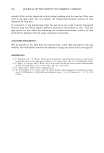
104 JOURNAL OF THE SOCIETY OF COSMETIC CHEMISTS amount of the activity deposited on skin during washing with the soap bar. Only tests such as the agar patch test can measure the residual bacteriostatic activity on skin deposited by soap bars. In conclusion, it was demonstrated that the agar patch test could correcdy distinguish between soap bars which deposit different amounts of triclocarban on skin. Thus the agar patch test was useful for evaluating the residual bacteriostatic activity on skin produced by washing with bar soaps containing triclocarban. ACKNOWLEDGEMENTS We are grateful to Dr. Phil Seitz for editorial help, to Dr. Bob Jaworski for the soap analysis, and to Richard Caston for his assistance during the course of the investigation. REFERENCES (1) F. Yackovich and J. E. Heinze, Evaluation of substantivity and antibacterial activity of soap bars on human skin by an in viva agar patch method, J. Soc. Cosmet. Chem., 36, 231-236 (May/June 1985). (2) E. Eigen, A. Legenjei, and S. Weiss, An in viva method for the detection of residual antimicrobial activity on human skin, J. Soc. Cosmet. Chem., 26, 411-425 (1975). (3) R. Theiler and L. Sands, Private communication. (4) W. M. Lindfield, R. E. Casely, and D. R. Noel, Studies in the development of antibacterial surfac- tants. II. Performance of germicidal and deodorant soaps, J. Am. Oil Chemists Soc., 37, 251-254 (1960).
Purchased for the exclusive use of nofirst nolast (unknown)
From: SCC Media Library & Resource Center (library.scconline.org)