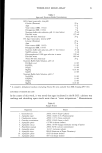
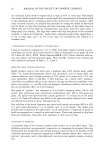
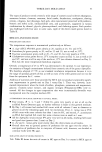
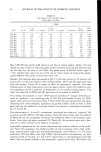
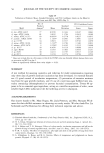
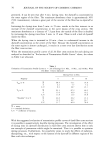
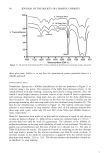
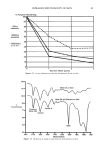
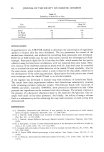
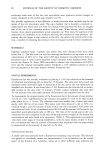
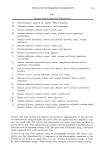
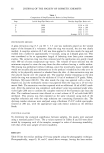
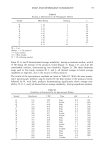
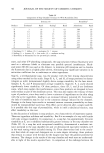
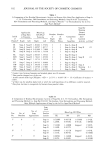
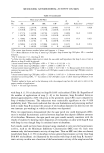
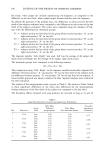
96 JOURNAL OF THE SOCIETY OF COSMETIC CHEMISTS Table IV Comparison of Soap Chamber Irritancy (5) With Rinsability Data Irritancy (5) Product Erythema• Rank Scaling2 Rank Rinsability 3 Absorbance Rank E .3 (1) .2 (1) .388 (5) B 1.0 (2) .5 (2) .197 (2) H 1.2 (5) 1.5 (7) .231 (4) D 1.2 (4) 1.1 (4) .526 (7) C 1.5 (7) 1.0 (3) .228 (3) G 1.0 (3) 1.3 (5) .143 (1) F 1.3 (6) 1.4 (6) .537 (8) J 3.0 (9) 1.8 (8) .629 (9) L 2.6 (8) 2.2 (9) .405 (6) 1: Erythema (1) = diffuse (2) = moderate (3) = intense. 2: Scaling (1) = dryness (2) = fine scales (3) = moderate scaling. 3: Rinsability as determined by the spectroscopic method. eners, and other UV-absorbing compounds, the soap solutions without fluorescein were used as a reference blank to eliminate any possible spectral interferences. Meth- anol:water (80:20) was used as the diluent, to minimize pH variations and to dissolve the fluorescein dye in a highly polar solvent, eliminating any significant variation in its extinction coefficient due to surfactants or other ingredients. Soap G, a triethanolamine soap, was the product with the best rinsing characteristics using either method in this study. Soaps B, A, C, and H, all soaps promoted to derma- tologists as mild, demonstrated slightly above average rinsability for the bars tested. Samples E, N, and P demonstrated average rinsability. Soaps D, F, I, and J showed significantly lower rinsability. Of these products, three (D, I, and J) are deodorant soaps, which may explain their performance, since these products are designed to leave some residue as part of the deodorant action. This may also explain the irritancy of these types of products, since they tend to leave a mixture of ingredients on the skin along with the active ingredient, leading to an increased irritancy potential (6). Conversely, the lack of rinsability may be due to the cutaneous damage induced by the cleansers. Damage to the horny layer results in increased stratum corneum permeability as deter- mined by transepidermal water loss. This effect can be detected after a single wash (8). It is possible that this type of permeability, while in itself a subclinical reaction, may affect rinsability in this test. In the discussion of mildness in soap products, two characteristics of importance appear. These are ingredient mildness and rinsability. Bar E is an example of a very mild syndet with only average rinsability. In comparison, L, a soap bar, has approximately the same rinsability as E, yet it exhibited substantially greater irritancy in the soap chamber test (Table IV). G, a soap bar with exceptional rinsability, demonstrated a moderate irri- tance potential in the soap chamber test and yet demonstated equivalent mildness to E in the wash testing which included rinsing (5). These observations lead to the conclu- sion that while all soaps and detergents are to some degree irritating, those products that remain in contact with the skin for the longest time have the greatest potential for irritancy. The changes in the results of the soap chamber and wash tests are understand- able in light of the results reported here. A comparison of the rankings between the

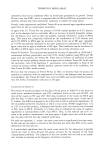
SOAP AND DETERGENT RINSABILITY 97 chamber and exaggerated wash testing illustrates the difficulty in correlating such pre- dictive assays as the soap chamber test with product use data. In an effort to screen for potentially mild formulations, a combination of chamber, rinsability, and final product use tests should be employed. REFERENCES (1) J. W. Jordan, F. A. Dolce, and E. D. Osborne, Dermatitis of the hands in housewives: Role of soap in its etiology, methods and prevention, JAMA, 115, 1001-1006 (1940). (2) E. Jungermann, New trends in bar soap technology and liquid soaps, Soap/Cosmetics/Chemical Speaal- ties, 30-34 (January 1982). (3) E. Jungermann, "Soap" in Bailey's Industrial Oil and Fat Products, 4th ed. O. Swerm, Ed. (John Wiley and Sons, New York, 1979), Vol. 1, pp 579-580. (4) K. D. Crow, Barrier creams, Practitioner, 202, 127 (1967). (5) P. J. Frosch and A.M. Kligman, The soap chamber test. A new method for assessing the irritancy of soaps,J. American Academy Dermatology, 1, 35-41 (1979). (6) P. J. Frosch, "Irritancy of Soap and Detergent Bars," in Principles of Cosmetics for the Dermatologist, P. Frost and S. N. Howitz, Eds. (C. V. Mosby Co., St. Louis, 1982), pp 5-12. (7) J. T. McClave and F. H. Dietrich, Statistics, 2nd ed. (Dellen Publishing, San Francisco, CA, 1982), pp 404-414. (8) A.M. Kligman, Personal communication (1983).
Purchased for the exclusive use of nofirst nolast (unknown)
From: SCC Media Library & Resource Center (library.scconline.org)