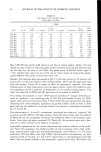
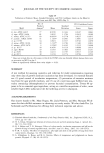
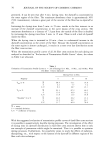
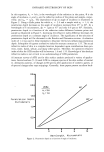
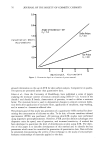
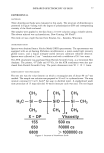
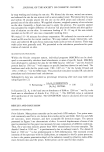
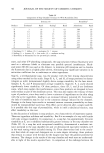
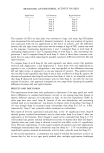
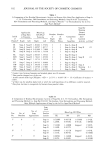
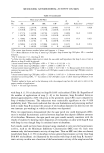
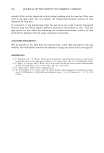
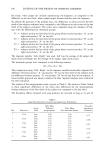
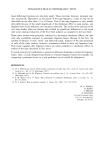
FRAGRANCE BIAS IN DEODORANCY TESTS 107 hours following treatment are relatively small. These intervals, however, represent real- istic use periods. Dependent on the nature of the soap fragrance, it may or may not be detectable on the skin after 12 or 24 hours. Even if the soap fragrance is only weakly detectable because of the small magnitude of the deodorant effect in soap studies, any fragrance bias would influence the conclusion obtained. The results of the analysis of the two soap studies (data not shown) also yielded no significant differences in the mean odor scores during evaluation of the first third subjects as compared to the last third. These three studies were primarily conducted to determine deodorant effects the data were only secondarily analyzed to investigate fragrance biases. Because of this fact, the number of subjects in each "third" was relatively small. Analysis of the data generated in each of the three studies, however, consistently failed to show any fragrance bias. This result suggests that fragrance biases are small compared to deodorant effects in studies of the type described in this letter. It would certainly be worthwhile to monitor additional deodorancy studies for fragrance biases. Also, a study designed specifically to evaluate fragrance biases (for example, by comparing a perfumed active to a non-perfumed active) would be informative. REFERENCES (1) H. S. Whitehouse and R. Owen Carter, Evaluation of toilet bars, Proc. of the Sci. Section of the Toilet Goods Assoc., 43, 31-37 (December 1967). (2) N. Shehadeh and A.M. Kligman, Variation in axillary odor, J. Soc. Cosmetic Chem., 14, 605-607 (December 1963). (3) P.M. Baxter and J. V. Reed, The evaluation of underarm deodorants, Inter. J. Cosmetic Sci., 5, 85-95 (1983). (4) D. L. Sackerr, Bias in analytic research,.J. Chronic Dis., 307, 719-724 (1979). M. B. FINKEY D. BUSCH J. HEINZE N. POULSEN The Dial Technical Center 15101 N. Scottsdale Rd. Scottsdale, AZ 85254

Purchased for the exclusive use of nofirst nolast (unknown)
From: SCC Media Library & Resource Center (library.scconline.org)