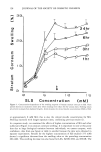
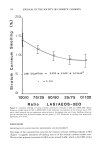
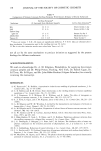
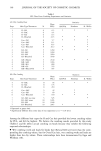
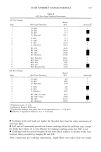
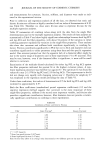
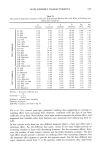
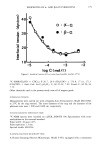
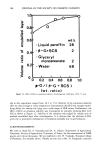
188 JOURNAL OF THE SOCIETY OF COSMETIC CHEMISTS 1.0 0.6 E 0.4 0.2 - wt% ß Liquid paraffin 28 . ß i•-G+SCS 2 ß Glyceryl monostearate 2 ß Water 68 I I I I 0 0.2 0.4 0.6 0.8 1.0 I•-G/( jS-G + SCS ) (wt. rat io) o C Figure 12. Effect of [•-G on emulsion stability. Centrifugation: 3000 rpm, 30 , 15 min. oils in this experiment ranged from 10.2 to 17.0. Stability of the emulsions observed after ten days storage at room temperature demonstrated that [3-G has enough emulsi- fying ability for various oils lying over a wide range of HLB values. Furthermore, the effect of [3-G on emulsion stability was investigated by partially replacing •3-G with SCS as shown in Figure 12. Stability of the emulsion was judged by volume ratio of residual emulsified layer after centrifugation. It is obvious that the addition of gives rise to prominent stabilization of emulsions probably due to gel formation. ACKNOWLEDGEMENTS We wish to thank Dr. S. Yamazaki and Dr. A. Okubo, Department of Agricultural Chemistry, Faculty of Agriculture, University of Tokyo, for the measurement of NMR spectra and critical discussion. We are indebted to Dr. H. Yoshioka, Shizuoka College of Pharmacy, for valuable advice. Thanks are also due to Mr. H. Futagoishi, emeritus

PROPERTIES OF or- AND [3-GLYCYRRHIZINS 189 general manager of our laboratory, to Mr. M. Yamagishi, general manager of our labo- ratory, and to Mr. T. Yoneya who encouraged us throughout this work. REFERENCES (1) H. Fujita, T. Sakurai, M. Yoshida, and S. Toyoshima, Antiinflammatory effect ofglycyrrhizinic acid. Effects of glycyrrhizinic acid against carrageenin-induced edema, UV-erythema and skin reaction sensitized with DNCB, Pharmacometrics, 19, 481-484 (1980). (2) A. Otsuka, Y. Yonezawa, K. Iba, T. Tatsumi, and H. Sunada, Physico-chemical properties of gly- cyrrhizic acid in aqueous media. I. Surface-active properties and formation of molecular aggregates, Yakugaku Zasshi, 96, 203-208 (1976). (3) A. Otsuka, Y. Yonezawa, and Y. Nakamura, Physicochemical properties of glycyrrhizic acid in aqueous media. II. Effect of flocculation-deflocculation behavior of suspensions of sulfathiazole and graphite, J. Pharm. Sci., 67, 151-154 (1978). (4) Y. Yonezawa and A. Otsuka, Physico-chemical properties of glycyrrhizic acid in aqueous media. III. Solubilizing properties for dyes and medicinal substance, Yakugaku Zasshi, 101, 829-835 (1981). (5) B. E. Azaz and R. Segal, Glycyrrhinzin as gelling agent, Pharm. Acta Helv., 55, 183-186 (1980). (6) A. Miyashita, K. Imoto, T. Kuramoto, K. Kakegawa, and Y. Otani, Reaction ofglycyrrhizic acid. I. Base-catalyzed isomerization. Abstracts of papers, The 100th Annual Meeting of the Pharmaceutical Society of Japan, Tokyo, April 1980, p 202. (7) K. Tsubone, S. Ohnishi, and T. Yoneya, Separation of glycyrrhizinic acid isomers by high-perfor- mance liquid chromatography, J. Chromatogr., 248, 469-471 (1982). (8) A. F. Cockerill, G. L. O. Davies, R. C. Hardon, and D. M. Rockham, Lanthanide shift reagents for NMR spectroscopy, Chem. Rev., 73, 553-588 (1973). (9) H. Yoshioka, K. Honda, and M. Kondo, Spin probe study of the aqueous solutions of or- and [3-glycyrrhizins,J. Colloid Interface Sci., 93, 540-544 (1983).
Purchased for the exclusive use of nofirst nolast (unknown)
From: SCC Media Library & Resource Center (library.scconline.org)