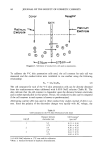
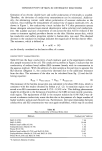
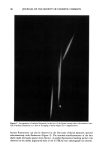
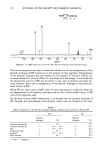
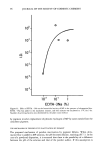
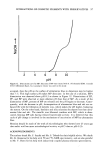
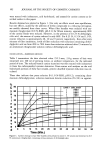
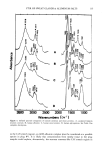
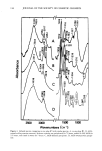
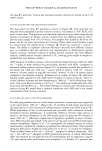
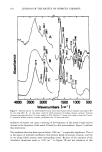
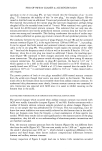
INTERACTIONS OF COSMETIC PIGMENTS WITH PRESERVATIVES 97 T I I I 8 lO pH Figure 12. Dissociation curve for MP. Solutions of MP were titrated with 0.1 N ethanolic KOH. A model GT-01 (Mitubishi Kasei, Co.) automatic titrator was used in this study. accepted, then the pH on the surface of ultramarine blue in dispersion may be higher than 7.3. This high surface pH makes MP dissociate. In the case of a solution, MP's dissociation was observed above pH 8.3 as shown in Figure 12. Dissociations of EP, PP, and BP were observed at more alkaline pH than that of MP. As a result of the dissociation of MP, protons of MP are released and the pH begins to decrease. Conse- quently, with the decrease in pH, decomposition of ultramarine blue and talc are en- hanced (8) with the liberation of metallic ions, which makes the pH higher, balancing the system. On the other hand, kaolinite and silica alumina decompose less than ultra- marine blue and talc. The metallic ions liberated combine with MP, which is disso- ciated, forming MP salts having reduced bactericidal activity. It is believed that this cycle of pH change is involved in the mechanism of inactivation of MP by ultramarine blue. Mention should be made of the work of microbiologists who showed over 25 years ago that sorbic acid has more microbiological activity at pH 5 than at pH 6 (9). ACKNOWLEDGEMENTS The authors thank Mr. F. Suzuki and Mr. S. Takada for their helpful advice. We thank Mr. K. Komatsu for his help with •H and •3C-NMR spectrometry, and are also grateful to Mr. Y. Horri for his help with inductively coupled plasma emission spectrometry.

98 JOURNAL OF THE SOCIETY OF COSMETIC CHEMISTS REFERENCES (1) C. W. Bruch, Cosmetics: Sterility vs. microbial control, American Perfumer and Cosmetics, 86, 45-50 (April 1971). (2) M. S. Parker, Microbiologically acceptable cosmetic, American Perfumer and Cosmetics, 86, 35-38 (December' 1971). (3) I. R. Gucklhorn, Cosmetic microbiology, Manufacturing Chemist and Aerosol News, 23- 35, (December 1968). (4) R. A. Anderson and Clara E. Chow, The distribution and activity of benzoic acid in some emulsified systems, J. Soc. Cosmet. Chem., 18, 207-214 (1966). (5) D. Coates and G. Richardson, Relationships between estimates of binding of antimicrobial agents by macromolecules, based on physiochemical and microbiological data: Benzoic acid and a nonionic surfactant, J. Appl. Bacteriol., 36, 257-262 (1973). (6) Seymour M. Blaug and Sayed S. Ahsan, Interaction of parabens with nonionic macromolecules, J. Pharm. Sciences, 50, 441-443 (1961). (7) R. T. Yousef, M. A. EI-Nakeeb and Suzette Salama, Effect of some pharmaceutical materials on the bactericidal activities of preservatives, Cand. J. of Pharm. Sci., 8, 54-56 (1973). (8) A. Kimura, Unpublished. (9) D. N. Entrekin, Relation of pH to preservative effectiveness, J. Pharm. Sci., 50, 743-746 (1961).
Purchased for the exclusive use of nofirst nolast (unknown)
From: SCC Media Library & Resource Center (library.scconline.org)