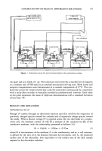
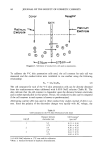
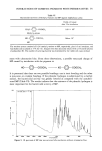
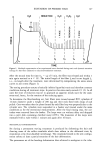
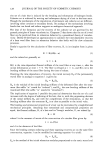
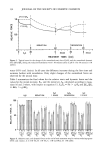
130 JOURNAL OF THE SOCIETY OF COSMETIC CHEMISTS E o = Fd(e s A o) (8) F o = force at the end of the straining step. ½s = initial static strain. A o = initial cross-section. The dynamic modulus at any time during the treatment Ea(t), normalized for the initial cross-section of the fiber, is given by: Ea(t) = AF(t)/(½ a Ao) (9) where AF is the difference between the peak force reached during the strain pulse and the force level of the base line, given as a broken line in Figure 1. ca is the magnitude of the strain pulse. For the untreated fiber in water at t tt, the initial dynamic modulus Eao is given by: Eao = AFo/(½aAo) (10) The difference that is observed between the initial modulus E o and the dynamic mod- ulus Eo a at equal strain rates can be attributed ro fiber crimp and to experimental influ- ences, that is, a certain deviation from perfect alignment in the experimental set-up that can never completely be avoided, so that: E o = k E• (11) with k 1. After the treatment, during the last rinse, and prior to release, the residual Ere of the initial modulus Eo, again normalized for A o, is given by: Ere •= E(t) = F(t)/(½ s Ao) for t • t 4 (12) Similarly, the dynamic modulus of the reoxidized fiber is given by: E•ao = Ea(t) = AF(t)/(½ a Ao) for t • t 4 (13) where E•ao is the dynamic modulus of the fiber in' the reoxidized state, yielding with equation 11 the initial modulus in the reoxidized state Ero as: Ero = k Erao (14) Equations 12, 14, and 13 are successively inserted into equation 6. Subsequently, the upper and the lower parts of the resulting equation for R o are both normalized by dividing by E o. Equations 11, 10, and 8 are introduced, yielding: R o = (F(t)/Fo)/(AF(t)/AFo) for t t 4 (15) Equation 15 states that the degree of fiber recovery depends on the interaction of the normalized static and dynamic forces after the treatment and during the final rinse, relative to the initial undeformed state of the fiber. With respect to the conditions of equation 6, equation 15 reads as: R o = (Fre/Fo)/(AF•o/AFo) (16)

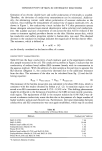
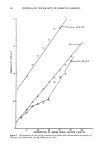
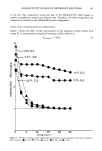
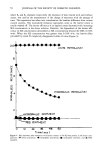
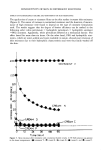
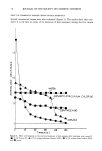
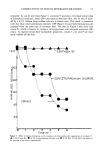
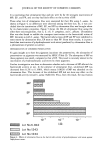
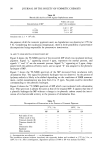
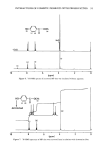
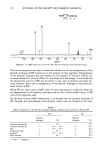
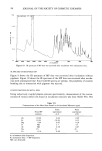
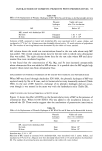
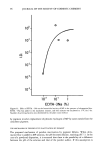
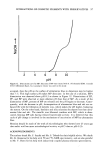
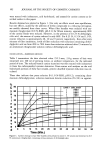
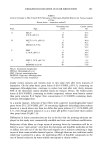
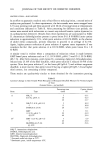
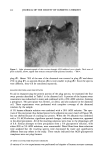
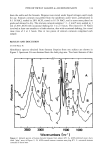
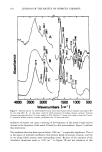
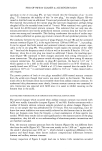
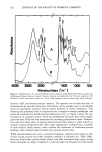
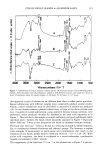
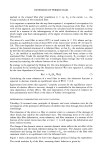
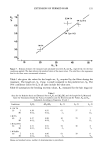
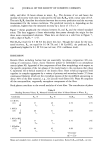
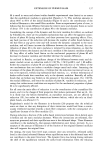
EXTENSION OF PERMED HAIR 131 DETERMINATION OF FIBER SET Treating hairs as loops on a cylindrical roller and then cutting the loops to measure the fiber set by observing how much of the initial loop form is retained is a convenient measure of the efficiency of a treatment and has close proximity to the practical situa- tion. Since the loops are formed as virtually two-dimensional structures, it is readily shown (neglecting the fiber diameter) that the bending recovery, R, acquired by the fiber at any point along the loop and the diameter of the circle enclosing the partially opened loop are related by: R = 1 - dc/d (17) dc = diameter of the cylinder. d - diameter of the circle enclosed by the partially opened loop. R i is the initial recovery measured within 1 min after cutting the fiber loops. To determine the increase of the recovery with time, the fibers were remeasured after 16 hours of release in water. The related recovery was termed R16. From the principles outlined above, recovery is expected to be independent of the fiber as well as of the roller diameter, in agreement with Mitchell and Feughelman's (11) observations. This result does not contradict the practical experience that the quality of a wave depends on the fiber and on the curler diameter (2) since the shape and the mechanical properties of the helix formed by the fiber released from the curler after the treatment depend on both fiber and curler diameter (12, 13) for various mechanical fiber properties. One further consequence of equation 6 is that the experimental procedure of extensional testing only indirectly applies to bending recovery via equation 4, while it directly relates to extensional recovery and extensional set. The extensional,set, i.e., the length set S L observed in the experiments, that should agree with the prediction according to equation 6 and equation 2, is defined as: S r = [(ll - 10)/10]/½ s (18) 10 is the initial length of the fiber, and 1• the length of the fiber after the treatment (Fig. 1). ½s is the initial static strain imposed. RESULTS Figures 2 to 5 show typical results for the change of the normalized static force F(t)/F 0 and of the normalized dynamic force AF(t)/AF 0 as continuous curves. The individual points are shown in Figure 2 to give the range of scatter and were omitted subsequently for reasons of clarity. Figure 6 summarizes the relative force data (95% confidence limits) from the static and the dynamic part of the experiment at the end of the various treatment steps. In all cases the static stress decreases during reduction and remains essentially constant during subsequent treatments, though a tendency for a 'further decrease is observed. This result supports Tobolsky's view (4) that the static stress reflects the performance of
Purchased for the exclusive use of nofirst nolast (unknown)
From: SCC Media Library & Resource Center (library.scconline.org)