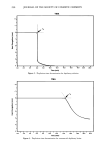
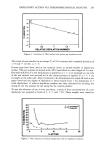
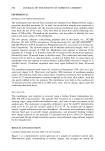
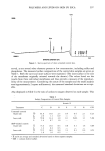
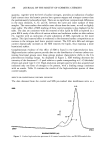
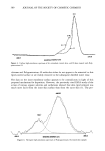
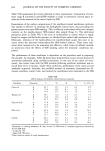
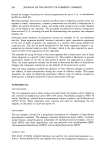
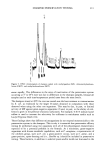
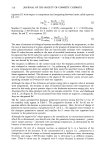
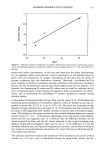
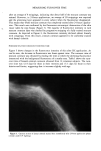
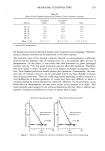
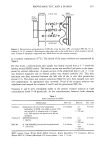
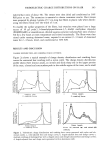
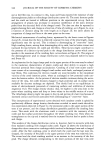
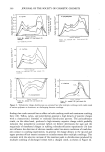
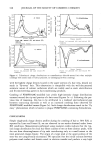
298 JOURNAL OF THE SOCIETY OF COSMETIC CHEMISTS quantity, together with the level of surface nitrogen, provides an indication of surface lipid content since the keratin portion has a greater oxygen and nitrogen content than the predominantly hydrocarbon lipid. There are no significant compositional differences in the main elements, C, O, and N, between the outer and inner surfaces of these samples. The outer surface does exhibit more silicon than the inner, as well as slightly more sulfur. The effect of SDS washing of these control samples is also displayed in the table. The data are consistent with the removal of skin lipids by SDS as reported in a prior ESCA study of the effects of various solvent and surfactant washes on skin surfaces (3), together with an indication of some adsorption of SDS, especially on the inner surface. This lipid removal effect is evidenced in the elemental surface composition as an increase in the nitrogen (and hence protein) content. The C/O ratio falls and nitrogen content dramatically increases as the SDS removes the lipids, thus exposing a more keratinized surface. Complementary evidence of this effect of SDS is found in the high-resolution data. High-resolution carbon spectra provide data on the distribution of various carbon-con- taining functional groups since these groups produce characteristic shifts in the C ls photoelectron binding energy. As displayed in Figure 2, SDS washing decreases the intensity of the dominant C-C peak relative to peaks corresponding to C-O (alcohols/ ethers) and amide type C = O. High-resolution nitrogen spectra were also acquired and indicated only one form of nitrogen to be present, with a binding energy consistent with an amide. Table II contains the results of the high-resolution spectra of these control samples. EFFECTS OF CONDITIONING POLYMER EXPOSURE The data obtained from the control and SDS pre-washed skin membranes serve as a lOOO 299.9 O II N-C C-C c.o /i / 279.9 BINDING ENERGY (eV) Figure 2. Carbon high-resolution spectrum of A) control unwashed skin, and B) SDS-washed skin.

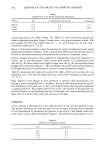
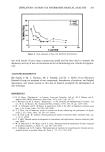
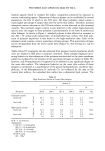
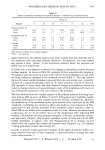
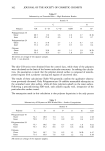
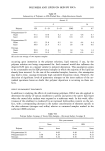
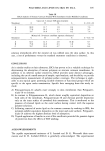
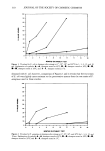
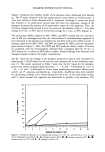
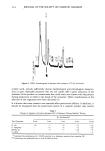
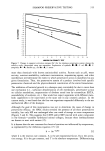
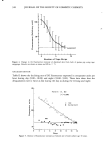
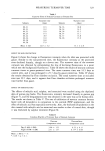
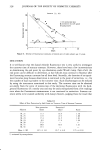
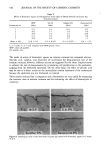
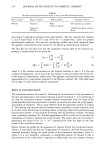
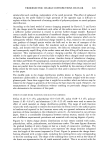
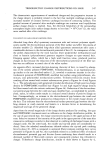
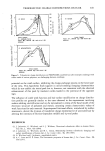
POLYMERS AND LIPIDS ON SKIN BY ESCA 299 baseline against which to compare the surface composition produced by exposure to various conditioning agents. Deposition of these polymers can be established by several parameters, the first of which is the C/O ratio. All three polymers tested contain a much higher percentage of oxygen than does the native skin surface. Therefore, polymer adsorption causes a decrease in the C/O ratio relative to that observed on the untreated controls. This increased oxygen content is also observed in the carbon high-resolution spectra since the oxygen in these polymers is predominantly in the form of alcohol and ether linkages. As shown in Figure 3, adsorbed polymer is thus reflected as increases in the 286.1 eV carbon peak characteristic of alcohol/ether-type carbon. The final indi- cator of polymer deposition is also found in the high-resolution data. Each of the polymers tested contains cationic quaternary nitrogen groups. This quaternary nitrogen can be distinguished from the native amide form (Figure 4), thus serving as a tag for adsorption. Tables III and IV summarize the data obtained from polymer-treated membranes which were not washed in SDS prior to polymer treatment. These samples displayed inter- esting behavior in that adsorption of the polymers was detected on the inner membrane surface (as evidenced by the presence of the quaternary nitrogen as shown in Table IV) however, only Polyquaternium-24 appeared to be adsorbed to any significant degree on the outer skin surface. The adsorption behavior on the outer skin surface of these samples is interpreted as a manifestation of the greater hydrophobicity, and hence lipo- philicity, of the Polyquaternium-24 molecule (5). As evidenced by the data on the control skin surfaces, the unwashed skin surface has a substantial lipid content. The Table II High-Resolution Results of Control Skin Samples Atomic % C N Treatment 284.6 286.1 287.6 288.9 399.6 402 Untreated controls Outer side Inner side SDS-washed controls Outer side Inner side X 65.4 10.0 3.5 2.2 2.3 N.D. S 3.4 1.3 0.9 0.5 0.9 -- X 64.3 9.1 4.0 2.4 3.0 N.D. S 0.6 0.9 0.6 0.3 1.0 X 52.5 12.8 6.4 2.1 8.3 N.D. S 0.6 0.5 0.7 0.4 0.3 -- X 50.3 12.6 6.9 2.7 9.0 N.D. S 1.8 0.6 1.0 0.9 0.2 N.D. = not detected. Assignments: C 284.6 C- C hydrocarbon 286.1 C- O alcohol/ether 287.6 N-C=O amide 288.90 - C = O acid/ester N 399.6 amide 402 NR4 +
Purchased for the exclusive use of nofirst nolast (unknown)
From: SCC Media Library & Resource Center (library.scconline.org)