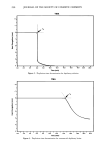
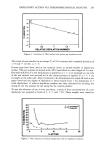
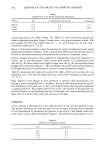
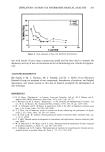
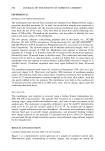
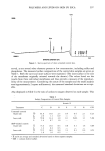
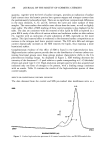
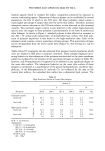
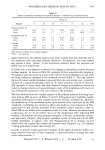
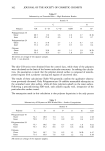
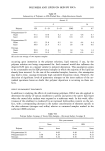
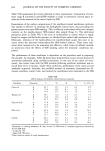
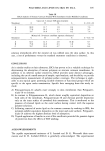
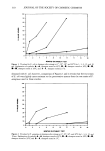
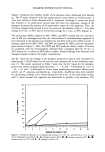
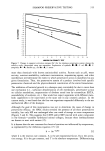
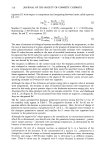
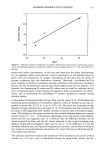
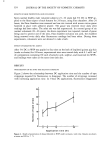
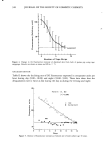
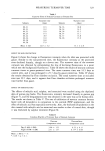
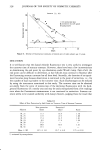
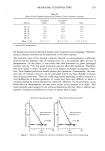
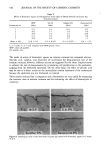
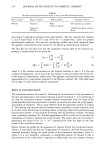
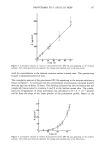
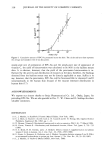
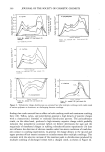
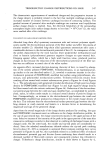
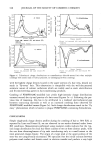
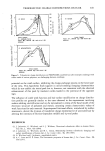
292 JOURNAL OF THE SOCIETY OF COSMETIC CHEMISTS Table I Comparison of T d for Several Commercial Depilatories Product pH % Thioglycolate (as Na salt) Td (Minutes) Roll-on 12.3 6.2 17.4 Cream 12.0 6.0 16.6 Lotion 12.3 6.1 17.7 guinea pigs and by our TMA method. The TMA Td's were then plotted against the relative depilation numbers. Figure 4 shows that a very good correlation results. The least squares fit of the line yields a slope of - 1.72, an intercept of 6.24 min, and a correlation coefficient of - 0.99. Figure 5 shows dose-response curves for solutions of sodium thioglycolate and a newly synthesized depilatory candidate. These curves clearly differentiate the formulas and can be used to determine optimum concentrations for solutions to be further tested. Several commerical products were analyzed for thioglycolate content by iodimetric ti- tration, and Td was determined. Table I shows these results. It is interesting to note that the T•'s for these products are slightly longer than the T•'s for the aqueous sodium thioglycolate solutions in Figure 5. This is probably the result of the lowered solubility of thioglycolate due to the presence of calcium or other formulation variables. Table II summarizes the results of a study of the effect of pH on the activity of a test depilatory active. For the pH range tested, the results show maximum activity at pH 11-11.5. Dose response curves (Figure 6) were generated to examine three formulations con- taining a newly synthesized active candidate. Two gels showed approximately equiva- lent depilatory activity and were, in fact, only slightly slower than the same compound in aqueous solution. This implies that for this active, the viscosity of the gels does not slow the kinetics of the depilatory reaction. Conversely, the cream formulation of the same active was slower than either the solutions or the gels. SUMMARY A new method is described for in vitro determination of the rate of depilatory action. The method detemines the time necessary for hair to begin stretching when immersed in test formulations by measuring the position of one end of a hair bundle under con- stant tension using a thermomechanical analyzer. The method has been shown to corre- Table II pH Effects on Depilatory Activity pH T• (minutes) 10.0 8.2 10.5 6.O 11.0 4.3 11.5 4.3

DEPILATORY ACTION VIA THERMOMECHANICAL ANALYSIS 293 I'-- 5L - .. / o 5 gel 2 get 1 cream % ACTIVE 20 Figure 6. Dose responses of three test depilatory formulations. late with results of tests using a guinea pig model and has been used to compare the depilatory activity of new actives and as an aid in formulating new vehicles for applica- tion. ACKNOWLEDGEMENTS My thanks to Dr. L. Hinman, Ms. J. Karolak, and Dr. L. Miller of our Discovery Research Group for synthesis of test compounds, formulation of products, and helpful discussions, and whose interest in this area of research prompted the development of this technique. REFERENCES (1) R. H. Barry, "Depilatories," in Cosmetics.' Science and Technology, 2nd ed., M. S. Balsam, and E. Sagarin, Eds. (Wiley-Interscience, New York, 1972), Vol. 2, pp. 39-72. (2) S. Brechner and M. E. Rieger, "Depilatories," in The Chemistry and Manufacturing of Cosmetics, 2nd ed., M. G. de Navarre, Ed. (Continental Press, Orlando, 1975), Vol. IV, pp. 1233-1246. (3) H. A. Yablonsky and R. Williams, A quantitative study of the effect of depilatory solutions upon hair, J. Soc. Cosmet. Chem., 19, 699-706 (1968). (4) T. J. Eliot, Use of laboratory model to evaluate the factors influencing the performance of depila- tories, J. Soc. Cosmet. Chem., 25, 367-377 (1974). (5) J. H. Hall and R. W. Godwin, Thermomechanical analysis of synthetic fibers, Instrument News, 21, 1, 10, 11 (1970). (6) P.S. Hill, Thermal analysis developments in instruments and applications, American Laboratory (Jan- uary 1984). (7) M. R. Martinelli, S. W. Mayer, and P. F. Jones, Thermomechanical examination of fabric composed of synthetic polymers,J. Forens. Sci., 24, 130-139 (1979). (8) L. Addyman and G. D. Ogilvie, Thermomechanical methods for researching the thermal and me- chanical history of synthetic fibers, Br. Polym. J., 11, 151-154 (1979).
Purchased for the exclusive use of nofirst nolast (unknown)
From: SCC Media Library & Resource Center (library.scconline.org)