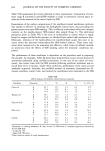
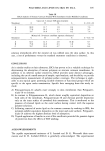
j. Soc. Cosmet. Chem., 38, 295-306 (September/October 1987) Adsorption of polymers and lipids on stratum corneum membranes as measured by ESCA E. D. GODDARD and W. C. HARRIS, Union Carbide Corporation, Specialty Chemicals Division, Tarrytown, NY (E.D.G.), and Bound Brook, NJ (W.C.H.). Received March i, 1987. Synopsis ESCA is shown to have the sensitivity to detect the presence of adsorbed conditioning polymers on isolated, treated stratum comeurn membranes and to rank them in terms of adsorbed amount. A cationic cellulosic polymer and chitosan show definite adsorption on the inner (dermis) side but less on the outer surface. This asymetric adsorption disappears upon pretreatment of the membranes with sodium dodecyl sulfate (SDS), thus implicating surface lipids in the observed deposition behavior. Conversely, a new, more hydrophobic cationic cellulosic polymer is found to adsorb symmetrically and to deposit to a greater extent than the other two polymers studied. This study also highlights the power of ESCA as a surface analytical tool. INTRODUCTION The barrier properties possessed by skin tissue depend to a large extent on the condition of the outermost skin surface, i.e., the stratum corneum. In addition, perceived ben- efits of the topical application of various conditioning agents can be related to the modification of the surface layer produced by these agents, and to their retention. Thus, it is desirable to have analytical techniques which are capable of directly examining the excised skin surface for the presence and concentration of such conditioners. Electron spectroscopy for chemical analysis (ESCA) is such a tool. The technique is inhe•rently surface-sensitive, providing chemical characterization of the outermost 25 to 50 A of the surface (1,2). Recently, ESCA has been applied to study the effects of various solvents and surfactants on lipid removal from stratum corneum membranes (3). The present study concerns the use of ESCA to examine the deposition of three syn- thetic polymers which are sometimes classified as conditioning agents on stratum cor- neum membranes. Two are cationic cellulosics and the third is a chitosan. Deposition on the outer and inner surfaces of the membranes is compared and the influence of prewashing the membranes with SDS on polymer deposition is reported. The ability of various emollients to provide protection from lipid removal by a surfac- rant wash is also examined using ESCA. 295
Purchased for the exclusive use of nofirst nolast (unknown)
From: SCC Media Library & Resource Center (library.scconline.org)