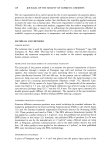
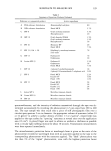
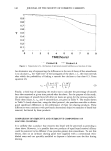
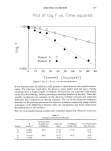
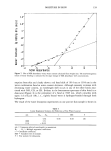
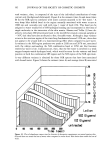
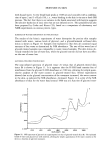
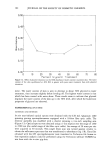
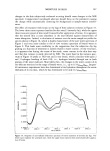
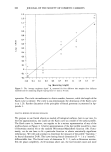
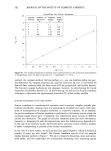
SHAVING CLOSENESS 145 information was recorded on a score sheet (Table IV). The number of smooth sides for all judges were totaled and the percent smooth sides at each evaluation time calculated. Two experiments comparing the perceived shaving efficacy of Products A and B were performed using the above protocol. For each product, the cumulative sum of smooth half-faces perceived by the judges was obtained as the function of time after the shave, expressed as y, or the fraction of the total number of evaluations undertaken for that particular product. A typical plot of y as a function of time is shown in Figure 1. The curves in Figure 1 clearly indicate that y is not a linear function of time. Consequently, simple statistical treatment of the data by means of a linear regression analysis did not seem a promising avenue to pursue. Instead, we decided to postulate a statistical model and to analyze our data in terms of this model. THE STATISTICAL MODEL FOR THE TIME DEPENDENCE OF SHAVING CLOSENESS PERCEPTION Let y denote the probability that a half-face is perceived as smooth and 1-y as rough at t time after the shave took place. Furthermore, let us assume that the rate of decline of y (i.e., the conversion of smooth to rough faces) at any given time, t, is proportional to two quantities, the actual probability of finding a smooth face at t time, i.e., to y and t itself: dy_ kyt (1) dt In justification of our assumption, we should like to point out that as the probability of finding a smooth face at any given time will depend on the total number of smooth faces available, hence the rate of finding smooth faces will decline with y. Indepen- dently, the rate of finding smooth faces will also decline with time owing to the steady growth of beard hair with time. Equation (1) yields after integration: y = exp(- V2kt 2) (2) Thus, the probability of finding a smooth face or the fraction of smooth faces perceived by the judges can be linearized by plotting In (y) as a function of t the slope of this plot yields the rate constant, k, that characterizes the decline of the fraction of smooth faces with time (Figure 2). Using the above model, the experimental data were subjected to a statistical analysis, and the values of k together with the confidence levels between pairs of k values were calculated. Table IV Summary of Experimental Details With Protocol 3 Razors Total no. No. of of evaluation panelists Judges per product Experiment 1 Experiment 2 Product A Product B Product A Product B Trac II 6 3 122 166 Trac II 9 5 420 434

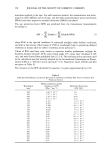
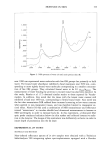
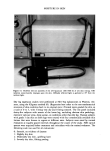
146 JOURNAL OF THE SOCIETY OF COSMETIC CHEMISTS Y 0.8 • 0.6 ? 0.4 L 0.3 t' 0.2 • 0.1 •- 0 I 2 3 4 5 6 7 8 9 TIME(hours) .... Product B • Product A Figure 1. Typical plot of y, the fraction of perceived smooth half-faces as a function of time. An alternative way of representing the differences in the rate of decay of face smoothness is to calculate t,/2, the "half time" of the lastingness of the shave, i.e., the time intervals after which the probability of finding a smooth face declines to less than 0.5. From equation (2), (3) Finally, a third way of expressing the results was to calculate the percentage of smooth faces that remained at given time periods after the shave. For the purpose of this study, the percentages of smooth faces left after six hours are given for the various products. These three values, k, t•/2 , and % smooth faces, are given in Table V. The results shown in Table V clearly show that, using the third protocol, the panelists were able to distin- guish significant differences in the performance of these two shaving products. These differences were consistent with previously determined objective measures of beard hair removal, facilitated by these products. COMPARISON OF OBJECTIVE AND SUBJECTIVE COMPONENTS OF SHAVING CLOSENESS It is unlikely that a product that removes less beard will be perceived as providing a closer shave. However, it is possible that two products of equal beard removal efficacy could be perceived to be different if one provides greater skin smoothness. To test this theory, men on an in-house shaving panel were supplied with a conventional twin- bladed razor and one specially modified to dispense a lubricant onto the face during shaving.
Purchased for the exclusive use of nofirst nolast (unknown)
From: SCC Media Library & Resource Center (library.scconline.org)